AI Agent Orchestration Is the New CX Challenge
Customer experience teams want AI agents to answer faster, route smarter, and cut support costs. The problem is that AI agent orchestration is where most of the real work starts. A single agent can handle one task. A customer journey is messier. It jumps between billing, identity checks, knowledge lookup, policy rules, and human escalation. If those pieces do not move together, the experience breaks. And customers notice fast.
That is why orchestration matters now. Companies are no longer asking whether an agent can draft a reply. They are asking whether the system can choose the right agent, pass the right context, and keep the whole interaction coherent. Think of it like a kitchen during dinner rush. One cook is useful. A full service needs timing, handoffs, and someone keeping the tickets in order.
- AI agent orchestration is the coordination layer, not the chatbot layer.
- Most CX failures happen at handoff points, not in model output.
- Context quality matters more than raw model size.
- Human escalation still needs clear rules and clean state transfer.
- Governance and logging are non-negotiable if you want scale.
Why AI agent orchestration is now a CX bottleneck
AI agents are easy to demo and hard to run in production. A support flow can start with a password reset, move to fraud checks, then shift to retention policy. That path may touch three systems and two teams. If orchestration is weak, the agent repeats questions, loses context, or sends the user back to square one.
Forrester and Gartner have both warned for years that poor service handoffs create frustration and longer handle times. AI does not remove that problem. It exposes it. The speed of automation makes every weak link more obvious.
“The value is not in one smart agent. The value is in the system that keeps many agents aligned while the customer still feels like they are talking to one company.”
Look, this is why so many pilots stall after the first win. The demo works because the path is neat. Real CX is a pile of exceptions (and exceptions are where architecture gets tested).
What AI agent orchestration has to do
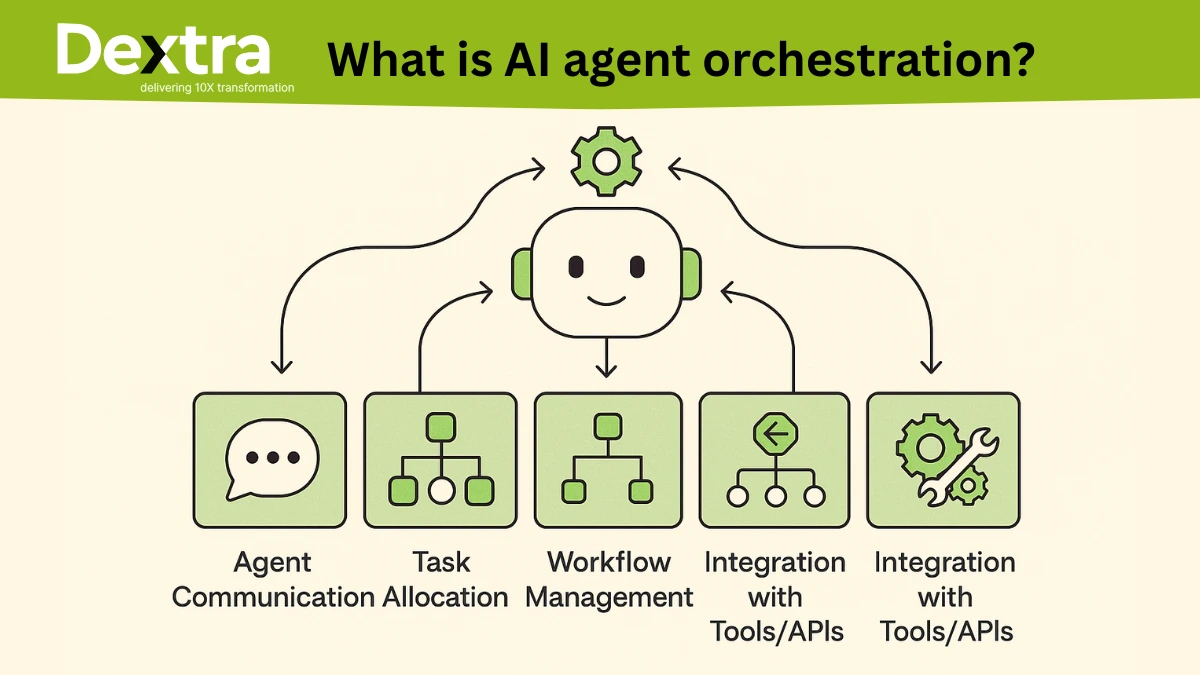
Orchestration is the control plane for the customer journey. It decides which agent or tool should act, what data each step needs, and when a person should take over. Without that layer, you get isolated automation instead of a working service system.
1. Route the request correctly
Start with intent detection, then route by complexity, risk, and customer value. A simple FAQ should not touch the same path as a chargeback dispute. Routing rules need to be visible, testable, and easy to change when policies shift.
2. Preserve context across steps
A good orchestrator keeps the thread intact. That means account status, prior messages, verification state, and action history all travel with the session. If the customer gets transferred, the next agent, human or machine, should not ask them to repeat everything.
3. Decide when humans step in
Full automation is still a fantasy in many CX settings. The right move is controlled escalation. Use confidence thresholds, policy triggers, and exception rules so the system knows when to stop guessing.
4. Track what happened
Logs are not a back-office nice-to-have. They are how you debug bad answers, audit decisions, and prove compliance. If you cannot reconstruct a customer journey, you cannot manage it.
What teams get wrong about AI agent orchestration
Many teams treat orchestration like a glue layer they can bolt on later. That is backward. Once you connect agents to billing systems, CRM tools, and identity services, the coordination model becomes the product.
Another mistake is over-automating too soon. A broad agent that tries to handle every issue usually becomes a noisy middleman. Narrower agents with clear jobs are easier to test and safer to scale. Why build a single giant brain when a set of well-trained specialists can do the job better?
- Do not start with the most complex journey.
- Do not hide routing rules inside prompts.
- Do not let every tool call happen in the same trust tier.
- Do not skip failure paths during testing.
How to design AI agent orchestration for real CX
Strong orchestration starts with process mapping. You need to know which customer journeys are repeatable, which ones carry risk, and where human judgment matters most. Then you can decide what each agent owns.
- Map the top 10 customer intents by volume and value.
- Break each intent into steps, systems, and decision points.
- Assign one owner for routing, one for context, and one for escalation.
- Define fallback behavior for low confidence, missing data, or tool failure.
- Test handoffs before you expand to more workflows.
This is not glamorous work. It is plumbing. But plumbing decides whether the house floods.
Use policy as code where you can. Put guardrails in a rules engine, workflow layer, or orchestration platform instead of burying them in prompts. That makes changes traceable and reduces the risk of one model update breaking the flow.
What to measure before you scale
Do not measure only deflection. That metric flatters bad systems. A better set of signals includes first contact resolution, transfer rate, time to resolution, escalation accuracy, and repeat contact rate. If the AI hands off poorly, the customer pays the price later.
You should also measure context loss. How often does the next step need data the previous step already had? How often does a human have to clean up after the agent? Those numbers tell you whether orchestration is working or just looking busy.
And here is the hard truth. If your orchestration layer cannot explain why a decision happened, your ops team will spend more time firefighting than improving service.
The CX teams that will win
The strongest teams will treat orchestration as a product discipline, not an AI add-on. They will design for handoffs, exceptions, and oversight from day one. That approach is less flashy than a demo reel full of agent magic. It is also the only one that survives contact with real customers.
AI agent orchestration will shape the next phase of CX the way workflow software shaped the last one. The companies that get it right will feel faster, calmer, and more consistent. The ones that do not will ship more bots and fix more complaints. Which side do you want to be on?