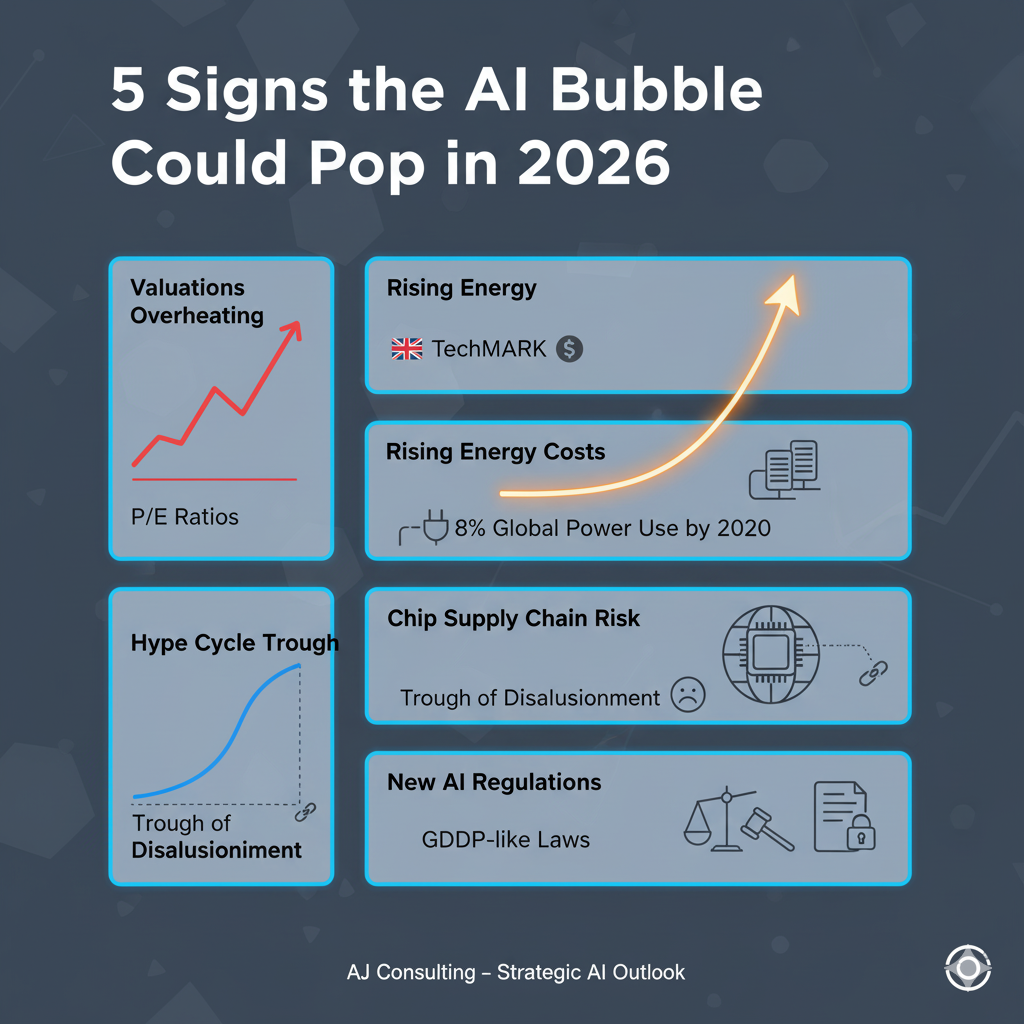
AI Bubble Risk Is Starting to Look Uncomfortably Real
You do not need to be a market historian to feel the tension in AI stocks. The rally has been fierce, the spending has been enormous, and the expectations are now sky high. That is why AI bubble risk has moved from a fringe worry to a serious market question. Investors are looking at the same ingredients that showed up in earlier speculative cycles: concentrated gains, rich valuations, and a belief that one technology can reset the rules. Maybe AI will justify much of the optimism. Maybe it will not, at least on the timeline markets are pricing in. Either way, this matters now because the biggest technology names carry heavy weight in major indexes, including the S&P 500 and Nasdaq. If sentiment cracks, the damage will not stay neatly inside one corner of the market.
What Stands Out
- AI bubble risk is about timing, not whether AI is useful. Great technologies can still become overpriced.
- Big Tech capital spending has become a central market signal, especially for chips, data centers, and cloud infrastructure.
- Concentration risk is rising because a small group of AI-linked stocks has driven a large share of index gains.
- The hard question is simple: can AI revenue grow fast enough to support today’s valuations?
Why AI Bubble Risk Is Back on Wall Street’s Radar
The Yahoo Finance report points to a growing concern among market watchers: the AI trade may be reaching a stage where expectations outrun earnings. That does not mean a crash is guaranteed. It means the margin for disappointment has narrowed.
Look, this is how late-cycle enthusiasm often feels. Nobody wants to leave the party early, especially when the music is still loud. But veteran investors know the uncomfortable part: the market often looks strongest close to the point where risk is most mispriced.
AI may change the economy, but the stock market is still bound by cash flow, margins, and the price investors pay for future growth.
That is the piece that hype tends to blur. AI models, accelerators, cloud platforms, and enterprise software can be valuable. The problem starts when investors treat future adoption as if it has already landed in quarterly results.
AI Bubble Risk Does Not Mean AI Is Fake
The dot-com comparison gets thrown around too easily. It is useful, but only up to a point. The internet was real in 1999, and it still produced a market collapse when valuations lost contact with business fundamentals.
AI could follow a similar split. The technology may be legitimate while parts of the trade become overheated. Those two ideas can coexist.
That is the trap.
In my years covering tech cycles, I have seen this pattern more than once. Investors start by funding infrastructure. Then they reward any company that can attach itself to the theme. Then the market begins asking a colder question: where is the profit?
The spending boom is the first pressure point
Large technology firms are pouring money into data centers, GPUs, networking equipment, power contracts, and AI talent. Nvidia has been the clearest winner, but the spending chain reaches cloud giants such as Microsoft, Amazon, Alphabet, and Meta.
Heavy investment is not automatically reckless. In AI, it may be required. Training and running advanced models is expensive, and companies want enough capacity to serve customers before demand fully arrives.
But investors should separate capacity building from guaranteed returns. A data center buildout is a bit like opening five new restaurants before you know whether the first one can fill tables every night. It might be brilliant. It might also leave you with expensive kitchens and thin margins.
What Would Make the AI Bubble Risk Worse?
Markets usually break when several weak spots line up at once. For AI stocks, the danger signs are not mysterious. They are already visible enough to track.
- Revenue lags spending. If AI products do not produce meaningful sales growth, investors will question the capital expense surge.
- Margins come under pressure. AI services can be costly to run, especially if companies subsidize usage to gain market share.
- Chip supply turns into overcapacity. A shortage can support pricing. A glut can punish suppliers and customers at the same time.
- Enterprise adoption slows. Many companies are testing AI tools, but pilot projects are not the same as long-term budgets.
- Interest rates stay higher than expected. Rich growth stocks are more fragile when future profits are discounted at higher rates.
Which of these matters most? I would watch enterprise adoption. Consumers can create buzz, but business spending pays the larger bills. If chief financial officers start asking why AI tools are not cutting costs or raising revenue, the tone will change fast.
How Concentration Turns AI Bubble Risk Into Market Risk
The AI rally is not evenly spread. A small cluster of mega-cap tech companies has carried a large share of index performance. That creates a mechanical issue for anyone who owns broad market funds.
You may think you are diversified through an S&P 500 ETF. In practice, your returns may still depend heavily on a handful of AI-linked names. That is not a moral problem. It is a portfolio problem.
Concentration cuts both ways. It boosts performance when leaders rise, then amplifies drawdowns when investors rotate out. And because passive funds track market capitalization, they buy more of the winners as those winners get larger.
The S&P 500 problem
The S&P 500 has always had leaders. The issue is scale. If the largest tech companies trade at premium valuations because of AI optimism, then any reset in that optimism affects retirement accounts, pension funds, and balanced portfolios far beyond Silicon Valley.
For investors, the question is not, “Do I believe in AI?” A better question is, “How much AI optimism is already embedded in what I own?”
What Investors Can Do Without Panicking
Panic is a poor strategy. So is pretending valuation does not matter. If you own AI stocks, cloud names, semiconductor companies, or broad index funds, you can make practical checks now.
- Review position size. If one theme dominates your portfolio, trim it to a level you can hold through a sharp pullback.
- Compare revenue growth with capital spending. Rising capex can be healthy, but only if future cash flow has a credible path.
- Look past adjusted earnings. Stock-based compensation, depreciation, and infrastructure costs matter.
- Track customer demand, not product demos. Paid adoption tells you more than keynote videos.
- Keep some dry powder. If AI is truly durable, better entry points may appear.
Honestly, the best investors I know do not try to call the exact top. They manage exposure. They ask what they can afford to be wrong about.
The Difference Between a Bubble and a Boom
A boom creates durable capacity and rising profits. A bubble creates too much capacity, too much debt, and too much faith in distant returns. AI could still land on either side of that line.
The next few earnings seasons will matter. Watch what management teams say about AI revenue, not just AI demand. Listen for specifics: contract values, renewal rates, productivity savings, inference costs, and capex discipline.
Vague language is a tell (and markets eventually notice).
Regulators and policymakers may also play a role. Data privacy rules, copyright lawsuits, export controls on advanced chips, and energy constraints can all affect the economics of AI infrastructure. These are not side issues. They shape cost, supply, and speed of deployment.
AI Bubble Risk Is a Valuation Test
The strongest case for AI stocks is that the technology becomes embedded in software, search, advertising, coding, customer service, drug research, and industrial systems. That could create real earnings power. The weakest case is that companies spend heavily to chase growth that arrives slower than promised.
Both can be true at different times.
That is what makes this market so difficult. The long-term story may be right, while the current price is wrong. Investors who ignore that distinction are playing a dangerous game.
What to Watch Next
Keep your eye on three numbers: AI-related revenue, capital spending, and free cash flow. If all three move in the right direction, the boom has better odds. If spending rises while cash flow weakens, AI bubble risk will stop being a headline and start becoming a portfolio problem.
The smart move is not to reject AI. It is to demand proof at the price you are paying.