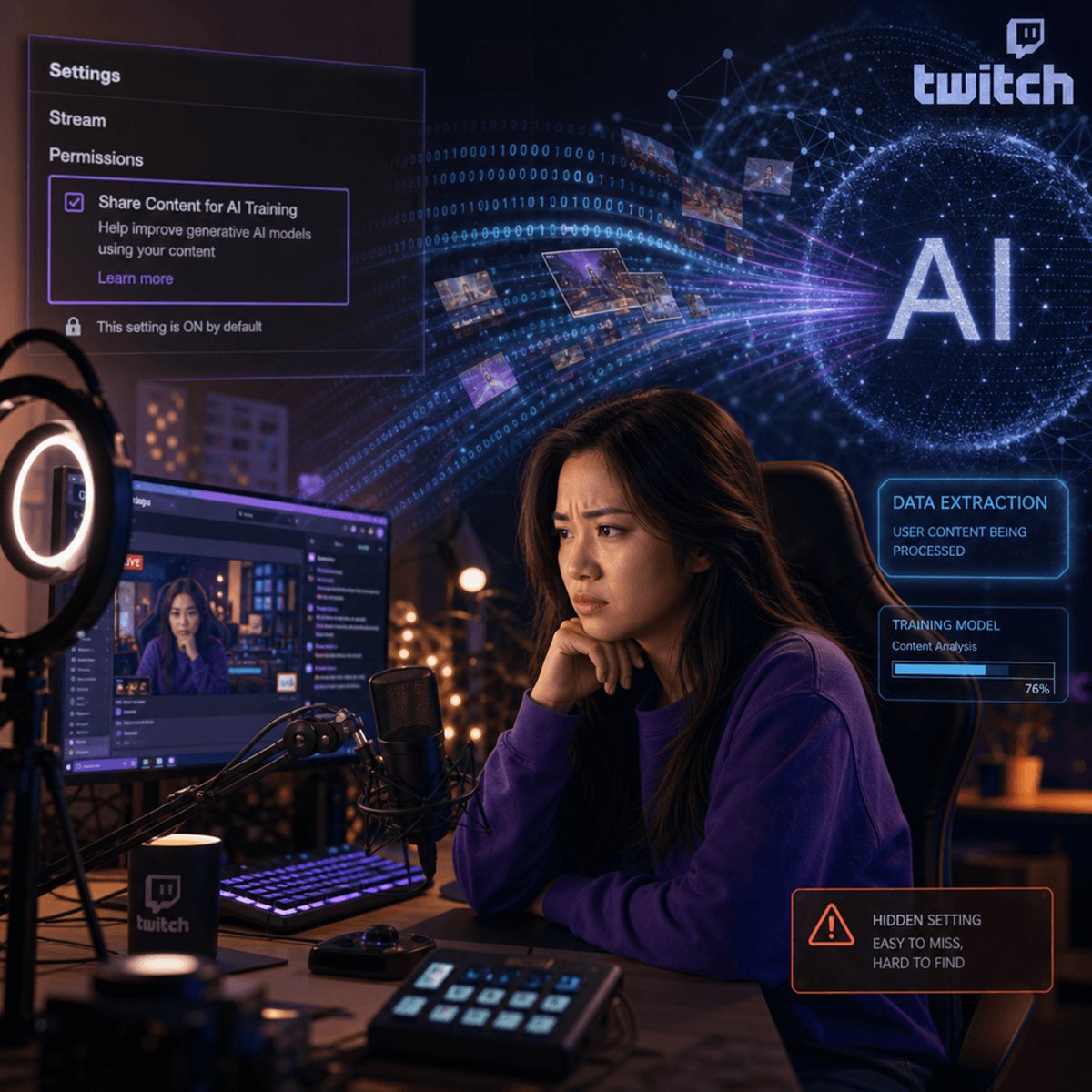
Amazon Twitch AI Training: What Streamers Need to Know
Amazon’s new default for Amazon Twitch AI training puts streamers in a familiar bad spot. Your live content, clips, chat reactions, and other on-platform material can become training fuel unless you change a setting. That matters because default settings shape behavior. Most people never touch them, and that is exactly how platforms like to move data collection forward without a loud announcement.
For creators, the issue is not abstract. It affects control over your voice, your face, your gameplay, and your audience’s chat culture. And if you earn money on Twitch, your content is part of your brand. So the real question is simple. Do you want your channel treated like a product input for model training, or do you want to make that choice yourself?
What Amazon Twitch AI training changes
- Amazon can use Twitch content for AI training by default unless you opt out.
- The change reaches beyond a single stream. Clips and related platform material may also be included depending on the policy language.
- If you do nothing, the default works against you. That is the part creators need to take seriously.
- This is a policy shift, not just a technical update. It changes how the platform treats creator data.
Look, defaults matter because they do the quiet work. They are like a kitchen timer set by someone else. If you do not notice it, the meal is already overcooked. Amazon is not the first company to push this kind of model training policy, but Twitch has a very direct relationship with creators, which makes the move more sensitive.
“If a platform changes the default and leaves the burden on creators to object, the power balance already moved.”
Why this matters for streamers
Streamers are not just uploading content. They are building a catalog of personality, performance, and community interaction. That makes Amazon Twitch AI training more than a backend policy. It becomes a question of ownership and consent.
Think about a live stream like a restaurant kitchen. You may serve the plate to the public, but that does not mean another company should be allowed to copy every recipe, every prep note, and every side conversation for its own use. Some creators will not mind. Others will, especially if their style, humor, or voice is part of the value they sell.
What data can get swept in?
The exact scope depends on the policy details, but creators should assume that anything hosted on the platform may be considered usable input unless restricted. That can include live video, VODs, clips, chat text, and metadata tied to your channel.
That is why you should read the opt-out terms carefully. Some policies only change future use. Others affect broader access rights. The fine print decides whether your choice is meaningful or cosmetic.
How to respond now
- Check your Twitch account settings and look for the AI training or data usage option.
- Read the policy language before you click anything.
- Document your choice with screenshots or saved confirmation pages.
- Review your channel rules, sponsorship terms, and any outside contracts tied to your content.
- Tell your team or co-hosts, since one person’s decision may not cover everyone on the stream.
Honestly, creators should treat this like security hygiene. Not glamorous. Non-negotiable. If you wait until the platform changes the interface again, you may miss the window to make a clean decision.
Amazon Twitch AI training and creator rights
The deeper issue is not whether AI training is useful to Amazon. Of course it is. The issue is whether a creator gets real control over participation. Regulators in Europe and privacy advocates elsewhere have spent years pressing companies to explain data use in plain language. Twitch now has to do the same if it wants trust from the people who keep the platform alive.
There is also a fairness problem. Streamers already face copyright claims, moderation mistakes, revenue cuts, and algorithm changes that can crush visibility overnight. Adding default AI training to the pile feels less like product improvement and more like another extractive layer.
And yes, platforms will argue they need broad data access to improve tools. Maybe. But consent matters. If the opt-out path is hidden, vague, or hard to verify, that is not meaningful consent. It is paperwork with a nicer font.
What to watch next
The next move will be in the details. Does Twitch clearly explain what content is covered? Does it give creators a durable opt-out? Does Amazon limit downstream use once data enters training sets? Those answers will tell you whether this is a narrow policy update or the start of a much bigger shift.
For now, streamers should not shrug this off. Check the setting, save proof, and decide on purpose. If platforms can rewrite the default once, why would they stop there?