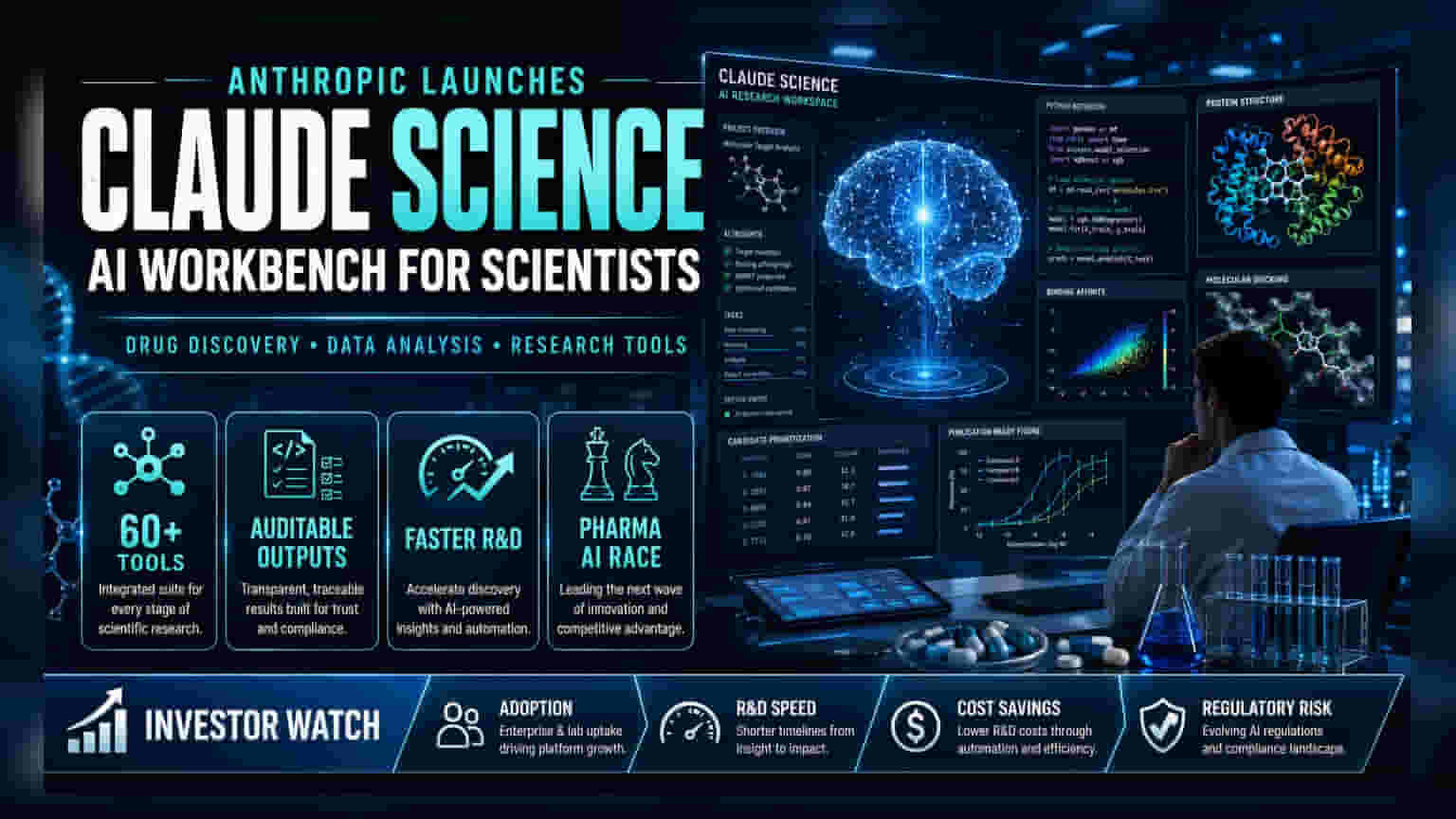
Anthropic Claude in Drug Development
You want AI that can save time in drug research without creating a mess of false confidence. That is the real test for Anthropic Claude in drug development. The promise is obvious. Scientists spend huge amounts of time reading papers, comparing targets, and sorting through narrow clues that can hide in plain sight. But drug discovery is not a chatbot demo. It is slow, expensive, and unforgiving. One bad shortcut can send teams down the wrong path for months. So the question is simple. Can Claude help researchers think faster without making them think sloppier?
Anthropic is pushing Claude as a serious tool for scientific work, and that matters now because drug companies are under pressure to cut time and cost while dealing with larger datasets than any human team can handle alone. The useful version of this story is not magic. It is workflow. Claude can help summarize literature, draft hypotheses, compare mechanisms, and speed up first-pass analysis. That is useful. But useful is not the same as reliable. And in drug development, that gap is the whole game.
What stands out about Anthropic Claude in drug development
- It can speed up reading. Long papers, dense methods sections, and scattered preprints are easier to triage.
- It can support hypothesis work. Teams can test early ideas before they commit lab time.
- It is better as a helper than a decider. Human researchers still need to validate everything.
- It fits knowledge-heavy workflows. Literature review, protocol drafting, and internal research notes are natural use cases.
Where Claude actually helps researchers
Claude is strongest when the task looks like a long, boring reading assignment. That is not a slight. It is the reality of scientific work. A model that can summarize a dozen papers on a target, pull out the common signals, and flag weak points can save hours. Think of it like a seasoned assistant in a lab, the one who knows which drawer has the right reagent and which notebook has the detail you forgot.
It can also help teams compare drug candidates, mechanisms, and trial data across sources. That matters because the same fact pattern often shows up in different papers with different wording. A model that can normalize that language gives you a cleaner first look. But first look is the key phrase. Not final answer.
“AI can compress the reading stage, but it does not remove the need for scientific judgment. It only changes where you spend your attention.”
Why this is not a shortcut to better drugs
Drug development punishes sloppy reasoning. A model can sound persuasive and still be wrong. That is dangerous in a field where a missed side effect or a weak mechanistic link can derail an entire program. What happens if the model confidently connects the wrong biomarker to the wrong pathway? You get a tidy summary and a very ugly month.
Look, the risk is not that Claude fails loudly. The risk is that it fails neatly. That is why researchers need checks at every step. They should verify citations, inspect source data, and keep the model away from anything that looks like autonomous decision-making. Claude can help with the scaffolding. It should not build the house alone.
How teams should use Anthropic Claude in drug development
- Start with reading. Use Claude to summarize papers, patents, and internal reports.
- Move to structured comparison. Ask it to map targets, assays, and known risks across sources.
- Use it for drafting. Let it create rough notes, meeting briefs, and literature tables.
- Validate every claim. Check original sources before any scientific or business decision.
- Keep humans in charge. Scientists, not models, should set the next experiment.
This is closer to how a good editor works than how a lab robot works. The editor does not write the whole book. The editor cuts noise, spots gaps, and pushes the writer to make the argument sharper. Claude can play that role. If you treat it like a replacement for expertise, you are asking for trouble.
What Anthropic still has to prove
The biggest open question is not whether Claude can be helpful. It can. The question is whether it can be trusted in high-stakes scientific workflows at scale. Can it consistently cite sources correctly? Can it avoid hallucinating a mechanism that sounds plausible but is not in the literature? Can it stay useful when the evidence is messy, which is most of the time?
Anthropic will need more than polished demos to answer that. It will need clear evidence from real research teams, better controls around factual grounding, and honest limits on what the model should do. That is especially true in regulated settings, where audit trails and reproducibility matter. Nobody in pharma wants a black box with a nice interface.
What researchers should watch next
The next phase is not about louder claims. It is about narrower, better measured wins. If Claude can cut literature review time, improve internal knowledge sharing, and help teams frame sharper questions before experiments begin, that is already valuable. In drug development, time is money, but bad time is expensive in a deeper way.
And that is the real benchmark. Not whether the model sounds smart. Whether it helps a scientist make one better decision, then another, and then another, without smearing confidence across the whole process. If Anthropic can keep Claude useful inside those limits, it will matter. If not, it becomes another shiny interface in a field that has seen plenty of those.