Anthropic Self-Improving AI: What the Research Really Means
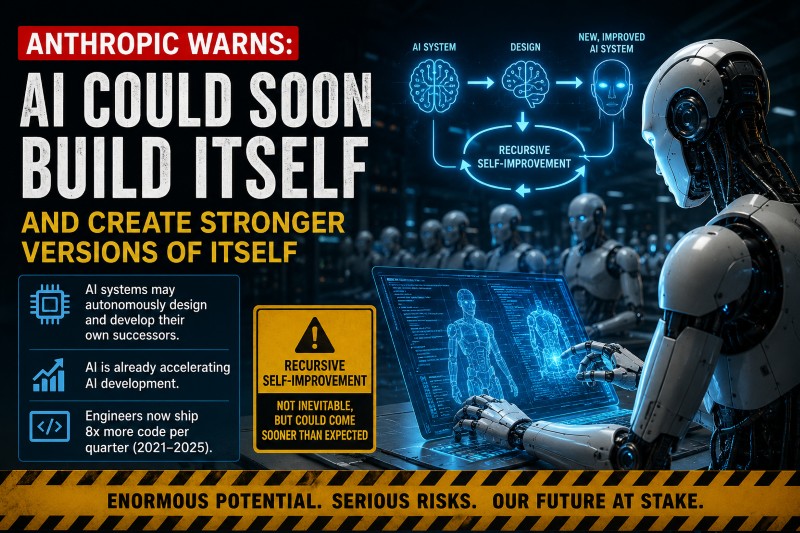
You are hearing more about Anthropic self-improving AI because the idea hits a nerve. If a model can improve parts of itself, that changes how fast systems evolve, how teams ship products, and how much control people keep along the way. That is not a minor lab curiosity. It is a pressure test for the whole field.
The phrase sounds dramatic, and vendors love dramatic. But the real story is narrower and more useful. Researchers are exploring whether models can help generate better prompts, better tools, better training signals, or better reasoning steps for the next version of the system. That is different from a machine that casually rewrites its own core and wakes up smarter. Still, even limited self-improvement can shift the pace of progress. How much control do humans keep if the model starts improving the workflow that builds the model?
- Self-improving AI usually means partial improvement loops, not sci-fi autonomy.
- The biggest risk is less about one leap and more about compounding mistakes.
- Safety, evaluation, and human oversight matter more, not less, as systems become more adaptive.
- Product teams should treat these systems like powerful assistants with failure modes, not magic agents.
What Anthropic self-improving AI actually points to
Look, the core idea is simple. A model can be used to improve some part of the pipeline that produces future models or better outputs. That might mean writing training data, suggesting refinements, judging answers, or helping researchers spot weak spots faster than a human team can alone.
That is not the same as a model fully redesigning itself. It is closer to a racing crew tuning a car between laps than the car building its own engine in the pit lane. The distinction matters, because public debate often jumps straight to runaway autonomy. Most real systems are still boxed in by compute limits, data limits, and human approval.
“The important question is not whether an AI can improve something. It is which part of the stack it can improve, how fast, and who can stop it.”
Why the Anthropic self-improving AI discussion matters now
There is a reason researchers and policy people pay close attention to this topic. If models get better at helping build better models, progress can compound. Even modest gains in evaluation quality, debugging, or alignment research can feed into the next training run.
That kind of loop can be useful. It can also hide bad assumptions. A system that looks strong in one benchmark might simply be better at producing benchmark-shaped answers (not better understanding). That is where the danger starts, because feedback loops can reward polish over truth.
And there is a business angle. Companies want lower costs, faster iteration, and fewer bottlenecks. Self-improving workflows promise all three. But if you cut humans out too early, you may end up with a very efficient error factory.
Where the real technical limits still sit
Anthropic self-improving AI, at least in the current public conversation, still runs into hard walls. Models do not have direct access to themselves in the way people imagine. They need scaffolding, external tools, evaluation harnesses, and human-defined goals.
Three limits keep showing up:
- Evaluation quality. If the test is weak, the improvement loop is weak.
- Goal drift. The model may optimize the proxy instead of the real objective.
- Compute and data. Better ideas still need serious infrastructure to matter.
Think of it like renovating a house while living in it. You can improve the kitchen, the wiring, and the insulation. But you still need permits, inspections, and someone who knows which wall is load-bearing.
What researchers will keep testing
Expect more work on automated evals, model-generated training data, agentic coding, and recursive improvement loops. Those are the pieces that can move the field from “helpful assistant” to “system that meaningfully helps build the next system.”
One researcher can find a clever trick. A team can validate it. A company can package it. The hard part is proving that the improvement is real, stable, and not just a fragile demo.
What this means for product teams and operators
If you build with frontier models, you should not wait for a sci-fi moment. The practical question is whether your own pipeline is becoming self-tuning in ways you understand.
- Audit where the model generates data, labels outputs, or ranks responses.
- Keep human review on any loop that changes training, policy, or release decisions.
- Measure not only accuracy, but also error concentration and refusal behavior.
- Separate experimentation environments from production systems.
Honestly, that last point is non-negotiable. A model that can help improve a workflow can also help spread a bad one faster.
Teams should also watch for hidden brittleness. If a model looks better after self-generated refinement, ask whether you improved reasoning or just narrowed the range of mistakes. That difference can be expensive.
Anthropic self-improving AI and the safety question
Safety people are right to be skeptical. Recursive improvement has a history of sounding cleaner on paper than it is in practice. Small errors can snowball. Incentives can get weird. And evaluation tends to lag behind capability.
But skepticism should stay precise. The current discussion does not prove that models are about to break free of control. It shows that some improvement loops are already useful, and useful systems tend to spread fast.
That is why governance matters now, before the tools get more capable. If you wait until the loop is fully autonomous, you have already lost the chance to shape its guardrails.
What to watch next
The next wave will likely center on three questions: Can models reliably improve the quality of training data? Can they help discover weaknesses in other models faster than humans can? And can developers prove that these gains hold up outside the lab?
Those answers will decide whether self-improving AI stays a research idea or becomes a standard part of model development. The race is not between humans and machines. It is between careful engineering and sloppy automation. Which side do you think will win if nobody slows down?
What this changes for you
If you work in AI, treat Anthropic self-improving AI as a warning and a tool. Useful systems are already here. So are the traps.
Keep your eyes on the feedback loop. That is where the story lives.