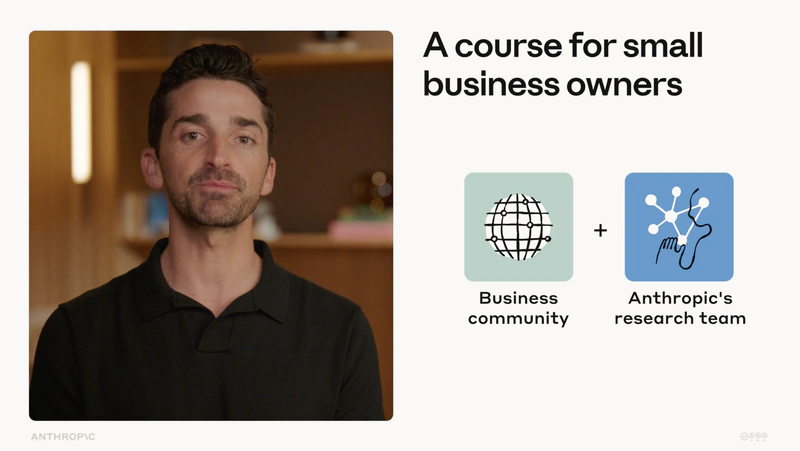
Anthropic Targets Small Business Owners
Small business owners keep hearing that AI will save time, cut costs, and make lean teams act bigger. Most of that pitch has been vague. Anthropic small business owners strategy matters because it points to a more grounded test of AI demand: can a tool like Claude help a busy owner answer customers faster, draft cleaner marketing copy, summarize paperwork, and keep operations moving without hiring more staff? That question matters now because the AI market is moving past raw novelty and into proof. Big enterprise contracts still get headlines, but smaller firms make up a huge slice of real economic activity. If Anthropic can win there, it has a stronger case that its products fit daily work, not just boardroom demos or developer experiments.
What stands out here
- Anthropic appears to be chasing a broader market than large enterprises and developers.
- Small business owners need time savings and simple workflows, not abstract AI promises.
- Claude may fit tasks like customer communication, document summaries, and first-draft writing.
- This move could signal that AI vendors now need practical adoption, not hype, to keep growing.
Why the Anthropic small business owners push matters
For the past two years, AI companies have largely sold two dreams. One was enterprise transformation. The other was developer productivity. Both are real markets, but they are also crowded, expensive, and slow to convert.
Small businesses are different. Owners buy software if it solves a problem this week. They do not care about lofty claims. They care about whether they can clear their inbox, respond to leads, write a proposal, or make sense of tax documents before dinner.
That is the real test.
If Anthropic is serious about this segment, it is betting that the next wave of AI growth will come from practical office work. Think less moonshot, more back office. It is a bit like a restaurant supplier deciding the real money is not in celebrity chefs, but in the neighborhood spots that place repeat orders every week.
AI adoption gets real when owners pay for saved hours, not for flashy demos.
What small business owners actually need from Claude
Look, small firms are not asking for agentic systems that rebuild their company from scratch. They usually want a dependable assistant that reduces repetitive work and does not create fresh risk.
Core use cases with obvious value
- Email and customer replies. Drafting responses, follow-ups, refund notes, and appointment messages.
- Marketing support. Writing ad variations, social captions, newsletters, and website copy.
- Document summaries. Condensing leases, vendor agreements, meeting notes, and policy documents.
- Research and comparison. Pulling together options for software, suppliers, or local competitors.
- Internal process help. Turning rough notes into SOPs, checklists, or training material.
These jobs are not glamorous. But they eat hours. And in a small business, the owner often carries all of them at once.
What would make Claude appealing here? Clear writing, low friction, and trust. If the interface feels simple and the outputs are steady, that is more valuable than a dozen advanced features buried in menus.
Where the pitch could break down
There is a hard truth in this market. Small business owners are some of the toughest software buyers around. They are price sensitive, skeptical, and short on time. If setup takes too long, they quit. If outputs need heavy correction, they quit faster.
And there is another problem. Many of the tasks above are already being chased by Microsoft Copilot, Google Workspace tools, OpenAI’s ChatGPT, Canva, HubSpot, and a long tail of vertical SaaS products. Anthropic is not entering an empty field.
So what would help it stand apart?
- Better writing quality for business communication
- Safer handling of uploaded documents
- Simple templates for common owner tasks
- Strong integrations with email, docs, CRM, and accounting workflows
- Pricing that feels easy to justify on a monthly basis
Honestly, model quality alone is rarely enough in this segment. Distribution, onboarding, and workflow fit matter just as much, maybe more.
Anthropic small business owners strategy versus enterprise AI
Enterprise AI sales can be large, but they move slowly and often get tangled in procurement, security review, and internal politics. Small businesses move faster. A sole proprietor or five-person team can decide in a day.
That speed is attractive, but it comes with tradeoffs. Revenue per customer is lower. Churn can be brutal. Support has to be efficient. Product design has to be almost self-explanatory (because nobody in a ten-person company wants to sit through training).
Anthropic may be reading the market correctly. The AI industry has reached the stage where vendors need durable usage across ordinary work. That means reaching accountants, agency owners, consultants, retailers, contractors, and local service firms. Not just CTOs.
A lot of AI leaders say they want to serve everyone. Few actually build for the mess of real small business work.
What this says about the AI market in 2026
This move hints at a wider shift. AI vendors are learning that the next growth pool may sit in businesses that do not call themselves tech companies at all. The glamour market got the first wave. The grind market may get the lasting one.
That should change how we judge these products. Instead of asking whether a model aces a benchmark, ask whether a florist, lawyer, dentist, or repair shop owner will keep paying for it after 90 days. That is a tougher standard. It is also a better one.
Recent research from the U.S. Small Business Administration has long shown that small businesses make up the overwhelming majority of U.S. firms, which is why even modest adoption rates can create a large software market. And surveys from groups like the National Federation of Independent Business often show the same friction points year after year: labor pressure, time pressure, and cost pressure. AI tools that shave busywork have a shot. Tools that demand babysitting do not.
How small business owners should evaluate Claude
If you run a small company, the smart move is not to buy into broad AI messaging. Test the tool against one stubborn task.
Use a simple evaluation checklist
- Pick one weekly job that eats at least two hours.
- Run that job through Claude for two weeks.
- Measure editing time, output accuracy, and whether you would trust the result in front of a customer.
- Check if the tool fits your existing stack, such as Google Workspace, Microsoft 365, or your CRM.
- Set a hard monthly value threshold. If it does not save more than it costs, drop it.
That sounds basic because it should be. AI buying for small teams should feel like buying a power tool. If it earns its spot in the drawer, keep it. If it slows you down, move on.
What to watch next
The interesting question is not whether Anthropic can market Claude to small business owners. It is whether those owners will keep using it once the first curiosity fades.
Watch for signs like small-team pricing, templates built for real business tasks, integrations with everyday software, and customer stories that show measurable time savings. Those are stronger signals than polished launch language.
Anthropic is making a sensible bet here. But sensible bets still need proof. If Claude becomes a daily tool for small business owners, the company will have found something bigger than a fresh customer segment. It will have found a path past AI theater and into routine work. And that is where this market either matures or stalls.