Claude Sonnet 5.5: Faster AI Work Partner, Lower Cost
You need AI that can handle real work without turning every prompt into a budget meeting. That is why Claude Sonnet 5.5 matters. Anthropic is pitching the model as a cheaper, faster work partner, according to TechCrunch, and that framing tells you where the company thinks the next fight is headed. The market no longer rewards models for sounding clever in a demo. Teams want coding help, document review, analysis, customer support drafts, and workflow automation that runs at a sane price. Speed matters too, because waiting on a model during a live task kills adoption. If Sonnet 5.5 can cut latency and cost while keeping output quality steady, it could become the default middleweight model for companies that do not need the largest system for every job.
What Stands Out
- Anthropic is selling Claude Sonnet 5.5 as a workplace model, not as a lab trophy.
- Lower cost and faster responses could matter more than small benchmark gains for many teams.
- The real test is reliability, especially in coding, research, and document-heavy workflows.
- Buyers should compare it against their own tasks, not generic chatbot prompts.
What Claude Sonnet 5.5 Is Really Aimed At
Anthropic’s language around Sonnet 5.5 points to a practical target, daily knowledge work. That includes writing briefs, summarizing long files, generating code, checking policy text, and helping employees move faster across messy internal systems.
This is the part of the AI market where buyers have become less patient. A model that costs too much sits behind approvals. A model that feels slow gets abandoned. And a model that makes confident mistakes creates cleanup work, which wipes out the time savings.
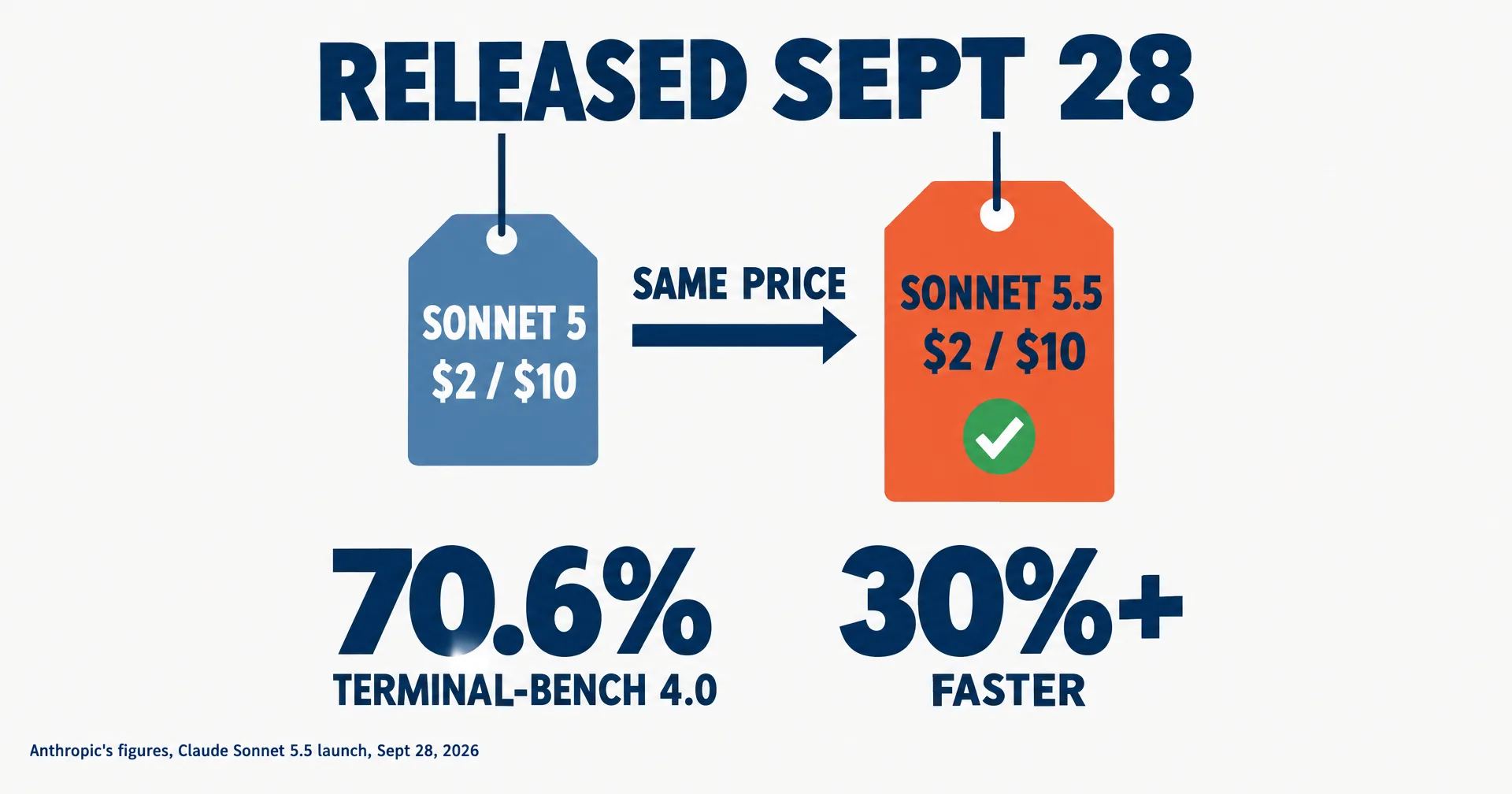
TechCrunch reports that Anthropic calls Sonnet 5.5 a cheaper, faster work partner. That phrase is doing a lot of work, because enterprise buyers now judge AI by throughput, accuracy, and total cost per useful task.
Look, this is the right battleground. Most businesses do not need a heavyweight model for every email draft or code explanation. They need a solid system that can handle the bulk of requests, then hand off harder jobs to a more expensive model only when needed.
Why Claude Sonnet 5.5 Cost Claims Matter
AI budgets have a funny way of looking fine in pilots and ugly in production. A 50-person test may look cheap. Roll that same usage to 5,000 employees, add agentic loops and API calls, and the bill starts to bite.
That is why the “cheaper” part of the Claude Sonnet 5.5 pitch matters. If Anthropic can reduce the cost of routine tasks, teams can run more AI work without rationing access. This changes how product managers and IT leaders think about deployment.
That is the part buyers should test first.
A useful comparison is a restaurant kitchen. You do not assign the head chef to chop every onion. You need a dependable prep line for repeatable work, then you bring in the specialist for the dish that actually needs them. In AI terms, Sonnet 5.5 could become that prep line if it performs consistently.
Speed Is More Than A Comfort Feature
Latency sounds like a technical detail until you watch people use AI at work. If a model takes too long to answer, users switch tabs, lose context, or stop asking follow-up questions. The tool becomes a side chore instead of part of the workflow.
Faster responses also change what developers can build. Customer support copilots, coding agents, spreadsheet helpers, and internal search tools all feel better when the model keeps up with the user. A few seconds can decide whether a feature feels useful or clumsy.
But speed can hide weak reasoning. A quick wrong answer is still wrong. Teams should measure whether Sonnet 5.5 improves time to completion, not only time to first token (a metric vendors love because it looks clean on a chart).
How To Test Claude Sonnet 5.5 Before You Switch
Do not move production workflows because a vendor says the new model is faster. Run a grounded test against your own tasks. Use old tickets, code reviews, policy questions, sales docs, or research requests that already have known good answers.
- Pick 20 to 50 real tasks. Use examples from actual work, including messy prompts and incomplete context.
- Compare against your current model. Track quality, latency, cost, and how often a human must fix the output.
- Score outcomes, not vibes. Did the answer solve the task, miss a constraint, cite bad information, or require a rewrite?
- Test long-context behavior. Feed it dense documents and ask for specific extraction, contradiction checks, and summaries.
- Run safety checks. Try sensitive requests, private data scenarios, and regulated workflow prompts.
What should you look for? Start with boring reliability. The best workplace AI often feels uneventful because it follows instructions, handles edge cases, and does not invent drama where none exists.
Where Anthropic Has An Opening
Anthropic has built its brand around safer, more controllable AI systems. Claude also has a strong reputation among many developers and writers for handling long documents and structured reasoning. That gives Sonnet 5.5 a credible path into business workflows, especially where trust matters.
Still, Anthropic faces a crowded field. OpenAI, Google, Meta, Mistral, and others are all pushing cheaper and faster models. The center of gravity is shifting from “which model is smartest?” to “which model fits this job at the right price?”
That question favors model routing. A company might use Claude Sonnet 5.5 for routine analysis, a larger Claude model for high-stakes reasoning, and a smaller open model for simple classification. The winner may be the vendor that makes this mix easy to manage.
What Businesses Should Watch Next
The next few weeks should bring more hands-on testing from developers, analysts, and enterprise AI teams. Pay close attention to coding benchmarks, agent tests, document analysis results, and API pricing comparisons. Public demos help, but production traces tell the truth.
One question matters more than the launch message. Can Claude Sonnet 5.5 reduce cost per completed task without increasing review time? If yes, Anthropic has a model that can win real workplace usage. If no, this becomes another release that sounds better in a headline than in a procurement meeting.
My advice is simple. Put Claude Sonnet 5.5 into a small, measured trial, compare it with your current stack, and let your own workload decide whether Anthropic’s cheaper, faster work partner claim holds up.