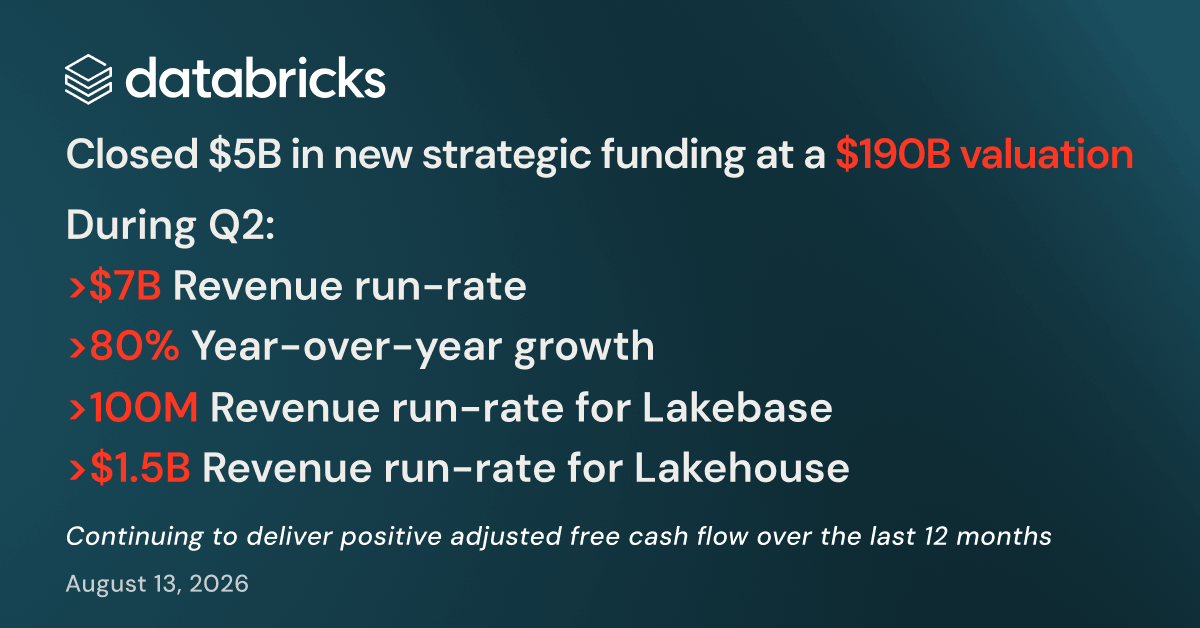
Databricks Valuation Rises to $190B After $5B Raise
Databricks just showed how strange private markets have become. The company reportedly wanted to raise $1 billion, investors pushed for far more, and the final deal landed at $5 billion with a $190 billion valuation. That is a huge number even by AI startup standards, and it matters because Databricks valuation is now a signal, not just a headline. It tells you how much money is chasing infrastructure, data, and AI tooling right now. It also tells you that top private software companies can still command terms that would have looked wild a few years ago. If you are tracking where enterprise AI money is flowing, this deal is hard to ignore. Is the market pricing real business strength, or just hunger for exposure to the next platform layer?
What Stood Out in the Databricks Valuation Deal
- The round reportedly grew from an initial $1 billion target to $5 billion.
- Investors pushed for a larger allocation than the company first planned.
- The final valuation landed at $190 billion.
- The deal reinforces demand for data platform companies tied to AI spend.
- It also raises the bar for every private SaaS and AI infrastructure rival.
Why the Databricks Valuation Matters Now
Look, the number is not the whole story. Databricks valuation matters because it sits at the intersection of three markets that still have real heat behind them: cloud data infrastructure, analytics, and enterprise AI. Databricks sells the plumbing that many companies need before they can do anything useful with model training, retrieval, or agent workflows.
That is why investors treat it differently from a flashy app company. It is closer to the foundation of a building than the paint on the walls. If the foundation is expensive, the whole structure gets repriced.
What a Bigger Round Signals to the Market
When investors ask for more shares in a private round, they are usually not doing charity. They want exposure to a company they believe can still grow into a much larger public-market story. In this case, the jump to $5 billion suggests deep conviction, but also scarcity. There are not many private names with this mix of scale, revenue reach, and AI relevance.
The real signal here is not just the valuation. It is the fact that investors wanted more, not less.
That appetite can ripple outward fast. Rival platforms such as Snowflake, data warehouse vendors, vector database players, and AI tooling startups now have to answer a harder question. What are they worth if one of the biggest names in the stack can still pull in money at this level?
How to Read the Databricks Valuation Without the Hype
First, separate price from proof. A private valuation is not the same thing as public-market validation. It reflects what a specific set of investors agreed to pay under specific conditions.
- Look at revenue quality, not just topline growth.
- Check whether the company is expanding inside large enterprises.
- Watch how much of its story depends on AI demand versus classic data workloads.
- Compare the valuation to competitors with similar customer reach.
- Ask whether the round funds product expansion or simply marks a higher price point.
Second, remember that mega-rounds can distort comparisons. A company can raise at a breathtaking valuation and still face pressure to prove margins, retention, and real platform lock-in. Money helps, but it does not erase the need to ship.
What This Means for Buyers and Competitors
If you buy software, this deal says your vendors will keep charging for AI add-ons, data integration, and platform upgrades. Everyone in the stack wants to sit closer to the budget line. And if you build in this market, you should expect sharper competition for talent, partnerships, and cloud credits.
There is also a practical lesson here for smaller vendors. You do not need to copy Databricks. You need a narrower wedge, a cleaner go-to-market motion, and a reason customers should care about your workflow before they care about your logo. That is not flashy. It is how durable companies get built.
Honestly, the market looks a bit like a restaurant that suddenly has too many chefs in the kitchen. Everybody wants a piece of the same dish, and the table is not getting bigger at the same pace. Who gets paid when the appetite cools?
What to Watch Next
The next useful signals are simple. Watch whether Databricks uses the money to deepen AI products, expand internationally, or accelerate enterprise sales. Watch whether other private giants try to match the valuation tone with their own raises. And watch how public investors react if this kind of pricing starts leaking into IPO expectations.
For now, the message is blunt. Databricks valuation is high because the market still believes data infrastructure is the seat of power in enterprise AI. If that belief starts to crack, a lot of other private pricing will look a lot less certain.
That is the next thing to test.