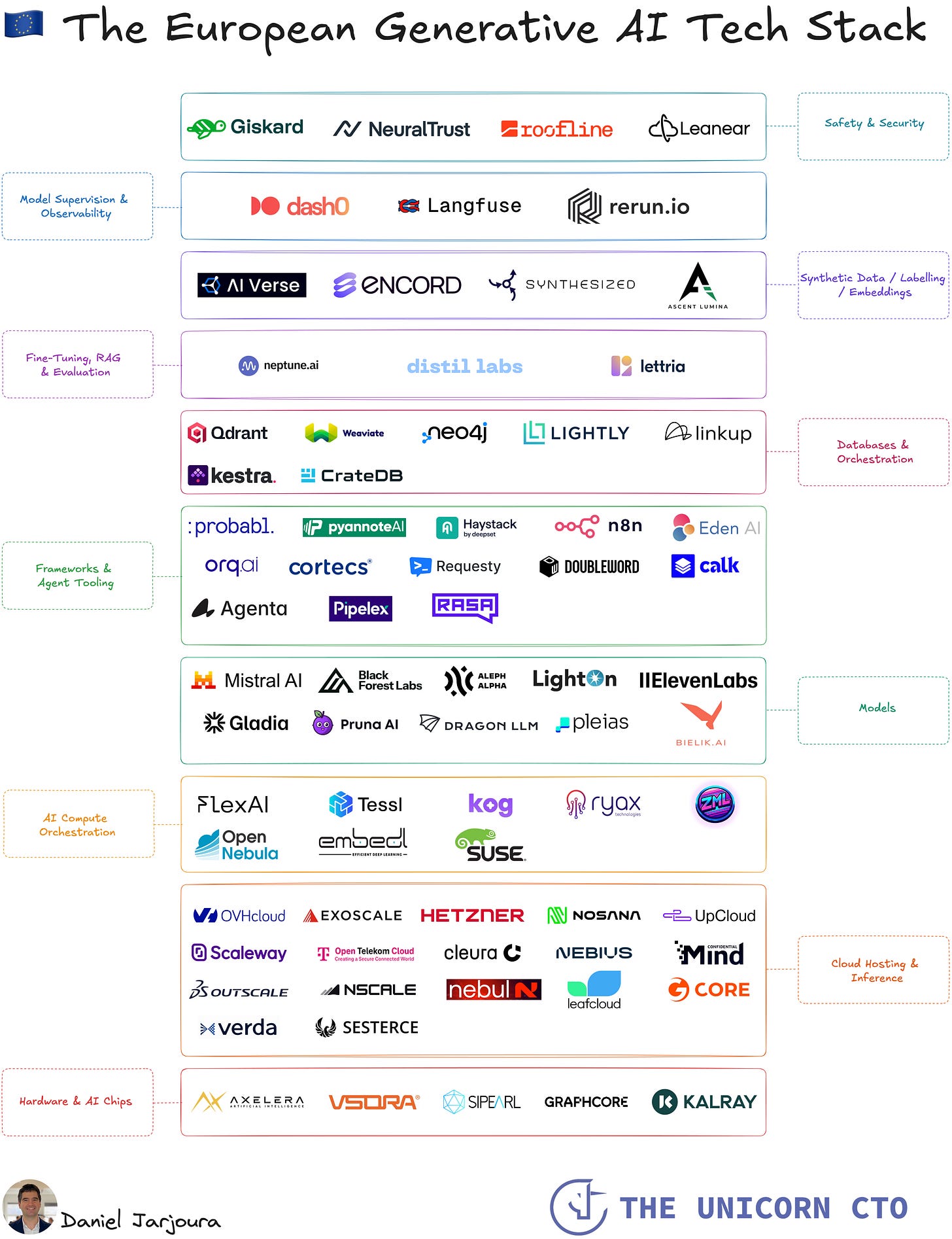
Europe Wants Its Own AI Stack
Europe has a plain problem. It relies on foreign AI systems, foreign chips, and foreign cloud platforms, and that dependency now looks risky. The push for a European AI stack is about control, cost, and power. It matters because the companies and governments building on top of AI do not want to wake up one morning and find the rules, prices, or access terms changed by firms outside the region. That pressure is now shaping policy, funding, and industrial strategy across the continent. Can Europe really build a serious AI ecosystem without copying Silicon Valley or chasing every model-size headline? That is the question, and it is no small one.
What Europe Wants From AI
- Less dependence on U.S. cloud and model vendors.
- More control over data, procurement, and compliance.
- Stronger local industry for models, chips, and infrastructure.
- Better fit for regulation like the EU AI Act and privacy rules.
The goal is not a vanity project. It is a response to hard reality. If your public sector, banks, factories, and startups all run on someone else’s stack, you do not own the terms of the game. Europe has learned that lesson the hard way.
Look at the shape of the market. The most visible foundation models come from the U.S. and China. The cloud layer is even more concentrated. That leaves Europe in a position like a city trying to design its own transit system while renting all the trains from abroad. It can work for a while. Then the bills arrive.
Why the mainKeyword Keeps Coming Up in Policy
The phrase European AI stack is showing up because policymakers are trying to connect several weak points at once. Models are one layer. Compute is another. Data access, compliance, and deployment sit on top. If any one of those layers stays external, the region stays exposed.
That is why Brussels, national governments, and local champions keep circling back to sovereignty language. Not because sovereignty sounds good in a speech. Because procurement, defense, health, and industrial data all carry real strategic weight. Who wants a hospital network or a government ministry tied to a single foreign vendor’s roadmap?
Europe does not need to win every AI benchmark. It needs to avoid strategic dependency in the systems that run public life and industrial work.
Where the European AI stack can actually win
Europe will not beat the biggest U.S. labs by trying to outspend them on frontier training runs. That path is a trap. But it does have openings.
1. Regulated sectors
Insurance, banking, pharma, energy, and public administration all need AI that can survive audits, privacy reviews, and procurement checks. That is a better fit for European firms that can build with compliance baked in from day one.
2. Industrial AI
Factories, logistics networks, and automotive systems need specialized tools more than giant general chatbots. This is where Europe’s manufacturing base matters. A tuned model that helps predict defects or manage supply chains can be more valuable than a flashy demo.
3. Open infrastructure
Open-source models, local cloud capacity, and regional compute pools can lower dependence without pretending Europe needs to build everything from scratch. This is the sensible lane.
Honestly, that is the clearest route. Build the rails. Do not obsess over being the loudest train.
What is holding it back?
The obstacles are not subtle. Europe has fragmented markets, slow procurement, uneven venture funding, and a history of moving in committees while the rest of the industry moves in code. That gap matters.
- Fragmented demand. A startup in Lisbon does not automatically have the same path to market as one in Berlin or Paris.
- Capital gaps. Scaling AI is expensive. Training, inference, and distribution all burn cash fast.
- Compute limits. Chips and data centers remain bottlenecks, and those are not solved by press releases.
- Talent competition. Europe produces strong researchers, but top engineers can still be pulled toward better-funded hubs.
And there is another problem. Europe often regulates faster than it builds. That is not automatically bad. Rules matter. But if regulation becomes the only visible output, the region ends up writing the rulebook for tools it does not control.
MainKeyword and the business case
The business case for the European AI stack is not abstract. Companies want lower risk, clearer contracts, and systems that do not create compliance headaches every quarter. Public institutions want vendors they can actually audit. Investors want a market that is big enough to scale and stable enough to survive long sales cycles.
This is where the comparison to architecture fits. You can build a beautiful top floor, but if the foundation is borrowed and the walls are thin, the whole structure stays shaky. Europe is trying to pour its own foundation now. The question is whether it can do that before too many buyers settle for cheaper foreign defaults.
What to watch next
Keep an eye on three signals. First, whether governments buy from local AI vendors instead of importing everything. Second, whether European cloud and chip investments turn into usable capacity. Third, whether startups can build products that feel native to the region’s rules and markets.
If those pieces start to align, the European AI stack stops being a slogan and starts looking like an industry. If they do not, Europe will keep talking about sovereignty while running on somebody else’s rails. Which version do you think will survive the next procurement cycle?
Where this goes from here
The smartest move for Europe is not to chase the biggest model. It is to build an AI stack that is useful, defensible, and boring in the best way. Boring means dependable. Dependable means adopted. And adoption is what turns strategy into power.