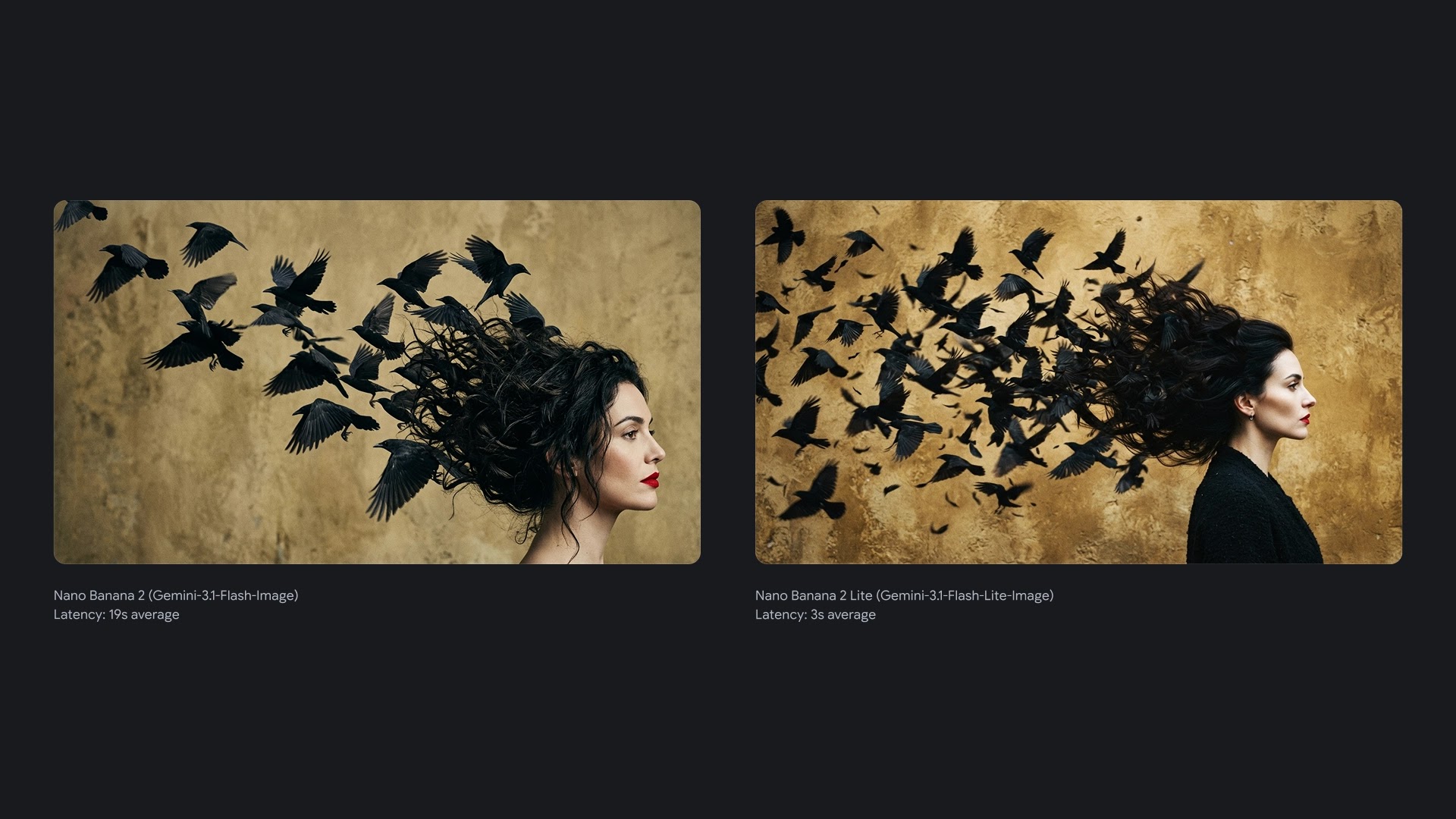
Google Nano Banana 2 Lite: Faster, Cheaper Image Generation
Image teams keep running into the same problem. They want fast turnaround, lower spend, and outputs that do not look like they came from a rushed demo. That is why Nano Banana 2 Lite matters. Google is pitching it as a lighter, cheaper image generator that can cut wait times and reduce costs without forcing you to rebuild your workflow around a heavyweight model. If you are shipping product mockups, ad variants, social assets, or internal concept art, speed is not a nice extra. It is the point. And cost pressure is only getting tighter. What does that mean for your stack, your budget, and your creative process?
What stands out about Nano Banana 2 Lite
- Lower cost per image for teams that generate at scale.
- Faster output for rapid ideation and high-volume tests.
- Better fit for everyday production work than one-off showcase prompts.
- More room for iteration when you need multiple drafts before approval.
Speed matters most when it removes friction from the work you already do. A model that is 20 percent better on paper means little if it slows your team down or burns budget on every prompt.
Why Google is pushing a cheaper image generator now
The image model market has shifted. The old race was about who could generate the flashiest sample. Now buyers care about latency, throughput, and predictable pricing. That is a very different game. Google is clearly trying to position Nano Banana 2 Lite as the practical option, the one you can point at a real workflow without babysitting every request.
That matters because most teams do not need museum pieces. They need usable drafts. They need variations for A/B tests. They need a model that behaves more like a dependable kitchen appliance than a showhorse. If a model can generate acceptable results fast, the creative team can spend time editing instead of waiting.
How Nano Banana 2 Lite changes the day-to-day workflow
Think of it like swapping a full-size delivery truck for a compact van. You give up some raw capacity, but you gain maneuverability and lower operating costs. For many product teams, that trade is non-negotiable.
Where speed pays off
- Concepting. You can test more visual directions before a review.
- Marketing. You can produce more ad variants for performance testing.
- Product design. You can turn rough ideas into visual references faster.
- Internal comms. You can make simple graphics without waiting on design bandwidth.
There is a catch, of course. Faster and cheaper usually means you should expect a more disciplined prompt strategy. Garbage in, garbage out still applies. But if Google has tuned the model well, you may be able to get usable results with less prompt wrangling than older systems required.
What teams should watch before they adopt it
Do not buy the pitch, buy the workflow. Ask whether the model handles your actual use case. Does it keep text readable? Does it preserve brand colors? Can it hold consistency across a set of images, or does it drift on every prompt?
Look at three practical tests:
- Consistency. Can it generate a series that looks like one campaign?
- Control. Can you steer style, composition, and subject clearly?
- Economics. Does lower cost survive when you factor in retries and edits?
Those questions matter more than benchmark bragging rights. A model that looks cheap in a blog post can get expensive fast if it needs three or four retries per usable image.
How Nano Banana 2 Lite compares with the current market
Google is not alone here. OpenAI, Adobe, Midjourney, and Stability AI all have their own takes on image generation. Some push quality first. Some push creator control. Some push integrations. Google seems to be leaning into operational efficiency, which is smart. It gives buyers a reason to care even if they are not chasing the fanciest sample on social media.
That said, the real test is adoption inside working teams. If the output is good enough for paid ads, pitch decks, thumbnails, and quick product visuals, the model has a real job. If not, it becomes another demo tool people admire and ignore.
The big question is simple. Can Google make the cheaper option the default option?
What you should do next
If you manage content, design, or growth ops, run a side-by-side test with your current generator. Use the same prompt set, the same review criteria, and the same budget target. Compare not only image quality, but also revision count and turnaround time.
That is where the truth shows up. Not in the promo copy. Not in the first pretty sample. The next wave of image tools will win on efficiency, and the teams that measure that properly will move faster than everyone else.
Bottom line for Nano Banana 2 Lite
Google is making a clear bet that most users would rather have a faster, cheaper image generator than a flashy one that drains time and money. If Nano Banana 2 Lite delivers on that promise, it could become the model teams reach for first when the work is repetitive, time-sensitive, and budget-aware. And if it falls short? Then the market will treat it like a reminder that speed alone is not enough.


