GPT-6.1 Sol: OpenAI’s Cheaper Flagship Alternative
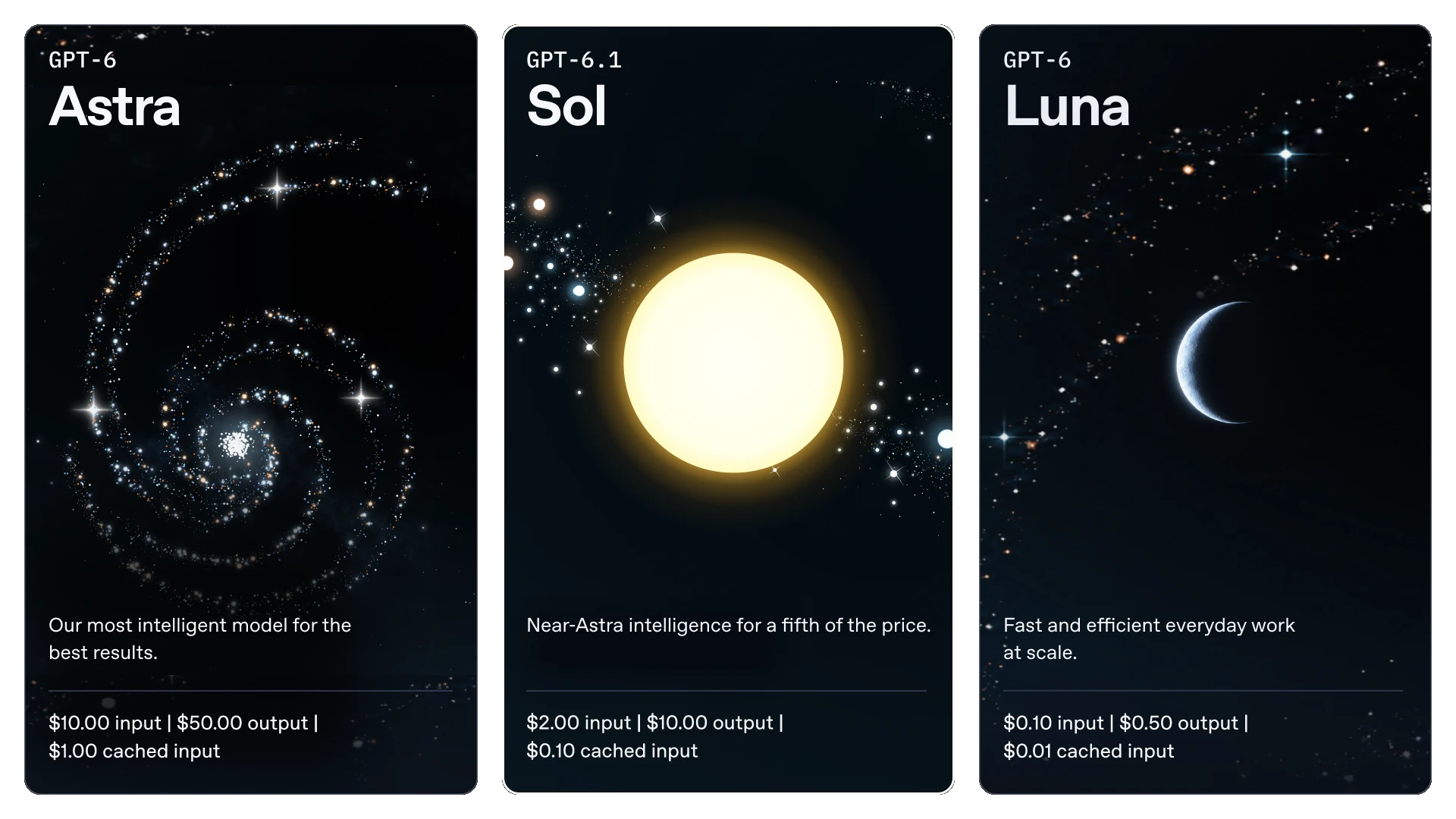
Your AI bill is probably getting harder to defend, especially if your team uses high-end models for coding, analysis, support, or content review. GPT-6.1 Sol, announced by OpenAI according to TechCrunch, is aimed straight at that problem: it is pitched as a lower-cost model that nearly matches GPT-6 Astra, the company’s stronger flagship option.
That claim matters now because model choice has become a budget decision, not a toy decision. If Sol can deliver Astra-like performance at a lower price, developers and buyers get a new default for daily workloads, while Astra becomes the model you reserve for the hardest jobs. The catch? OpenAI’s statement is only the starting point, and serious teams should test Sol against their own prompts before moving spend.
What Changed
- OpenAI has launched GPT-6.1 Sol, a cheaper model positioned close to GPT-6 Astra in capability.
- The move targets teams that need strong reasoning, coding, and language quality without paying top-tier rates for every request.
- Sol could shift default model routing in apps, agents, and internal AI tools.
- Independent benchmarks and real production testing still matter more than launch claims.
Why GPT-6.1 Sol Matters for AI Costs
For most companies, the biggest AI cost problem is not one dramatic invoice. It is thousands or millions of small model calls that look harmless until finance asks why support automation, search, and internal tooling now have their own runaway line item.
GPT-6.1 Sol gives OpenAI a familiar play: keep the premium model for the hardest workloads, then offer a cheaper near-flagship option for volume. That is how cloud providers sell compute, and it is how AI vendors are learning to sell intelligence.
Think of it like a restaurant kitchen. You do not need the head chef plating every lunch order, but you do want the same recipe, timing, and quality control across the line.
Cheaper near-flagship models are where AI adoption gets real. They decide whether teams use AI in a few demos or bake it into daily software.
GPT-6.1 Sol vs GPT-6 Astra: What to Test First
OpenAI says Sol nearly matches Astra, according to the TechCrunch report. That word, nearly, is doing a lot of work, because the gap may be tiny for one task and painful for another.
Why pay flagship rates for work that a cheaper model can handle? The smarter move is to split your evaluation into task types, then measure quality, latency, and cost side by side.
- Reasoning tasks: Test multi-step analysis, policy questions, and planning prompts that have clear right and wrong answers.
- Coding tasks: Compare bug fixes, test generation, refactoring, and code review comments against your current model.
- Long context tasks: Run Sol on dense documents, contracts, support histories, and technical specs.
- Customer-facing responses: Check tone, factual accuracy, refusal behavior, and escalation handling.
- Agent workflows: Measure tool calls, retries, failure loops, and whether the model follows instructions under pressure.
Astra may still win on the weird edge cases, the kind that show up in security reviews, complex codebases, or messy enterprise data. But if Sol gets 90 percent of the way there for half the price, that is not a minor product change.
Where GPT-6.1 Sol Could Become the Default
Developers will likely try Sol first in places where output quality matters, but a perfect answer is not always required. Internal chat, summarization, ticket triage, sales research, and document cleanup are good early candidates.
For software teams, the more interesting use case is model routing. A system can send routine prompts to Sol, then escalate thorny requests to Astra when confidence drops or the task hits a higher risk threshold (legal review, production code, medical content, or financial analysis).
That is the product story.
The best AI stacks already act this way. They treat models like different tools in a workshop, not one magic box that handles every job with the same cost and accuracy.
What Buyers Should Ask Before Switching to GPT-6.1 Sol
OpenAI’s pricing and performance claims deserve attention, but procurement teams need boring details too. Boring is where the budget survives.
Ask these questions before you change your default model:
- What is the actual price difference for input tokens, output tokens, cached context, and tool calls?
- Does Sol support the same API features, context length, multimodal inputs, and safety controls as Astra?
- How does it perform on your private benchmark set, not only public tests?
- What are the latency numbers at peak traffic?
- Can you route sensitive or high-stakes tasks to Astra automatically?
- Will outputs remain stable enough for regulated workflows and audit logs?
Look, I have covered enough model launches to distrust the clean launch chart. The real story usually appears two weeks later, after developers run the model through ugly prompts, broken data, and production traffic.
GPT-6.1 Sol and the New Model Hierarchy
The Sol launch also shows how OpenAI is segmenting its lineup. Instead of one flagship that absorbs every use case, the company appears to be building a ladder: premium models at the top, cheaper high-performance models below, and smaller models for speed or cost control.
That structure puts pressure on rivals like Anthropic, Google DeepMind, Meta, and xAI. If OpenAI can make near-flagship quality cheaper, competitors have to answer with better pricing, stronger open models, or clearer enterprise controls.
Developers benefit from that fight, at least if they avoid lock-in. Keep your prompts portable, keep your evaluations model-neutral, and resist building around one provider-specific trick unless it saves real money.
The Smart Next Move
Do not swap everything to GPT-6.1 Sol on launch day. Pick three high-volume workflows, run an A/B test against GPT-6 Astra, and decide based on error rate, latency, and cost per successful task.
If Sol holds up, the savings could be immediate. If it stumbles, you will know exactly where Astra still earns its premium, and that is the kind of clarity AI budgets badly need.