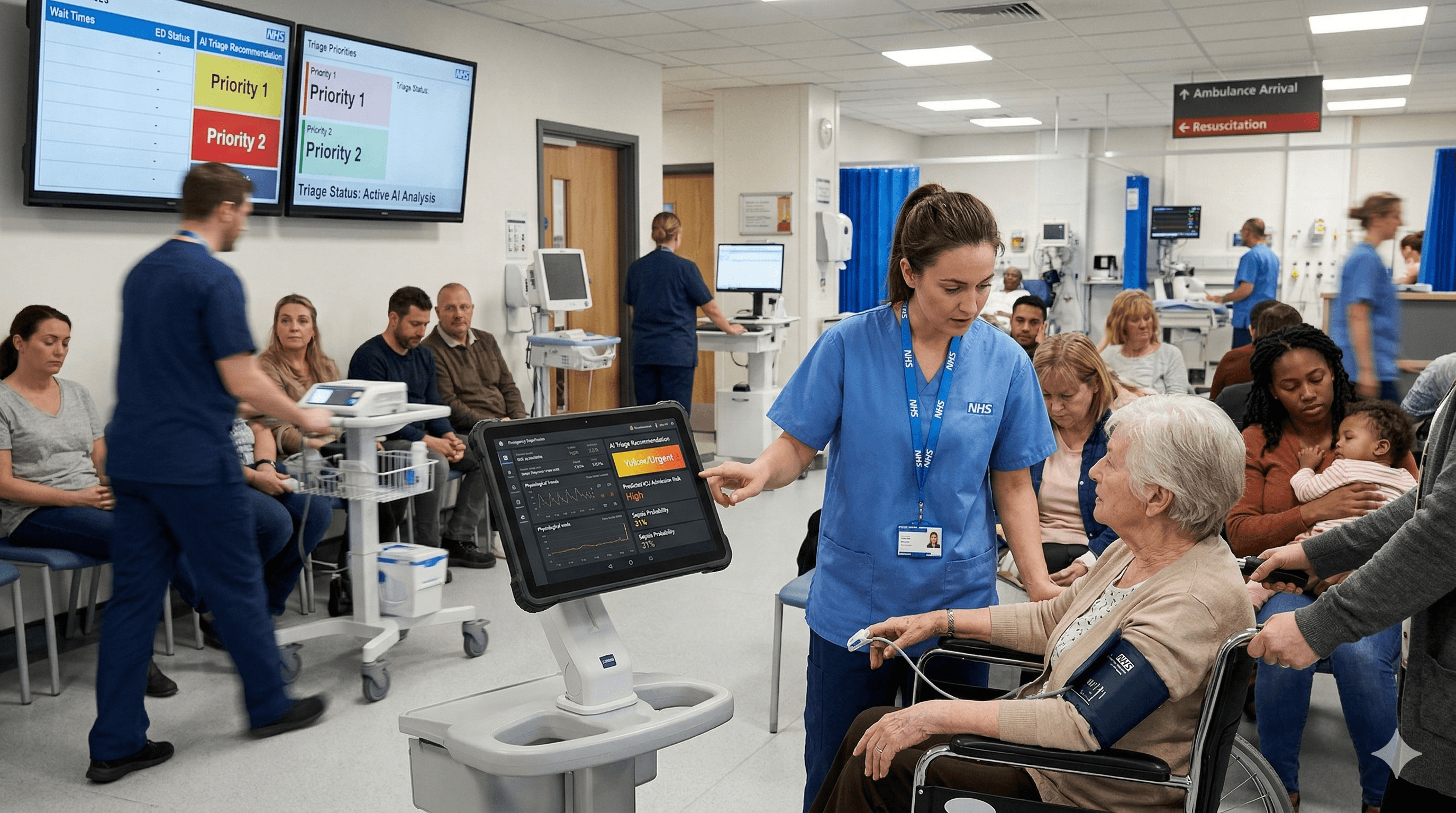
HealthLeap AI Funding Signals a New Hospital Triage Race
Hospitals do not need another dashboard that blinks in the background. They need tools that help clinicians spot trouble sooner, without burying nurses and doctors under more alerts. That is why HealthLeap AI hospital triage matters now. According to TechCrunch, HealthLeap has raised $38 million for software that flags hospital patients who may need a closer look. The pitch is simple: use artificial intelligence to scan patient data and surface risk before a human team might catch it during normal rounds.
I have covered health tech long enough to be wary of neat demos. Hospital floors are messy, loud, and short-staffed. Still, this category has teeth. If HealthLeap can reduce missed deterioration without adding alert fatigue, it will land in a market hungry for practical clinical AI. If it cannot, it becomes one more expensive tab in the electronic health record.
What Stands Out
- HealthLeap raised $38 million, according to TechCrunch, to grow AI software for inpatient monitoring.
- The product focuses on flagging hospital patients who may need a closer clinical review.
- The real test is workflow fit, not model accuracy alone.
- Hospitals will want proof around false positives, clinician adoption, and patient outcomes.
- This deal points to rising investor interest in AI that supports care teams inside hospitals.
Why HealthLeap AI Hospital Triage Is Getting Attention
Hospital triage is no longer limited to the emergency department. Every inpatient unit has its own quiet triage problem: which patient needs attention first, which lab trend deserves action, and which vague change is a warning sign?
HealthLeap appears to be aiming at that blind spot. The company’s AI reviews patient information and flags people who may need closer monitoring. Think vitals, lab results, clinical notes, medication changes, and patterns that can be hard to catch during a rushed shift.
That is a real problem. Nurses often track too many patients at once, and physicians move across floors, consults, and admissions. A good AI system could act like a second set of eyes. Not a doctor. Not a replacement. A smoke alarm.
Here is the hard part: in hospitals, a tool that is right too late is useless, and a tool that cries wolf too often gets ignored.
The $38 million raise gives HealthLeap room to hire, run pilots, expand integrations, and chase health system contracts. But money does not make a clinical product safe or trusted. Hospitals will ask for evidence.
What HealthLeap AI Hospital Triage Must Prove
Health systems have been burned by predictive tools before. Some worked well in narrow settings. Others looked better in slide decks than in live wards. So what should buyers inspect?
1. Does it reduce missed deterioration?
The best case is clear. The system flags a patient whose risk is rising, a clinician intervenes, and the patient avoids ICU transfer, cardiac arrest, or a longer stay. That is the outcome hospitals care about.
But HealthLeap will need to show this in real clinical settings. Retrospective validation is useful, but live deployment is the main event. Did clinicians act on the alerts? Did response times improve? Did adverse events fall?
2. How noisy are the alerts?
Alert fatigue is poison.
Clinicians already deal with alarms from monitors, medication systems, sepsis tools, and EHR prompts. A model can have strong sensitivity and still fail if it floods staff with low-value warnings. Precision matters because attention is scarce.
A strong product should let hospitals tune thresholds by unit. An oncology ward is not a cardiac step-down unit. A surgical floor has different risk patterns than general medicine. One-size scoring rarely survives contact with bedside care.
3. Can it explain why it flagged a patient?
Clinicians do not need a graduate seminar on model weights. They do need a short reason: rising respiratory rate, falling blood pressure, new confusion in a note, creatinine trend, recent opioid dose, or some combination.
Black-box alerts face resistance for good reason. If the system says “high risk” but cannot show its work, the nurse has to burn time figuring out why. That defeats the point.
The Business Case Behind HealthLeap AI Funding
HealthLeap’s funding lands in a practical corner of AI. Generative AI scribes have grabbed headlines because they save documentation time. Inpatient risk tools target a different pain point: clinical risk, capacity, and cost.
Avoiding one ICU transfer can save a hospital real money. Shorter length of stay matters too, especially when beds are full. And hospitals under staffing pressure want tools that help teams prioritize without hiring at a rate they cannot sustain.
Look, investors are not funding hospital AI out of charity. They see budgets moving toward products tied to measurable outcomes. That puts HealthLeap in a promising lane, but also a demanding one.
- Integration: The product must work with major EHR systems, especially Epic and Oracle Health.
- Implementation: Hospitals need fast setup, local calibration, and training that does not drain staff time.
- Evidence: Buyers will expect validation across patient populations, not only one friendly pilot site.
- Liability: Clear rules must define who reviews alerts and how actions are documented.
The analogy I keep coming back to is kitchen prep in a busy restaurant. A good expeditor does not cook every dish. They spot the plate that is late, the steak that is over, and the table that is about to walk out. Hospital AI should do the same kind of sorting, with far higher stakes.
Where Health AI Can Go Wrong
The risk is not that AI enters hospitals. That already happened. The risk is that hospitals buy tools that look smart but do not fit clinical life.
Models can also perform unevenly across patient groups. If training data underrepresents certain populations, the alerts may be less reliable for them. That is not a theoretical concern. Research on healthcare algorithms, including work published in Science in 2019 on racial bias in a widely used care management algorithm, showed how flawed proxies can produce unfair results.
HealthLeap and its customers will need strong monitoring after launch. Model drift is a quiet problem. Patient mix changes, treatment protocols shift, and documentation habits vary by hospital. An algorithm that works in March may need adjustment by November.
And then there is trust. Can a nurse challenge the system? Can a physician mark an alert as wrong? Does that feedback improve the product? The answers matter more than any glossy claim about accuracy.
What Hospitals Should Ask Before Buying
If your health system is evaluating HealthLeap or a similar AI triage product, skip the vague vendor questions. Ask for specifics.
- What data sources does the model use, and which ones are required?
- How often does it refresh patient risk scores?
- What are the false positive and false negative rates by unit type?
- Has the tool been tested across age, race, sex, language, and insurance groups?
- What clinical outcomes improved in live deployments?
- Who is expected to respond to each alert?
- Can clinicians see the reason behind a flag?
- How does the vendor monitor model drift?
- What happens if the EHR feed breaks?
Honestly, the boring questions will decide whether this product works. Procurement teams love broad claims. Bedside teams need sharp edges: who sees what, when, and why?
The Real Signal From HealthLeap’s $38 Million Raise
HealthLeap’s raise is another sign that hospital AI is moving from back-office automation into clinical decision support. That shift raises the bar. A scheduling bot can annoy people. A bad patient-risk alert can change care.
The upside is meaningful. Better early warning systems could help clinicians catch sepsis, respiratory decline, bleeding risk, or medication-related trouble sooner. But the market should resist treating every AI flag as medical wisdom. Is the system improving care, or is it creating a new queue for tired clinicians?
HealthLeap now has capital and attention. The next step is proof inside real hospitals, with real patients, during real shifts. That is where health AI stops being a pitch and starts earning its place.