Keenable Is Indexing the Web for AI Agents
If your AI agent keeps missing the right pages, hitting junk results, or getting stuck behind the same old search stack, you already know the problem. The web was built for people with browsers, not for software that needs clean, structured access at speed. That is why AI agent web indexing matters now. It is the difference between a bot that can guess and a system that can act with some confidence.
Keenable, the Accel-backed startup covered by TechCrunch, is betting that agents need a new layer of retrieval. Not another chatbot wrapper. Not another search box. A better way to map the web so machines can find, rank, and use information without wading through human-first clutter. That sounds neat on a slide deck. But the real test is harder. Can a company build an index that is fresher, cleaner, and more useful than the giant platforms already sitting on top of the open web?
What stands out about AI agent web indexing
- It targets agents first. That changes how pages are crawled, normalized, and scored.
- It focuses on retrieval quality. Agents fail fast when search results are noisy or stale.
- It could reduce tool sprawl. Teams do not want five systems just to answer one question.
- It raises hard infrastructure questions. Freshness, deduping, and permissions are non-negotiable.
Why AI agent web indexing is different from search
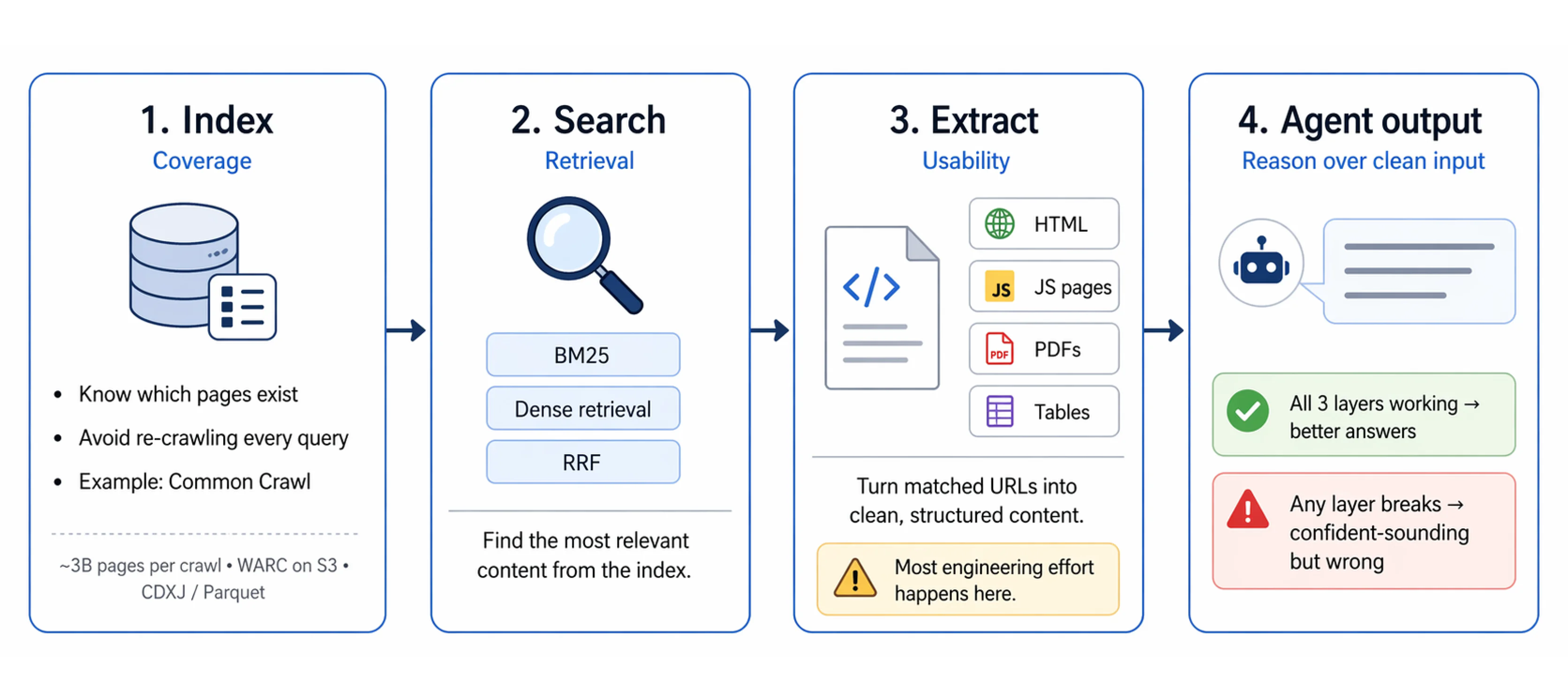
Traditional search tries to satisfy a person with a screen full of links. AI agent web indexing has a different job. It has to feed systems that may summarize, compare, act, or call other tools. That means the index cannot stop at keyword matching. It needs structure, entity understanding, content quality signals, and enough context to keep the agent from making a dumb move.
Think of it like building a kitchen for a professional line cook instead of a home chef. A home kitchen can hide clutter. A line kitchen cannot. Every pan, spice, and ingredient has to be where the cook expects it. Agent indexing has the same pressure.
“The web is already indexed. The real question is whether it is indexed in a way machines can actually use without tripping over noise.”
Where Keenable may find demand
The clearest buyers are teams building internal agents, research agents, and workflow tools. They need fresher public web data than a static database can offer, but they do not want to build a crawler stack from scratch. That is expensive, brittle, and a maintenance headache.
There is also a practical enterprise angle. If your agent is helping sales, support, compliance, or procurement, bad retrieval creates bad outputs. And bad outputs waste time. Nobody wants an assistant that confidently quotes the wrong policy or pulls an expired product page.
- Search and retrieval teams want better ranking signals.
- Agent builders want lower latency and less cleanup.
- Enterprises want traceability and source quality.
- Developers want APIs that do one job well.
What could hold AI agent web indexing back
The hard part is not crawling pages. It is deciding what matters. The web is messy, repetitive, and full of near-duplicates. A human can skim past that. An agent often cannot. So the index has to solve freshness, spam, content extraction, and authority scoring at once. That is a nasty pile of engineering work.
Then there is the business problem. Why would a customer switch if a general-purpose search provider is already close enough for their use case? Keenable will need a sharp answer. Better coverage alone is not enough. Better outcomes are.
There is also the policy side. Robots.txt, publisher rights, rate limits, and content licensing do not disappear just because the consumer is an agent. Who gets to crawl what, and who gets paid when an agent relies on that content?
What to watch next
Look for three signals. First, does Keenable show that its index returns better source quality than standard search APIs? Second, does it offer enough metadata for agents to reason over results instead of just retrieve them? Third, does it prove it can stay current without drowning in web churn?
That last part is where many startups stumble. The web changes by the minute. An index that looks smart in a demo can feel stale a week later. And in agent systems, stale is fatal. If Keenable can stay fresh while keeping results clean, it has a real shot. If not, it becomes another well-funded layer in a crowded stack. Which side of that line do you think most AI infrastructure startups actually land on?
What AI teams should do now
If you are building with agents, do not treat retrieval as a side detail. Test the index before you trust the agent. Measure source quality, recency, and how often the system hallucinates because the underlying data was thin or wrong. The model gets blamed. The index often deserves it.
Start small. Pick one workflow, one query type, and one quality metric. Then compare outputs across your current stack and a purpose-built option like AI agent web indexing. If the gain is real, you will see it fast. If not, you have saved yourself from another shiny detour.