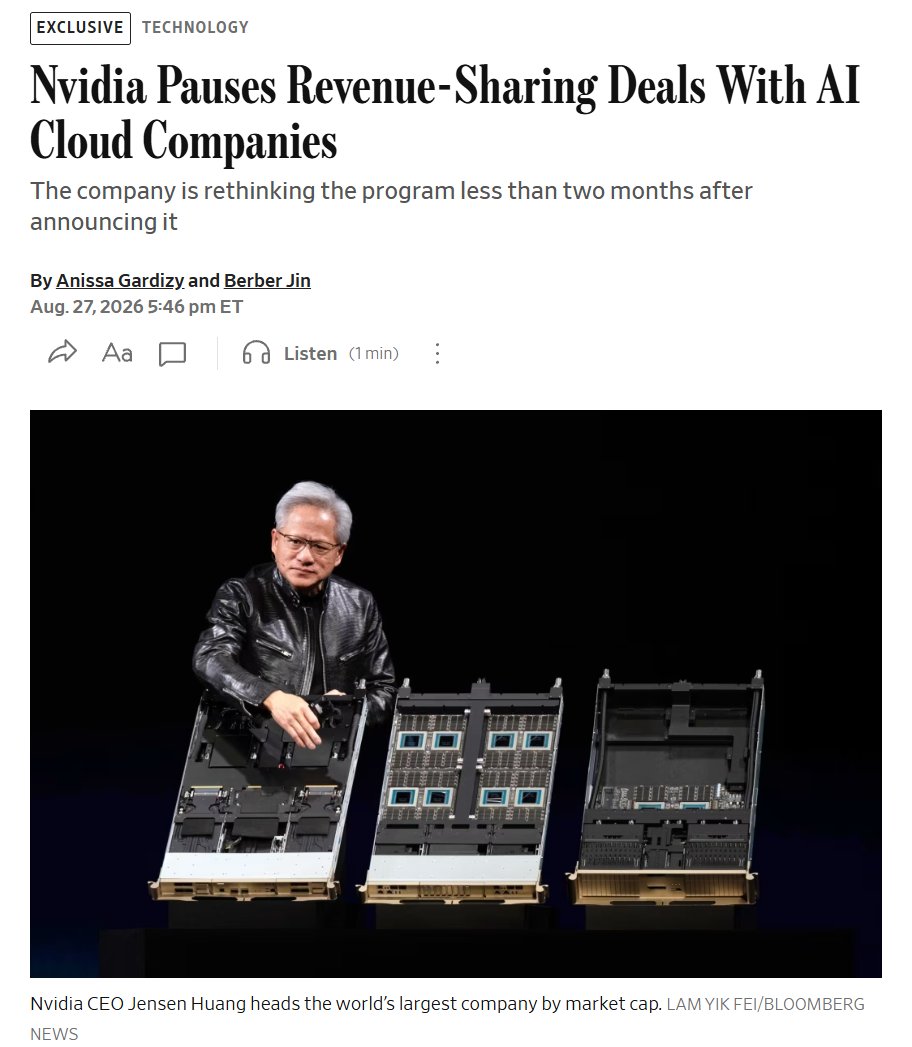
Nvidia Pauses Revenue Sharing Deals With AI Cloud Firms
AI infrastructure is already expensive. Now the economics are getting tighter. Nvidia has reportedly paused revenue-sharing deals with some AI cloud companies, and that matters because Nvidia revenue sharing deals have helped shape how smaller GPU cloud providers fund growth, sign customers, and keep margins alive. If those agreements slow down or disappear, the pressure moves straight into pricing, inventory, and cash flow. And if you run an AI startup that depends on rented compute, you feel that pressure too.
This is not a minor contract tweak. It is a signal about power in the AI supply chain. Nvidia sits at the center of the market for advanced chips, while AI cloud firms sit closer to the customer and absorb the risk of buying and reselling that capacity. What happens when the chip seller changes the rules?
- Revenue-sharing deals can help AI cloud firms offset huge GPU costs.
- Any pause may force smaller providers to rethink pricing and expansion plans.
- The move could strengthen Nvidia’s leverage over the AI cloud market.
- Customers may see fewer discounts and tighter access to high-end GPUs.
Why Nvidia revenue sharing deals mattered in the first place
These deals are a financial patch for an ugly reality. AI cloud firms often spend heavily upfront on Nvidia GPUs, then rent that compute to customers over time. Revenue sharing can soften that risk by giving the chip maker a slice of downstream sales while helping the cloud provider justify the initial outlay.
Think of it like a restaurant supplier taking a cut of every meal sold because it helped finance the kitchen. That arrangement can work, but only if demand stays hot and the operator keeps enough margin. When the market tightens, the balance gets brittle fast.
Look, this is really about who gets to capture the value in the AI stack. If Nvidia can pause one deal type, it is reminding the market that chip supply is still the main gatekeeper.
What the pause could mean for AI cloud companies
Smaller AI cloud firms live on thin margins. They buy expensive hardware, race to keep it utilized, and compete with bigger names that have deeper pockets and better supply access. A pause in Nvidia revenue sharing deals makes that job harder, because it removes one of the few tools that can improve the math.
Some providers may try to absorb the hit for a while. But they may also raise prices, slow expansion, or narrow access to only the most profitable customers. Honestly, that is the part to watch.
- Pricing pressure. Expect less room for discounts on premium GPU capacity.
- Capital strain. Firms may need more debt or equity to keep buying chips.
- Customer churn. Buyers may move if a provider cannot guarantee enough capacity.
- Deal redesign. Partners may push for fixed-fee or usage-based contracts instead.
What this says about Nvidia revenue sharing deals and market control
Nvidia does not need every side agreement forever. It already controls a scarce product, and scarcity is a powerful negotiating tool. Pausing Nvidia revenue sharing deals gives the company more flexibility to shape partner economics without locking itself into a formula that may no longer fit the market.
That also tells you something about the broader AI boom. A lot of the sector still depends on a small number of hardware vendors and a narrow supply chain. Remove one support beam, and everyone notices. Fast.
Why customers should care
If you buy compute from an AI cloud provider, this is not just boardroom noise. It can affect how much you pay, how quickly you can scale, and whether your provider can hold onto enough GPUs for your workload. The weakest link in the chain often turns into the price you see on the invoice.
Could this push more buyers toward hyperscalers or directly toward Nvidia’s preferred partners? Very possibly. That is the kind of shift that changes procurement decisions for months, sometimes years.
What to watch next
Watch for three things. First, whether Nvidia resumes these deals with stricter terms. Second, whether AI cloud firms start talking more about financing, utilization, and long-term supply commitments. Third, whether customers begin seeing tighter availability for the highest-end chips.
One more thing matters too. If this pause spreads, it may force the market to stop pretending every AI infrastructure player can grow at the same pace. Some can. Many cannot. And Nvidia knows the difference.
Where this goes from here
The AI boom still runs on hardware scarcity, not magic. Revenue sharing was one way to smooth the rough edges of that business model. If Nvidia is backing away, the next phase may look less generous and more disciplined. For AI cloud firms, that means harder choices about financing and scale. For customers, it could mean paying more for the same inference job. Keep an eye on the deals, not the hype. The contracts will tell you where the market is headed next.