Open vs Closed AI: The Startup Choice That Shapes Cost, Control, and Speed
Your AI stack is becoming a board-level decision. The debate over open vs closed AI now affects product speed, cloud bills, hiring, compliance, and your ability to stand apart from the next startup with the same API access. TechCrunch reports that Nvidia’s Nader Khalil and investor Sydney Sykes will tackle this question at TechCrunch Disrupt 2026, and the timing fits. Founders are under pressure to ship fast, but customers are asking tougher questions about data, reliability, and vendor risk.
Look, there is no clean answer. Closed models can get you to market faster. Open models can give you more control. The wrong choice can quietly hardwire your company into a cost structure you cannot defend. So what should you pick, and when should you switch?
What Matters Right Now
- Closed AI is often the fastest path for prototypes, sales demos, and early customer validation.
- Open AI can help startups tune models, reduce vendor lock-in, and keep more control over sensitive workflows.
- Infrastructure choices matter more as usage grows, especially if inference costs become a large share of gross margin.
- Nvidia’s role matters because GPUs, software tooling, and deployment patterns shape what is practical for young companies.
- The best answer may change by stage. Seed-stage speed and Series B unit economics are different games.
Why Open vs Closed AI Is More Than a Model Choice
The lazy version of this debate turns it into ideology. Open is good. Closed is safe. That misses the business reality. A startup is not choosing a logo on a model card. It is choosing a path for product architecture, data handling, hiring, procurement, and future margins.
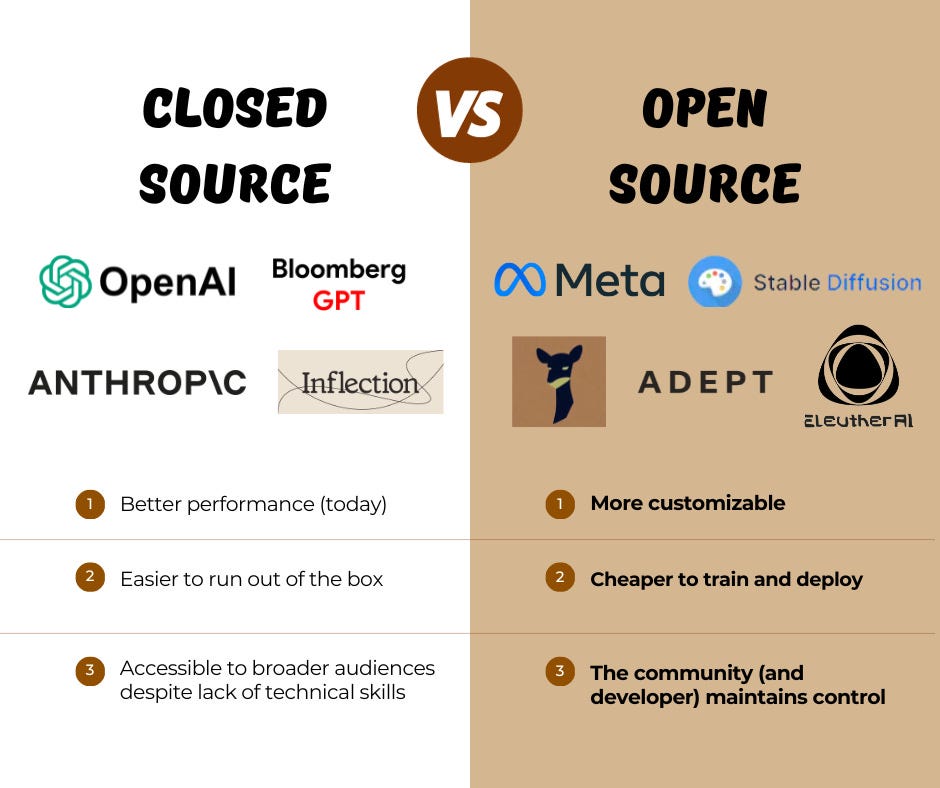
Closed AI systems, such as models accessed through commercial APIs, usually reduce setup work. You pay for access, plug into documentation, and lean on the provider for model updates, safety work, scaling, and uptime. That can be a gift when your team is small and every week matters.
Open models, including models released with public weights under varying licenses, shift more responsibility to your team. You may need machine learning engineers, infrastructure support, evaluation pipelines, and more hands-on security review. But the payoff can be real if your product depends on domain tuning, data control, or lower per-unit costs at scale.
Open AI gives you control. Closed AI gives you speed. The hard part is knowing which risk you can afford.
That tradeoff is why the TechCrunch Disrupt 2026 session matters. Nvidia sits near the center of the AI buildout, from GPUs to inference software, while startup investors see which choices help companies survive past the demo phase.
Open vs Closed AI for Early-Stage Startups
If you are pre-product-market fit, closed AI often wins. Not always. Often.
Why? Because your main job is learning. Can users describe the problem? Will they pay? Does the workflow save time or create revenue? A commercial API can help you answer those questions before you hire an infrastructure team or rent serious GPU capacity.
Here is the thing. Many founders overbuild early AI infrastructure because it feels strategic. It can become a tax. Like opening a restaurant and buying a flour mill before you know if people like the pizza, owning every layer sounds pure until cash gets tight.
Speed is a strategy when the product is still uncertain.
Use closed AI when you need proof fast
- Build the first version with a reliable hosted model.
- Track prompts, outputs, latency, and cost from day one.
- Create a small evaluation set based on real user tasks.
- Flag use cases where the model fails often, gets expensive, or creates compliance friction.
- Revisit open models once usage patterns are clear.
This approach gives you data instead of vibes. It also prevents a common mistake: switching to open models before you know which parts of the product actually need them.
Where Open AI Starts to Make Sense
Open AI becomes more attractive when your product has repeated, narrow, high-volume tasks. Customer support summarization, document classification, code review assistance, medical admin workflows, legal research triage, and internal copilots can all benefit from tighter control.
The shift usually starts with one of four triggers:
- Cost pressure: API bills rise faster than revenue, and inference starts to hurt gross margin.
- Data concerns: customers need stronger guarantees about where data goes and how it is processed.
- Customization needs: the product needs fine-tuning, retrieval design, or domain-specific behavior that generic models cannot deliver.
- Reliability gaps: the team needs stable outputs, lower latency, or fallback systems that are hard to control through one hosted provider.
But open does not mean free. You still pay through compute, engineering time, monitoring, security reviews, and model maintenance. Some open model licenses also restrict commercial use or require careful legal review. That detail gets skipped too often in pitch decks.
How Nvidia Fits Into the Open vs Closed AI Debate
Nvidia is not a neutral bystander. Its hardware and software stack influence how startups train, tune, and serve AI models. GPUs remain the workhorse for frontier AI and a large share of inference workloads, while tools such as CUDA and Nvidia’s inference software shape developer choices.
That does not mean every startup should buy GPUs or manage its own cluster. For many teams, cloud providers or inference platforms will be the sensible route. But as AI usage grows, founders need to understand the economics under the hood. If a product depends on millions of daily model calls, compute is not a back-office detail. It is part of the product’s margin story.
That is why a session featuring Nvidia’s Nader Khalil is worth watching. The conversation is likely to move past vague model talk and into the practical question: what can startups actually run, afford, and scale?
How to Choose Open vs Closed AI Without Fooling Yourself
Founders should stop asking which side is better. Ask which side matches the job.
Pick closed AI if:
- You need to ship in days or weeks.
- Your team does not have deep ML operations experience.
- Your workload is unpredictable or still changing.
- Your customers accept third-party model providers.
- Your usage volume is too low to justify custom infrastructure.
Pick open AI if:
- You have stable, repeated workflows with measurable quality targets.
- Your customers require stricter control over data or deployment.
- Your model costs threaten gross margin.
- You need fine-tuning or domain-specific behavior.
- You can support evaluation, monitoring, and updates internally.
One practical test works well: price your AI feature at 10 times your current usage. If the economics break, you need a plan before growth arrives. That plan might be prompt optimization, caching, smaller models, open-weight deployment, or a hybrid setup.
The Hybrid Path Is Usually the Adult Answer
Most serious AI companies will not stay purely open or purely closed. They will mix models by task. A startup might use a closed frontier model for complex reasoning, an open model for high-volume classification, and a small local model for privacy-sensitive extraction.
This is where product discipline matters. You need routing rules, quality benchmarks, fallback behavior, and cost dashboards. Otherwise, the AI stack turns into a junk drawer full of experiments no one wants to maintain.
Good teams also separate the user experience from the model provider. If your product is tightly bound to one model’s quirks, switching later will be painful. Build abstraction layers early, even if they are simple. Keep logs. Keep evals. Keep options.
The strongest AI startups will treat models like supply chains, not magic boxes. They will know what each model costs, where it fails, and when to replace it.
What to Watch at TechCrunch Disrupt 2026
The Disrupt conversation should be useful if it avoids the usual theater. The real questions are specific. How should a founder budget for inference? Which workloads are moving toward open models first? How much control do enterprise buyers now expect? Where does Nvidia see demand shifting as startups move from demos to production?
Sydney Sykes can add the investor lens here. Venture firms are watching whether AI startups can defend margins and build durable products. A thin wrapper on a closed model can work for a while, but buyers eventually ask why the product is better than a feature from an incumbent platform.
And that is the uncomfortable question: if every competitor can call the same model, what do you own?
The Move Founders Should Make Next
Do not turn open vs closed AI into a belief system. Turn it into a quarterly review. Track cost per task, latency, failure rate, customer data requirements, and engineering effort. Then decide what should stay closed, what should move open, and what should be replaced by a smaller model.
The smartest founders will keep their options open without slowing the product down. Start with speed if you need speed. Move toward control when the numbers demand it. The companies that get this right will not be the loudest ones at the conference. They will be the ones still standing when the API bill, customer audit, and next model shift all arrive at once.