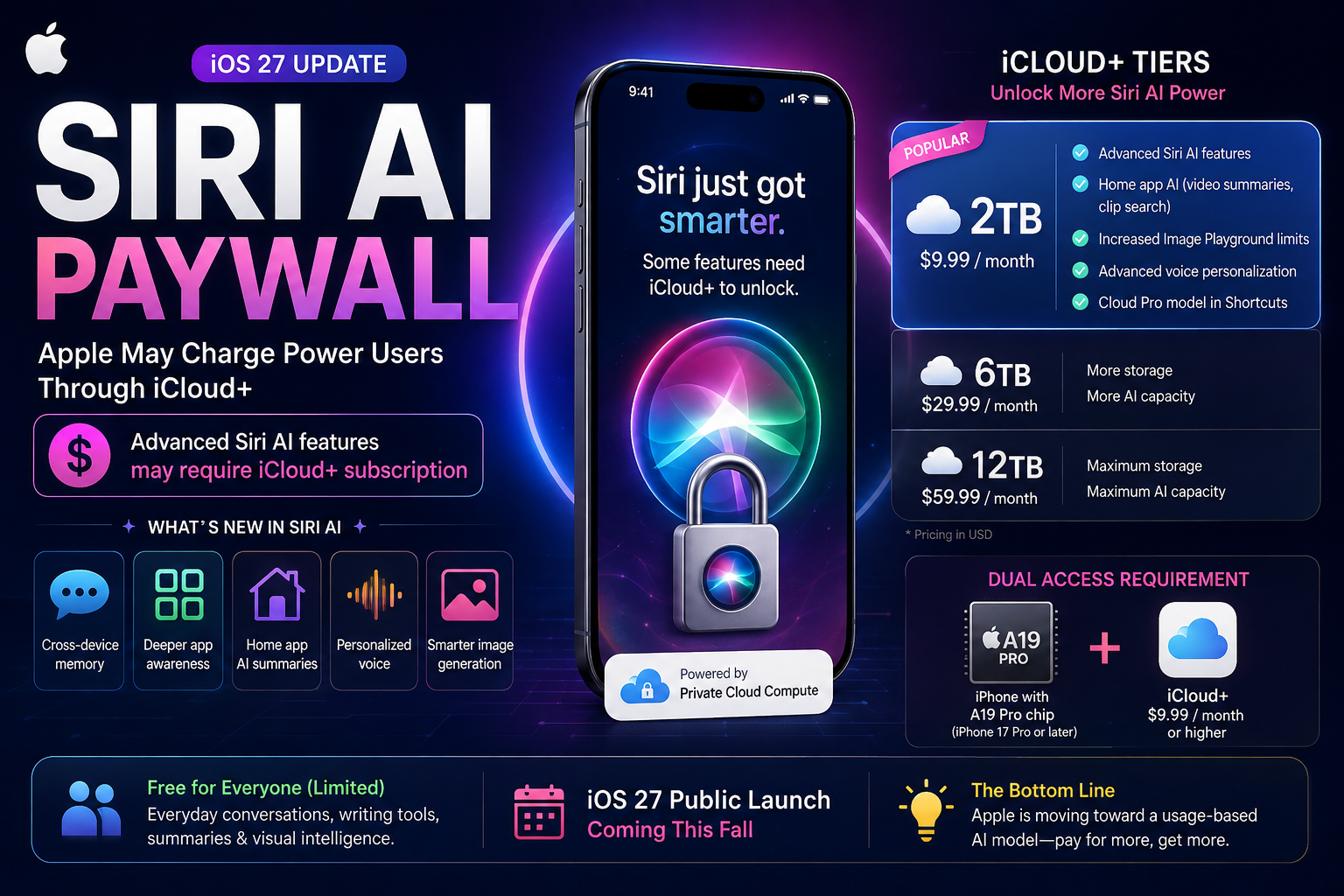
Siri AI Paywall for Power Users: What It Could Mean
Apple has spent years promising a smarter Siri, and now the company may put some of the best features behind a Siri AI paywall. That matters because Siri is no longer just a voice shortcut for timers and weather. If Apple charges for advanced capabilities, you will have to decide whether those features are worth another monthly bill on top of everything else you already pay for. And that choice is getting harder as AI tools spread across phones, laptops, and apps.
Look, this is not just about Siri. It is about Apple deciding where the line sits between basic device help and premium AI assistance. That line could shape how people use the iPhone, how developers build for it, and whether voice assistants finally become useful enough to matter every day. Or does Apple risk turning a useful upgrade into another subscription people ignore?
- Basic Siri may stay free, while advanced AI features could move into a paid tier.
- Apple could tie pricing to higher-end productivity tools, not simple voice commands.
- A paywall may change how often people use Siri for work, travel, and device control.
- Apple’s move could pressure rivals like Google, Amazon, and OpenAI to defend their own pricing.
Why a Siri AI paywall matters now
Apple usually keeps core iPhone features inside the device price. That is part of its pitch. But AI changes the math because the most useful features often depend on cloud compute, model updates, and ongoing engineering costs. Those costs do not vanish after launch. They keep stacking up.
If Apple splits Siri into free and paid tiers, the company is saying advanced AI belongs with software subscriptions, not one-time hardware sales. That would be a real shift for a product that has long lived in the background, quietly doing small tasks. Now Siri is being positioned like a service with tiers, limits, and upsell pressure.
Apple can frame this as premium AI. Users may see it as paying extra for features that should have worked better in the first place.
What a Siri AI paywall could include
Apple has not publicly laid out final pricing or feature bundles. But a likely split is easy to imagine. Free Siri would handle alarms, calls, messages, and basic device control. Paid Siri would handle richer task completion, more contextual responses, deeper app actions, and possibly more personalized assistance across your calendar, email, and documents.
That model looks a bit like a gym membership. The front desk and treadmill stay open to everyone. But the classes, coaching, and nicer machines sit behind the next tier. Apple would probably hope users start free, then upgrade after they hit the limits.
Features that could stay free
- Set reminders and alarms
- Send messages and make calls
- Control music, lights, and simple HomeKit tasks
- Answer basic factual questions
Features that could become paid
- Longer context across apps and conversations
- Advanced summarization of emails, notes, or documents
- Multi-step task execution
- More personalized responses tied to your data
That split would make sense from a product standpoint. But people do not judge AI tiers by logic alone. They judge them by friction.
How a Siri AI paywall changes your daily use
If you use Siri only for simple chores, a paywall may not matter. But if you want Siri to act more like an assistant and less like a speakerphone with a brain, the pressure rises fast. The moment Apple asks for money, you start comparing it with ChatGPT, Gemini, Alexa, and whatever your phone already does for free.
That comparison is where Apple can stumble. Siri has always had a trust problem. It often works well enough to start a task, then loses the thread. If the paid version does not feel sharply better, people will not stick around. Why pay for a promise?
Good AI subscriptions need clear wins. They have to save time in a way you notice on day one. If Siri cannot do that, the paywall becomes a tax on impatience.
What Apple is really testing
This is not only about revenue. Apple is testing whether users will accept AI as a recurring utility. That question matters because the entire industry is moving that way. OpenAI, Google, Microsoft, and others already sell premium access to stronger models or extra features. Apple has mostly stayed on the hardware side of the business. A paid Siri would pull it closer to the subscription crowd.
Apple also gets a nice bit of control. A premium tier lets it meter demand, manage server costs, and separate casual users from heavy users. From Cupertino’s view, that is tidy. From your view, it may look like one more subscription trying to slip into your monthly budget.
What you should watch before you upgrade
- What exactly is behind the paywall? Broad language is a red flag. You need named features, not marketing fog.
- Does Siri save time in real tasks? Try it with email, messages, scheduling, and cross-app requests.
- Is the price lower than competing AI tools? If not, the value case gets shaky fast.
- Does it work reliably? One bad answer can wipe out the appeal of a subscription.
Apple has the brand to make people try a paid tier. That part is easy. The hard part is keeping them there. People forgive a lot when software feels magic. They forgive less when they are billed for half-baked help.
The real risk for Apple
The danger is simple. Apple could turn Siri into a premium product before it becomes a dependable one. That would repeat an old tech mistake: charging for potential instead of value. And users have seen enough of that from the rest of the industry.
Still, Apple has one advantage that rivals do not. It controls the phone, the operating system, and many of the apps people use every day. If it gets the integration right, Siri could feel less like a chatbot and more like a built-in operator. But the execution has to be sharp. Really sharp.
Apple does not need Siri to sound smart. It needs Siri to finish the job.
Where this could go next
The next Apple move will tell you a lot. If the company bundles premium Siri into a larger AI plan, expect a familiar Apple playbook, a polished pitch, a clean subscription page, and a lot of pressure to upgrade. If it keeps advanced Siri features free for too long, that may mean Apple is still sorting out the economics behind the scenes.
Either way, the bigger question is not whether Apple can charge for AI. It can. The real question is whether Siri finally becomes useful enough to justify the bill. That is the line to watch, and Apple knows it.


