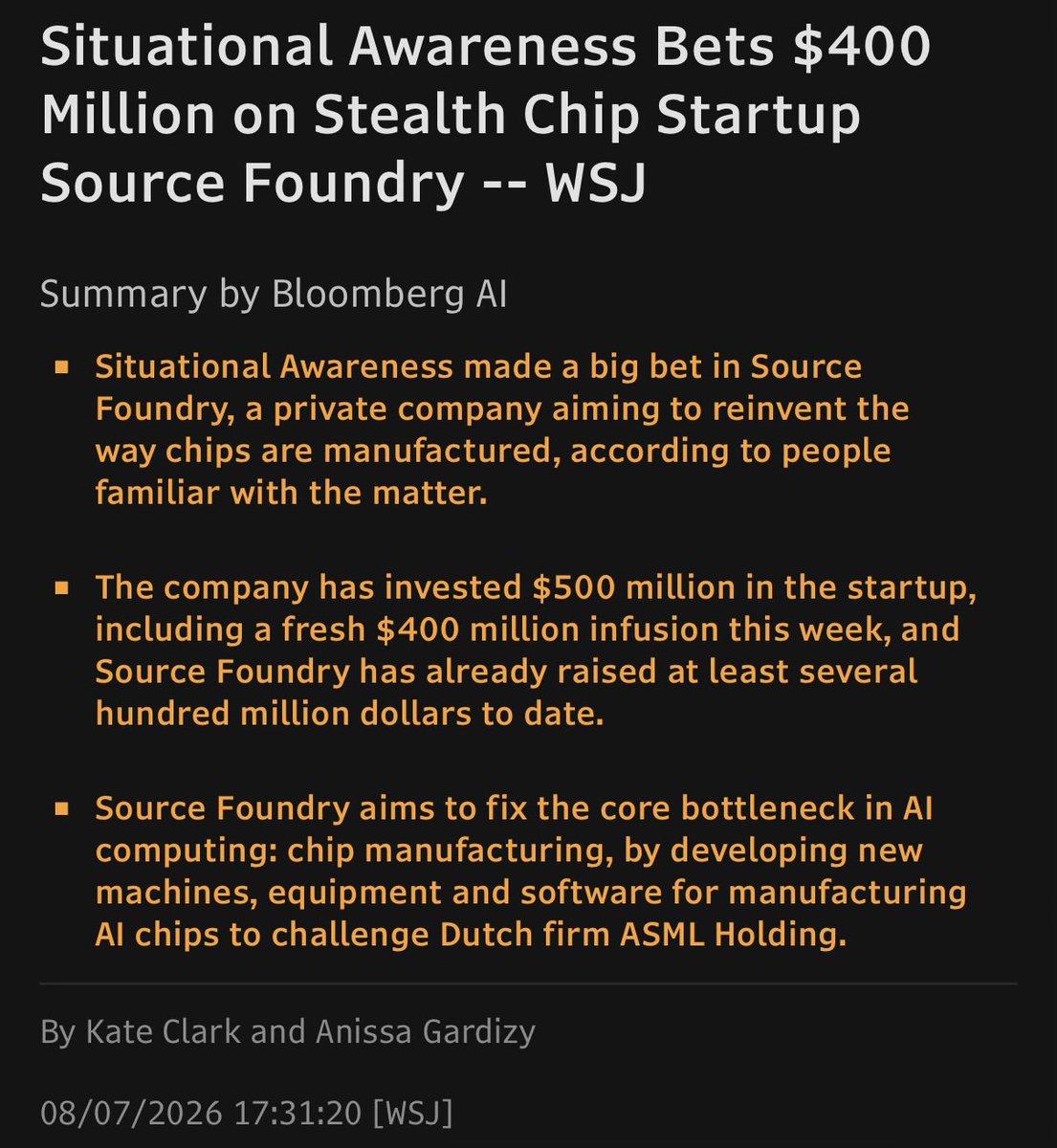
Situational Awareness Puts $400M Into Source Foundry
Chip startups are getting money again, and that changes the stakes for everyone watching the sector. Source Foundry investment from the embattled hedge fund Situational Awareness is the kind of move that can reset expectations fast, especially when the check is as large as $400 million. For founders, it signals that capital is still available for hardware plays if the story is big enough. For investors, it raises a sharper question. Is this a smart bet on compute demand, or another heat-seeking round chasing the latest chip narrative? The answer matters because chip funding is slow, expensive, and unforgiving. Miss the timing, and the burn rate eats you alive.
What the Source Foundry investment tells us
- The round size is a signal. $400 million is not seed money. It suggests serious manufacturing, talent, or supply chain ambitions.
- Chip deals are back in favor. Investors keep chasing companies tied to AI infrastructure, accelerators, and packaging.
- Risk appetite is uneven. A hedge fund making a large startup bet can look bold, but it can also reflect strain and search for outsized returns.
- Execution still rules. In semiconductors, product timelines and fabrication partners matter more than pitch decks.
Why does a hedge fund matter here?
Hedge funds are not the usual lead voices in semiconductor venture rounds. They can bring speed and size, but they also bring pressure. That makes the Source Foundry investment worth a second look, because the backer matters almost as much as the startup.
Look, money from a fund under stress can cut two ways. It can mean conviction. It can also mean the fund is hunting for a breakout before public markets or other asset classes force it to regroup. Which one is it here? You should ask that every time a nontraditional investor writes a giant check into chips.
Big capital does not fix bad timing. In semiconductors, a funding round can look impressive on paper and still fail if the product misses its window or the supply chain slips.
What Source Foundry likely has to prove
Any chip startup taking this kind of money has to show more than slides. It needs evidence that the design works, that the manufacturing path is real, and that customers will pay for the performance.
- Technical proof. Does the chip meet its target on power, speed, and cost?
- Foundry access. Can the company get wafer capacity at a node that makes sense?
- Customer pull. Are there named buyers, not vague interest?
- Unit economics. Can the business survive long enough to ship at scale?
That list sounds basic. It is not. Chip startups fail on one of these steps all the time, even after a headline-grabbing round.
How this fits the broader chip funding cycle
The chip sector always lures capital when demand spikes for a new workload. Right now, AI keeps pulling investors toward data center silicon, networking gear, and specialized accelerators. That creates a crowded field, and crowded fields punish weak differentiation.
Think of it like building a stadium. You can pour concrete fast, but if the foundation is off by an inch, the whole structure becomes a problem later. Chip investing works the same way. The money arrives early, but the costs and failures show up later, often when there is no easy exit.
Source Foundry investment and the real test ahead
The next few quarters will matter more than the announcement itself. If Source Foundry can turn this capital into taped-out silicon, customer trials, and a credible production plan, the deal starts to look disciplined. If not, it becomes another oversized bet in a market that keeps rewarding ambition and then punishing delay.
And that is the real story here. Not the size of the check. The discipline behind it. If you are watching chip startups, the better question is simple: who can still turn money into actual silicon, and who is just buying time?
Watch the milestones, not the headlines. The market will tell you soon enough whether this was foresight or desperation.