SpaceX IPO Risk Factor: What xAI Means for Investors
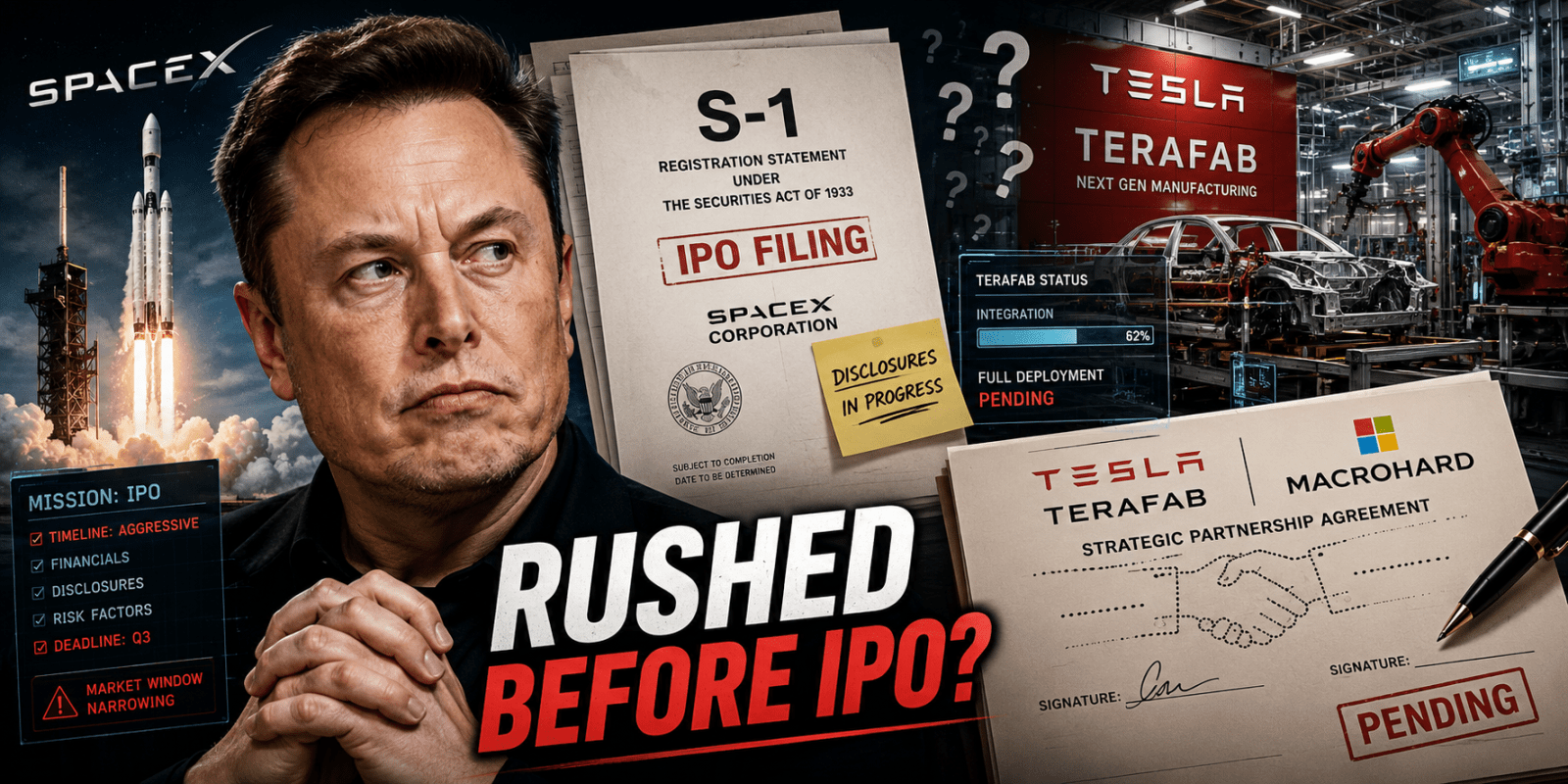
If you are watching for a SpaceX IPO, you probably want more than hype. You want to know what could actually affect valuation, governance, and long-term risk. That matters right now because a reported new risk factor tied to Elon Musk’s AI company, xAI, hints at the kind of disclosure investors may face if SpaceX ever goes public. It is not a small side issue. Musk runs multiple companies that share talent, attention, and sometimes strategic priorities. For public market investors, that overlap can become a real pricing question. The latest reporting from The Verge points to a familiar concern around Musk-led businesses. Who gets the best engineers, the strongest focus, and the most valuable deals when several companies sit inside the same orbit?
What stands out
- The reported SpaceX IPO risk factor centers on xAI, not just rockets or launch revenue.
- Investors should pay close attention to related-party conflicts, especially across Musk-controlled companies.
- Governance may matter as much as growth if SpaceX ever files publicly.
- This is a preview of likely investor questions around management focus, resource sharing, and disclosure quality.
Why the SpaceX IPO risk factor matters
The Verge reported that SpaceX added a risk factor tied to xAI in documents connected to a tender offer. That is notable because private companies usually reveal far less than public ones, and SpaceX has long operated with limited outside visibility compared with a listed company. So when a new risk factor appears, it is worth reading closely.
Here is the core issue. Elon Musk controls or heavily influences several companies at once, including SpaceX, Tesla, X, Neuralink, and xAI. That creates obvious conflict questions. If one AI engineer can work at only one company, who decides where that person goes? If computing resources, supplier access, or business partnerships are limited, which company gets first call?
For investors, the real story is not whether Musk can run many companies. It is whether the rules for dividing time, talent, and opportunity are clear enough to price the risk.
Public investors have seen versions of this before with Tesla. Musk’s acquisition of Twitter, now X, raised repeated questions about distraction and capital allocation. His launch of xAI added another layer because AI talent and compute are scarce, expensive, and strategically valuable.
That changes the frame around any future SpaceX IPO.
How xAI could affect a future SpaceX IPO
A lot of SpaceX bull cases lean on two things. First, the launch business. Second, the much larger promise of Starlink. Both depend on execution, engineering depth, and management attention. If xAI becomes a magnet for the same scarce resources, that can affect how investors model SpaceX.
1. Competition for top technical talent
AI hiring is brutal right now. Meta, OpenAI, Google, Anthropic, and xAI are all fighting for a small pool of elite researchers and infrastructure engineers. SpaceX is not an AI lab, but modern aerospace and satellite systems rely on software, autonomy, and data-heavy operations. Some of the same rare technical people can fit more than one Musk company.
Think of it like a football club trying to win multiple tournaments with one shallow bench. You can field stars in every match, but the strain shows up somewhere.
2. Management bandwidth
Musk’s time is finite. That sounds obvious, yet investors often underprice it during strong markets. If xAI demands more of his attention because of fundraising, product launches, data center buildout, or regulation, that may leave less direct oversight for SpaceX. And yes, SpaceX has a deep executive team, but founder involvement still carries weight in private market pricing.
3. Intercompany relationships and deal flow
If SpaceX and xAI work together in any formal way, investors will want details. Are there shared services? Shared infrastructure? Cross-investments? Preferential commercial terms? None of those are automatically bad. But they need clean disclosure and governance guardrails.
Honestly, this is where markets get twitchy. Not because related-party arrangements are rare, but because weak disclosure can make even ordinary arrangements look messy.
What investors should ask before any SpaceX IPO
If SpaceX ever files publicly, smart investors should move past the usual headline metrics like revenue growth and launch cadence. Start with the boring stuff. The boring stuff often decides the multiple.
- How are conflicts of interest defined? Look for explicit policies on opportunity allocation, hiring overlap, and shared vendor relationships.
- Who sits on the board, and how independent are they? Independence matters most when the founder controls several adjacent companies.
- Are there formal agreements with xAI, Tesla, or X? If so, investors need terms, pricing logic, and approval processes.
- How much of SpaceX depends on Musk personally? A stronger bench lowers key-person risk.
- What does the risk disclosure actually say? Boilerplate is common. Specific language is more useful.
SpaceX IPO risk factor and the bigger governance picture
Plenty of investors will still line up for a SpaceX IPO. That is rational. SpaceX remains one of the most important private companies in the world, with a dominant launch position and a satellite internet business that could support huge long-term cash flow. But market demand does not erase governance risk.
Look, founder-led companies often outperform for stretches because they move fast and ignore bureaucracy. That edge is real. The catch is that public investors usually get less tolerance for ambiguity once the numbers get big enough and the web of related entities gets denser.
And Musk’s web is dense.
That is why this xAI-linked disclosure matters beyond one filing detail. It signals that even inside SpaceX’s private documentation, conflict risk is serious enough to name. For investors, that is not a red flag by itself. It is a prompt to ask harder questions early.
What The Verge report suggests about timing and transparency
The Verge article does not mean a SpaceX IPO is imminent. SpaceX has strong private-market access and little obvious need to rush into public markets. In fact, staying private gives management more room and fewer mandatory disclosures. That has been a strategic advantage.
But if SpaceX eventually wants broader liquidity, index inclusion, or a wider capital base, transparency standards will change fast. Public filings force a company to explain risk in a way private markets sometimes tolerate only loosely. That process can expose soft spots in governance, especially around overlapping ownership and executive control.
Would public investors accept that tradeoff anyway? Probably, if growth stays strong and disclosures are clear enough.
If you are tracking a future SpaceX IPO
Do not get distracted by the spectacle. Watch the paperwork, the board structure, and the language around xAI and other Musk companies. Those details may tell you more about future shareholder risk than another headline about valuation.
- Track tender offer disclosures and any updated risk language.
- Watch whether SpaceX formalizes conflict policies.
- Compare governance standards with Tesla’s history and market reaction.
- Pay attention to executive bench strength, not just Musk’s public profile.
The next big SpaceX story may not be about rockets at all. It may be about whether investors think the company’s rules are solid enough to handle Elon Musk’s expanding empire.