AI Data Centers and Water Use: What the Numbers Say
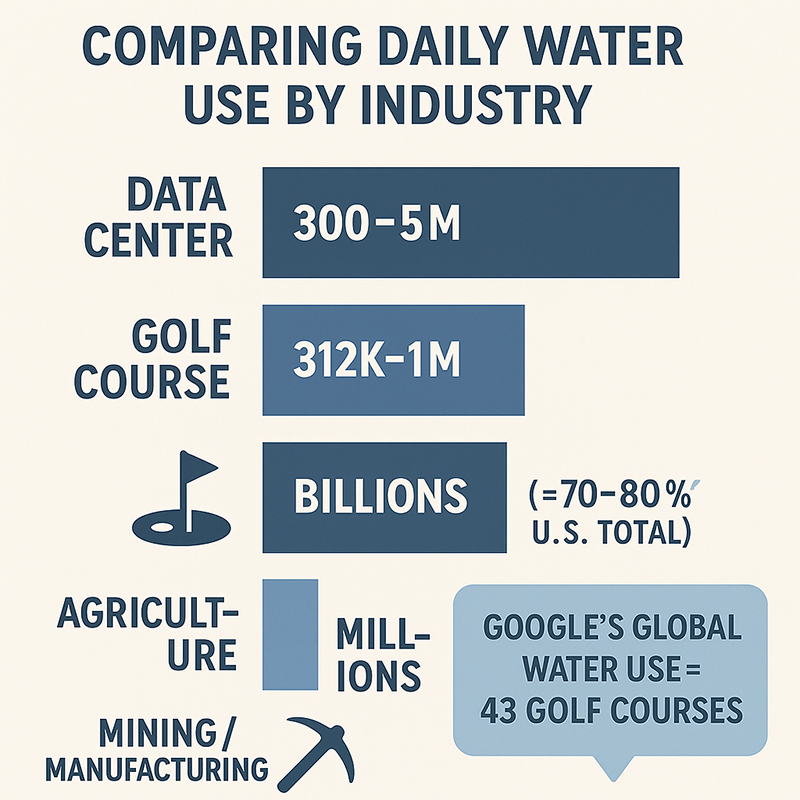
AI data center water use has become a favorite talking point, and for good reason. Cooling big server halls takes water, electricity, and planning, so the concern is real. But the debate often skips the basic question that matters most: how much water are we actually talking about, compared with other uses in the same region?
That context matters now because local water stress is already a problem in many places, from Phoenix to parts of northern Virginia. If you only look at a single facility, you can miss the bigger picture. If you only look at national totals, you can miss the local pain. Both views matter. The hard part is holding them together without slipping into hype or panic.
What stands out about AI data center water use
- The scale is real, but uneven. Some facilities use little water on site. Others use a lot, depending on cooling design and climate.
- Local impact matters more than national averages. A small share of total water use can still strain a specific watershed.
- Cooling method changes the math. Air cooling, evaporative cooling, and liquid cooling do not have the same footprint.
- Energy and water are linked. A facility that saves water may use more power, and the tradeoff is not trivial.
- Policy needs better reporting. Without disclosure, you are guessing.
How AI data center water use actually works
Data centers use water mostly for cooling. Servers generate heat, and heat has to go somewhere. If a site uses evaporative cooling, it can consume water directly. If it uses chillers or other systems, water use may shift to another part of the process or move off site through electricity generation.
Here is the thing. A facility is not a standalone machine. It sits inside a utility grid, a local water system, and a climate zone. That makes comparisons messy. A server hall in a dry county has a very different impact from one in a cooler region with different infrastructure.
The cleanest way to judge AI data center water use is not by the biggest scary number, but by the local context around that number.
Why headlines can mislead you
Water numbers are easy to weaponize. One side points to huge projected demand and says AI is draining the planet. The other side says data centers are a rounding error and shrugs off the issue. Both positions can be wrong at the same time.
Think of it like restaurant traffic on a busy street. One new diner may not change citywide congestion, but it can still jam a narrow intersection at dinner hour. Water use works the same way. The overall share can be small while the local pressure is sharp.
That is why simple national comparisons are not enough. A report from one region, one utility district, or one basin can show a real stress point even if the broader country barely notices it.
What the better questions look like
- Where is the facility? Dry regions face different risks than humid ones.
- What cooling system does it use? Air cooling, closed-loop liquid cooling, and evaporative systems have different footprints.
- How is water measured? Look for direct on-site use, not vague estimates.
- What is the local water supply like? A site on a stressed aquifer deserves more scrutiny.
- What is the tradeoff with power? Less water can mean more electricity, and that can shift the burden elsewhere.
Why disclosure is the missing piece
Public debate gets muddy fast when operators do not publish clear numbers. Some companies report water use, but the metrics are not always comparable. Others disclose little or nothing. That makes it hard for cities, regulators, and residents to judge whether a project is a net benefit or a bad bargain.
Better reporting would help a lot. Not perfect reporting. Just enough to compare sites on the same basis and see whether promised efficiency gains show up in practice.
What regulators and communities should demand
If you are a policymaker, local planner, or resident reading permit filings, push for three things. First, site-level water data. Second, cooling design details. Third, estimates for peak demand during heat waves, when the system is under the most stress.
That is the practical test. A data center should not ask a drought-prone region to absorb hidden costs while the company points to national averages or broad sustainability pledges. A serious project should explain the tradeoffs in plain language and show the numbers.
And yes, the broader AI boom still needs scrutiny for energy use, land use, and grid strain. But water deserves its own lane. It is a separate constraint with separate local consequences.
What to watch next
The next wave of AI data center water use will likely depend on three things. Cooling innovation, utility rules, and where companies choose to build. If operators keep chasing cheap land without treating water as a hard constraint, the local backlash will get louder. If they publish better data and shift to designs that fit the basin they are in, the debate gets more honest.
So the real question is not whether AI data centers use water. They do. The real question is whether companies can prove they are using it in a way that a stressed community can live with. That is the benchmark now, and it is not going away.