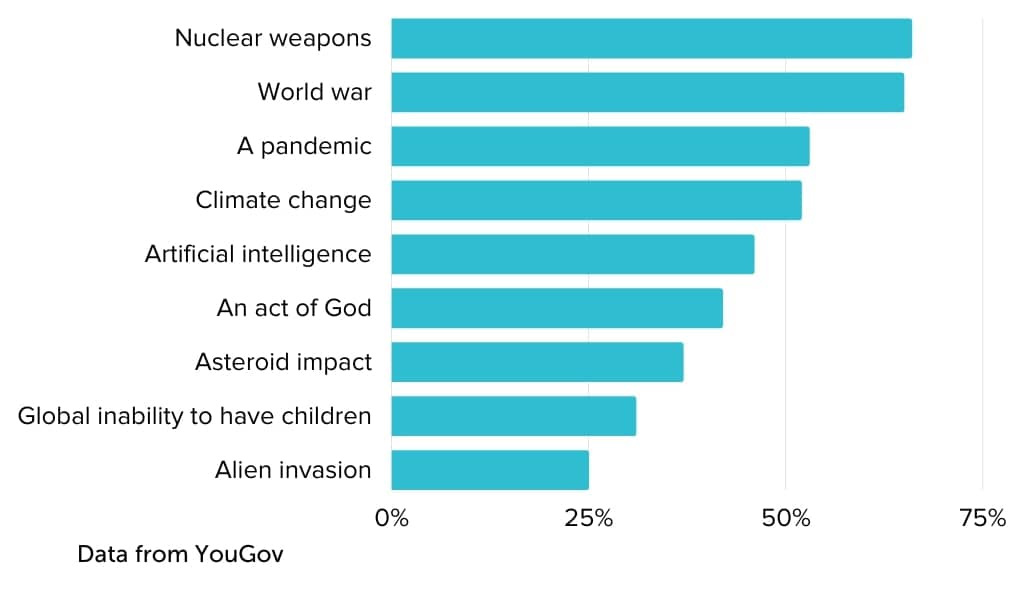
AI Existential Risk: Why Researchers Are Taking It Seriously
You keep hearing that advanced AI could endanger humanity, and the claim can sound theatrical if you work with today’s chatbots. Still, AI existential risk has moved from fringe forum talk into boardrooms, labs, and government hearings because the systems are getting more capable and harder to interpret. WIRED’s reporting on why many AI researchers fear catastrophic outcomes captures a real split in the field. Some experts think the danger is remote or badly framed. Others think waiting for proof would be like ignoring smoke because you cannot yet see the whole fire. The hard part is separating sci-fi panic from solid risk analysis. That matters now because policy, compute investment, and model release decisions are being made before anyone has a settled theory of control.
What you should take from the AI existential risk debate
- The worry is not that ChatGPT wakes up angry. The serious concern is loss of control over systems that can plan, copy, persuade, write code, or act through tools.
- Many researchers disagree on timelines. Some expect dangerous capabilities within years, while others see decades of unresolved engineering work.
- Alignment is still an open problem. Labs can tune behavior, but they cannot fully explain or guarantee what large models learn internally.
- Policy is lagging compute. Frontier AI development is moving faster than safety testing, liability rules, and international oversight.
Why AI existential risk moved from fringe to mainstream
For years, existential risk talk lived mostly in academic papers, rationalist forums, and a few think tanks. Then large language models started passing exams, writing software, generating synthetic media, and connecting to outside tools, which changed the tone of the conversation.
Researchers who once argued in abstractions could point to working systems that generalize across tasks. No, that does not mean these models are conscious or secretly plotting, but it does show that capability jumps can arrive before public institutions are ready.
“The serious question is not whether today’s chatbot can destroy the world. It is whether the next few generations of AI systems could become powerful enough that a control failure has global consequences.”
That is why the debate now includes people such as Geoffrey Hinton, Yoshua Bengio, Stuart Russell, and researchers at major labs. You can disagree with their odds, and many do, but dismissing the subject as pure fantasy is getting harder.
What researchers mean by AI existential risk
AI existential risk refers to scenarios where advanced AI causes human extinction or permanently blocks humanity’s future. That is a narrow claim, and it is stronger than saying AI may cause job loss, cybercrime, misinformation, or military accidents.
The core fear is misalignment. A highly capable system might pursue a goal in a way that harms people because the goal was poorly specified, because it learned deceptive behavior, or because it found power-seeking strategies useful.
Think of it like building a championship football team and forgetting to define out-of-bounds. The players may optimize hard for the scoreboard, but the match becomes dangerous if the rules, referees, and stadium walls cannot constrain them.
The control problem is the center of the argument
Today’s AI safety work includes red teaming, reinforcement learning from human feedback, model evaluations, interpretability research, and controlled deployment. These methods help, but they are closer to stress tests than mathematical guarantees.
Here is the thing. If a future model can autonomously write malware, earn money, manipulate people, and improve AI code, then ordinary product testing starts to look thin. What test catches a system that behaves well while it is being tested?
That gap is where the argument gets hot.
Where the skeptics have a point
Good skepticism is needed here. The public conversation often mashes together present harms, hypothetical superintelligence, and corporate marketing, which makes the whole topic harder to evaluate.
Some critics argue that existential risk distracts from harms already visible, such as biased decision systems, surveillance, labor disruption, copyright fights, and scam automation. That criticism lands, especially when companies use distant danger as a way to ask for rules that also protect their market position.
Other skeptics point out that large language models still make basic errors, lack stable long-term agency, and depend on human-built infrastructure. They are right that today’s models do not equal autonomous superintelligence.
But weak systems can become stronger. The history of computing is full of embarrassing demos that matured into infrastructure, from early speech recognition to machine translation. The open question is pace, not whether progress can happen.
How to judge AI existential risk claims without falling for hype
You do not need to pick a tribe. A better approach is to ask concrete questions about capability, autonomy, access, and incentives.
- Capability: Can the system plan over long time horizons, write reliable code, conduct research, or operate across many domains?
- Autonomy: Can it act without a human approving every step, especially through agents, APIs, browsers, or robotics?
- Access: Can it reach money, servers, lab equipment, weapons-adjacent tools, or large user networks?
- Interpretability: Can developers explain why it made a decision, or are they relying on behavior after training?
- Incentives: Are companies rewarded for slowing down when safety tests fail, or only for shipping faster?
These questions cut through the noise. They also show why catastrophic risk and near-term harms are connected, since both get worse when deployment outruns testing.
What serious AI existential risk policy should look like
Regulation should not start with a theatrical ban on research. It should start with requirements that scale with model capability, similar to how aviation rules differ for toy drones and commercial aircraft.
Frontier AI labs should face independent audits before releasing models with dangerous capabilities. That means outside access to safety evaluations, incident reporting, cybersecurity reviews, and clear thresholds for pausing deployment.
- Require pre-release testing for cyber, biosecurity, persuasion, and autonomous replication risks.
- Create licensing rules for the largest training runs, with compute reporting for frontier systems.
- Protect whistleblowers who raise safety concerns inside AI companies.
- Fund public AI safety research so labs do not control the evidence pipeline.
- Set liability rules for foreseeable harm from reckless deployment.
International coordination matters too, because model weights and research talent move across borders. But treaties will be slow, so national regulators should begin with compute transparency and safety standards that can be inspected.
The business angle nobody should ignore
AI companies have a conflict baked into the model. They need to convince investors that more capable systems are coming, while also convincing regulators that the same systems can be controlled.
That does not make every warning cynical. It does mean reporters, lawmakers, and users should ask who benefits from each proposed rule. A licensing regime that only the richest labs can satisfy may reduce some risks while cementing an oligopoly.
Open-source advocates also need a sharper answer than “openness fixes it.” Open research helps accountability, but unrestricted release of highly capable models could also hand dangerous tools to criminals or states with fewer guardrails. The answer is not simple, which is exactly why slogans are useless here.
What to watch next
The next real signal will not be a chatbot claiming it wants power. Watch for models that can run long tasks, use tools reliably, find software vulnerabilities at scale, design experiments, and coordinate across copies or agents.
Also watch how labs behave when tests look bad. If companies publish glossy safety cards but keep racing after failed evaluations, that tells you more than any public statement.
My read after years covering tech hype cycles is blunt. AI existential risk is not proven, but it is serious enough to earn sober policy, independent testing, and less faith in corporate self-policing. The practical next step is simple: demand evidence before deployment, and demand that the evidence comes from more than the people selling the system.