AI Glossary: Common Terms Explained
You hear AI terms everywhere now, in product demos, earnings calls, school policy fights, and vendor pitches that sound more confident than they should. A clear AI glossary helps you separate useful claims from expensive fog, especially as companies bolt chatbots, agents, and generative tools onto software you already use. If you do not know what a model, token, prompt, or hallucination means, you are negotiating with one eye closed.
The timing matters because AI has moved from lab talk to budget line item. TechCrunch has been tracking the language shift around artificial intelligence, and the pattern is familiar to anyone who covered cloud or crypto. The words arrive first, then the confusion, then the invoices.
What You Need to Know First
- AI is an umbrella term. It covers many methods, from old-school rules to large language models.
- Generative AI creates output. It can write text, make images, produce code, or generate audio based on patterns in data.
- Hallucinations are not bugs in the usual sense. They are false or unsupported outputs that can sound convincing.
- Tokens affect cost and context. They are chunks of text that models process, bill, and remember within a session.
- Agents remain uneven. Some handle narrow tasks well, but broad autonomy still needs guardrails.
AI Glossary Basics: The Terms Buyers Keep Hearing
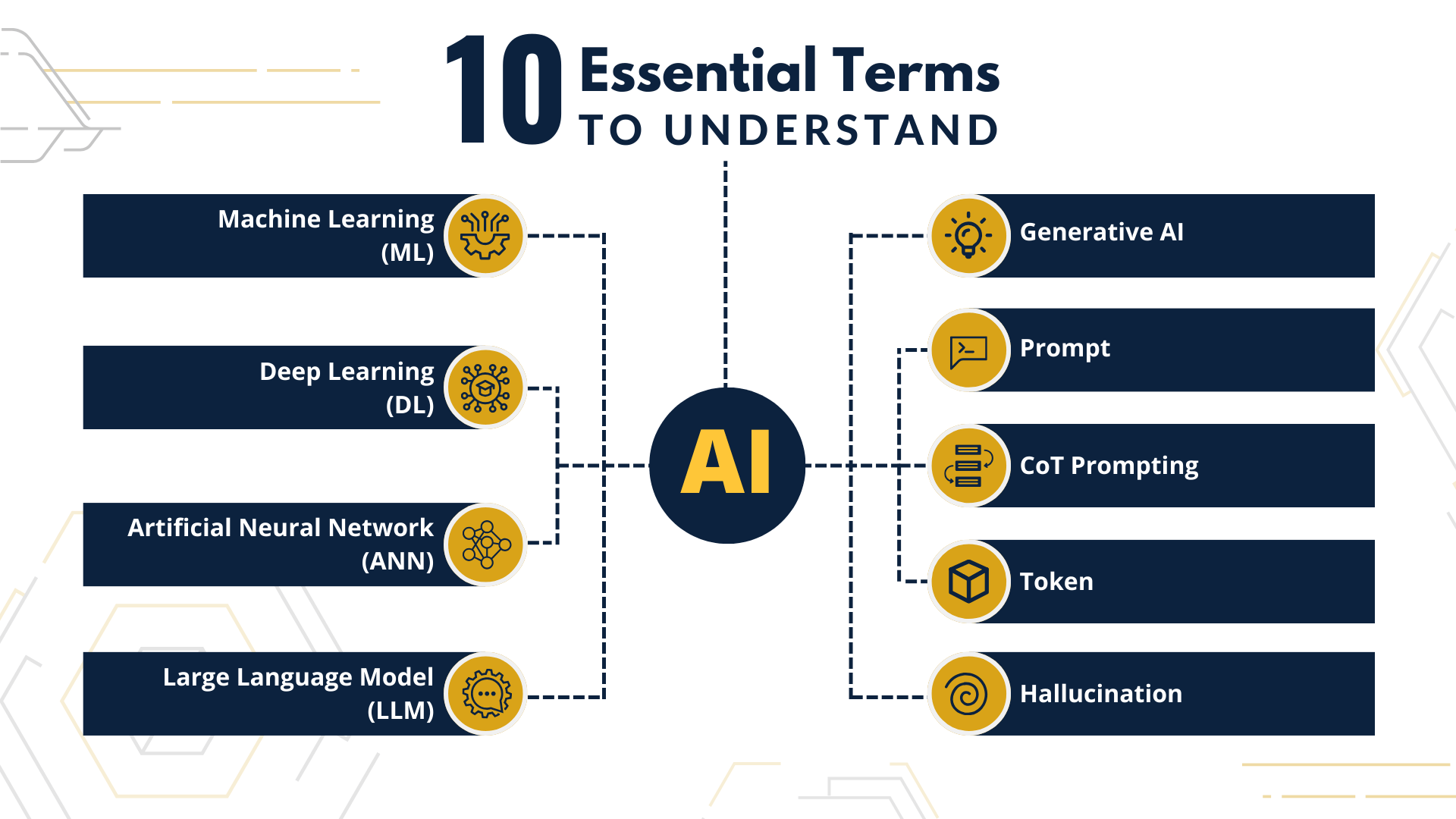
Artificial intelligence means software that performs tasks associated with human reasoning, pattern matching, prediction, or generation. That definition is broad by design, which is why a spam filter, a chess engine, and a chatbot can all sit under the same roof.
Machine learning is a subset of AI where systems learn patterns from data instead of following only hand-written rules. Deep learning is a subset of machine learning that uses layered neural networks, which helped push speech recognition, image classification, and large language models forward.
Generative AI refers to systems that create new material, such as text, images, video, music, code, or synthetic data. The output can look fresh, but the system is still making statistical predictions based on training patterns, user input, and system instructions.
The simplest test is this: if a vendor cannot explain what their AI system does without hiding behind buzzwords, keep asking questions. Clear products can survive plain English.
AI Glossary for Models, Prompts, and Tokens
A model is the trained system that produces predictions or generated output. Think of it like a kitchen recipe that has absorbed millions of examples, except the recipe is made of mathematical weights rather than written steps.
A large language model, or LLM, is trained to process and generate language. OpenAI’s GPT models, Anthropic’s Claude, Google’s Gemini, and Meta’s Llama are well-known examples, though each differs in training data, safety methods, pricing, context size, and product design.
A prompt is the instruction or input you give the model. It can be a simple question, a long brief, a set of examples, or a structured command that tells the system how to respond.
A token is a chunk of text, often part of a word. Tokens matter because they shape three things you will feel fast: cost, speed, and how much information the model can handle at once.
Definitions are product strategy in disguise.
Context window means the amount of information a model can consider in one request or conversation. A larger context window can help with long documents, but it does not guarantee better reasoning, cleaner citations, or perfect recall.
Hallucinations, Grounding, and Why Confidence Can Mislead You
A hallucination is an output that is false, made up, or not supported by the source material. The awkward part is tone: the model may present the answer with courtroom confidence, even when the facts are shaky.
Why does this happen? LLMs predict likely text, and likely text is not the same as verified truth. If the prompt is vague, the training data is thin, or the model lacks access to current records, it may fill gaps with plausible nonsense.
Grounding means connecting the model’s answer to reliable data, such as your company documents, a database, search results, or cited sources. Retrieval-augmented generation, often called RAG, is one common approach: the system fetches relevant material first, then asks the model to answer from it.
Grounding helps, but it is not magic. Bad retrieval can feed the model the wrong material, and a weak prompt can still produce sloppy output from good sources.
Training Data, Fine-Tuning, and Inference
Training data is the material used to teach a model patterns. It may include public web pages, licensed content, code, books, images, transcripts, or internal data, depending on the system and the company behind it.
Fine-tuning adjusts a trained model for a narrower task or style. A support team might fine-tune a model on approved help articles, while a medical company might tune a system for clinical language, though regulated use needs tougher review.
Inference is the moment the model runs and produces an answer. Training is the long, expensive gym session. Inference is game day, where latency, cost, and reliability show up.
Synthetic data is data generated by software rather than directly collected from the real world. It can help fill gaps, protect privacy, or test systems, but low-quality synthetic data can also teach models bad habits.
Agents, Copilots, and Automation Claims
An AI copilot usually assists a human inside a workflow. It may draft emails, summarize meetings, suggest code, or prepare a support response for review.
An AI agent is meant to take steps toward a goal, often by using tools. For example, an agent might read a ticket, check an order system, draft a refund response, and update a CRM record.
That sounds tidy in a demo. In production, the hard parts are permissions, error recovery, audit logs, and knowing when the software should stop and ask a person.
- Define the task boundary. Do not ask an agent to “handle support.” Ask it to classify refund requests under clear rules.
- Limit tool access. Give read-only access first, then expand slowly.
- Log every action. You need a trail when the system changes data or contacts customers.
- Set human review points. Use approval steps for refunds, legal language, medical content, and hiring decisions.
AI Glossary Terms That Matter for Risk
Bias means a system produces unfair or skewed results for certain groups or cases. The cause can sit in training data, design choices, labels, deployment context, or feedback loops after launch.
Explainability is the ability to understand why a system produced a result. This matters in lending, health care, insurance, employment, and other areas where people can be harmed by opaque decisions.
Model drift happens when real-world conditions change and the system’s performance drops. A fraud model trained on last year’s patterns may miss this year’s scam tactics, much like a football defense that keeps studying an old playbook.
Red teaming means testing a system by trying to make it fail. Security researchers, policy teams, and outside experts may probe for unsafe answers, data leakage, prompt injection, bias, or harmful instructions.
How to Use This AI Glossary Before You Buy
Look, most AI pitches sound better before procurement asks dull questions. The dull questions are where the money is saved.
Ask vendors what model they use, what data touches the system, how long prompts and outputs are retained, and whether your data trains future models. Ask for error rates on tasks like yours, not generic benchmark slides.
You should also test with your own messy examples. Clean demos hide the real work: odd customer wording, missing fields, outdated policy documents, conflicting instructions, and edge cases that do not fit the sales script.
- Request sample logs and admin controls before signing.
- Check whether outputs include citations or source links.
- Run a small pilot with a clear success metric.
- Measure time saved after review, not before review.
- Assign an owner for failures, updates, and user feedback.
The Next Term to Watch
The vocabulary will keep shifting because the products are still unsettled. My bet: the next fight will center on “agentic” systems, since that word lets vendors imply autonomy without proving dependable performance.
Keep the glossary close, but do not worship the terms. The practical question stays the same: can the system do the job safely, repeatedly, and at a price that beats the old way?