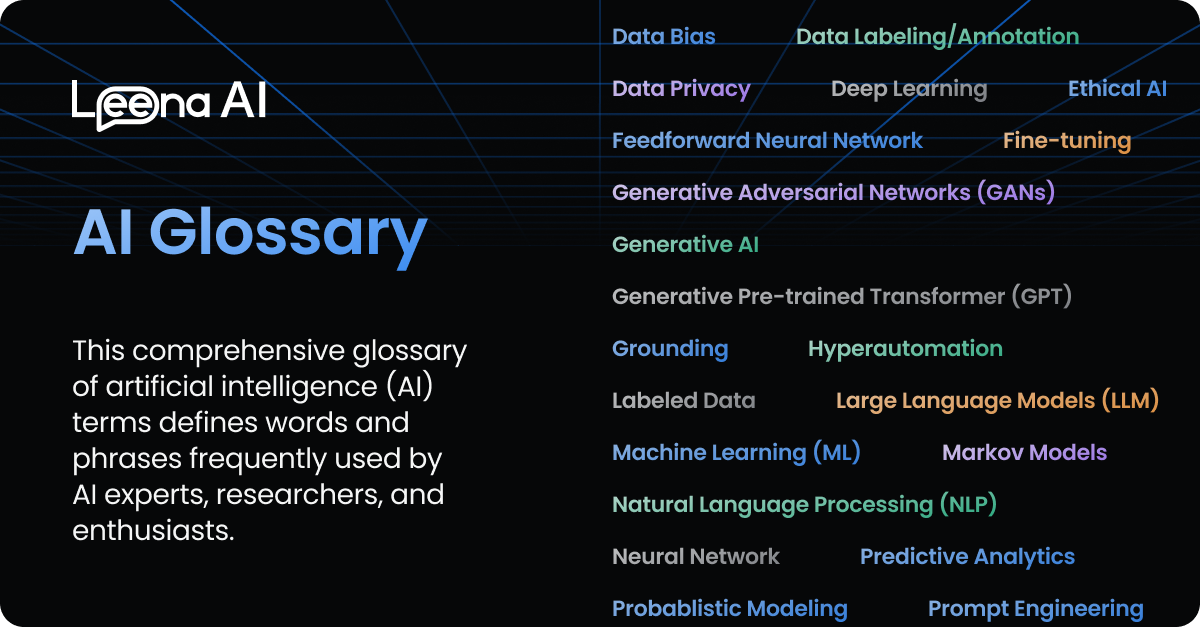
AI Glossary: Common Terms You Need to Know
If you are trying to keep up with AI news, the language can feel slippery. One headline says a chatbot “hallucinates,” another says a model is “multimodal,” and a third promises a “foundation model” that changes everything. That kind of jargon makes it harder to judge what actually matters. This AI glossary gives you the plain-English version, so you can read product claims, understand risks, and ask better questions before you trust the output. Why does that matter now? Because AI is no longer a niche topic. It sits inside search, office software, customer support, coding tools, and more. If you do not understand the terms, you are guessing. And guessing is expensive.
What matters first in this AI glossary
- Hallucinations are wrong or made-up outputs, and they are still a core problem in generative AI.
- LLMs power many chatbots, but they do not “know” facts the way people do.
- Tokens shape cost, speed, and how much text a model can handle.
- Multimodal systems can work with text, images, audio, or video.
- Fine-tuning changes a model for a specific job, often with a smaller dataset.
AI glossary basics: the terms you will see everywhere
Let’s start with the words that show up in almost every product launch. These are the terms that separate useful reporting from pure marketing copy. Think of them like the rules of a sport. If you do not know what counts as a foul, the scoreboard means very little.
Artificial intelligence
Artificial intelligence is the broad term for systems that perform tasks that usually require human judgment. That can mean spotting patterns, making predictions, translating language, or generating text. The phrase covers a lot of ground, which is why vendors use it so loosely.
Machine learning
Machine learning is a subset of AI. It refers to systems that learn patterns from data instead of following only fixed rules. Netflix recommendations, fraud detection, and spam filters all use forms of machine learning.
Generative AI
Generative AI creates new content. That includes text, images, audio, code, and video. It is different from older AI tools that mainly classify or predict. A spellchecker flags errors. A generative model writes a paragraph.
Large language model
Large language model, or LLM, is the engine behind many chatbots. It predicts the next word or token based on patterns learned from huge amounts of text. That sounds simple, but the scale is enormous. And scale matters here.
“A model can sound confident and still be wrong. That is the trap users keep falling into.”
AI glossary on hallucinations, tokens, and training
This is where the hype starts to crack. The most important terms in the AI glossary are the ones that explain why models fail, cost money, or need constant tuning. If you are buying tools or writing policy, this section matters most.
Hallucination
A hallucination happens when a model produces false or unsupported information. It may invent a source, get a date wrong, or state a fact with total confidence. That is not a bug you can ignore. It is a structural issue in systems that predict language rather than verify truth.
Here’s the thing. A model can be useful even if it hallucinates, but only if you know where the error risk sits. Legal summaries, medical advice, and financial guidance need extra checks. Would you trust a calculator that sometimes made up answers?
Token
A token is a chunk of text a model processes. It might be a word, part of a word, or punctuation. Token counts matter because they affect cost, speed, and how much information fits in one prompt or response.
Training data
Training data is the material a model learns from. It can include books, websites, code, images, and licensed datasets. The quality of the training data shapes the quality of the output. Garbage in still leads to garbage out, even if the machine is more polished.
Fine-tuning
Fine-tuning adjusts a pretrained model for a specific task. A company might fine-tune a model on customer support logs, legal documents, or internal jargon. This can improve results, but it does not erase the limits of the base model.
How AI glossary terms change product decisions
Glossary words are not trivia. They affect how you buy tools, set expectations, and assess risk. A vendor calling something “AI-powered” tells you almost nothing. You need to know what model is inside, what data it uses, and how often it gets things wrong.
- Ask about the model. Is it an LLM, a smaller classifier, or a workflow wrapped in AI branding?
- Check the output limits. Does it handle only text, or can it process images and audio too?
- Look for verification. Does the system cite sources or just produce fluent text?
- Measure the failure mode. A tool that hallucinates 1 percent of the time may still be risky in the wrong job.
That is the real test. Not whether the demo looks slick. Whether the system helps you do better work without slipping quietly off the rails.
AI glossary: a few more terms worth knowing
Some terms are less common, but they show up often enough that you should recognize them. These are the ones that often confuse nontechnical readers.
Multimodal
Multimodal systems can process more than one type of input or output. For example, a model may read text, analyze an image, and generate a caption. This is useful in search, accessibility tools, and document analysis.
Prompt
A prompt is the instruction or question you give a model. Good prompts are specific. They set the task, the tone, and the limits. Bad prompts invite vague answers.
Embedding
Embedding is a way to turn words, images, or other data into numerical form so a model can compare them. Search tools often use embeddings to find similar content faster than old keyword matching methods.
Model weight
Model weights are the internal parameters a model learns during training. They shape how the system responds. You do not usually see them, but they are the reason one model behaves differently from another.
Look at the terms, and the pattern is obvious. The best AI products are rarely magic. They are systems with tradeoffs, limits, and failure modes.
Reading AI claims without getting played
Do not let the vocabulary do the thinking for you. When a company says its tool is “autonomous,” ask what it actually does without human review. When it says “accurate,” ask for the benchmark, the dataset, and the error rate. When it says “real-time,” ask how much delay you should expect under load.
That habit pays off fast. It helps you spot inflated claims before they turn into a budget problem or a compliance headache. It also helps you separate tools that solve a real job from those that merely sound advanced.
What to remember next time you read an AI headline
The smartest move is simple. Learn the vocabulary, then test every claim against a real use case. If a product depends on hallucination-prone output, slow review, or expensive token usage, that changes the whole decision.
Use this AI glossary as a filter. The next time a launch post throws around terms like LLM, multimodal, or fine-tuning, you will know what is real and what is just polish. And if the pitch still sounds too smooth, ask the basic question everyone should ask: what happens when the model gets it wrong?