AI Hallucinations Definition: Plain-Language Glossary for Teams
Your team keeps arguing about what counts as an AI hallucination, and every sprint slows to a crawl. You need a fast, clear glossary that nails the basics so product, engineering, and legal stay aligned. Here it is: a concise breakdown of AI hallucinations definition, why the term matters for product risk, and the related language you must use with precision. Misaligned vocab drags down QA, fuels misreported metrics, and confuses customers. This guide leans on real-world examples instead of jargon and packs in enough nuance to brief stakeholders who are still catching up. Expect practical cues, not hype.
Quick Hits You Can Act On
- Define AI hallucinations definition the same way across product, trust, and comms.
- Separate model errors from data errors to debug faster.
- Track hallucination rates with human review before automating alerts.
- Use rejection strategies that match your model and latency budget.
AI Hallucinations Definition: Why Precision Matters
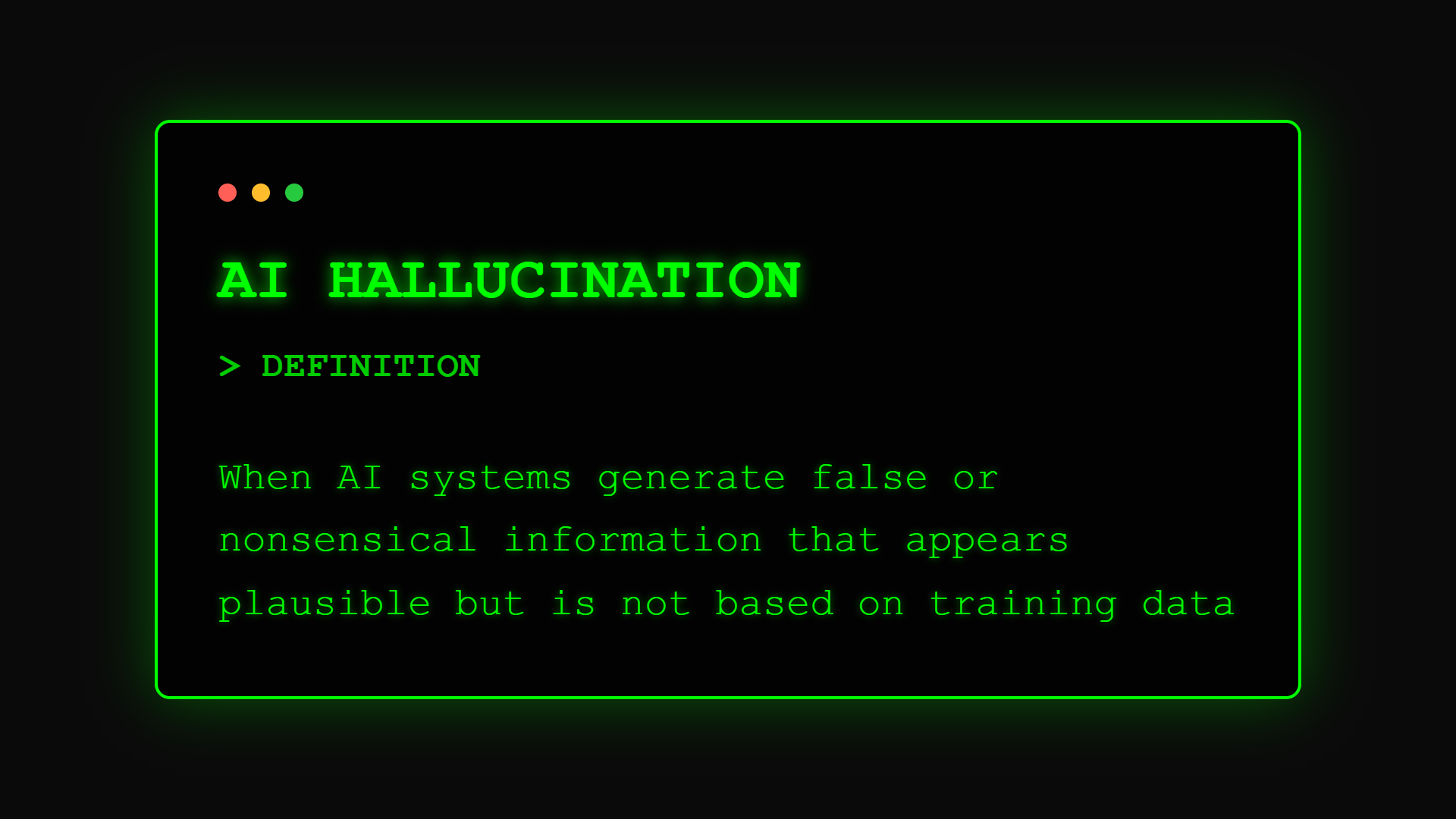
An AI hallucination is a fabricated output that appears plausible but is not grounded in the model’s input or training facts. Think of a chatbot inventing a citation, or a vision system naming a non-existent object. If you blur this term with plain prediction error, your incident reports lose clarity and fixes stall. Legal teams care because fabricated claims can cross into misleading advertising. Product teams care because wrong answers tank trust faster than slow answers.
Mislabel a term and your team ships the wrong fix.
I have seen teams debate for hours whether a wrong answer was “creative” or a hallucination. The delay hurt more than the bug.
Analogy Check
Treat a hallucinating model like a quarterback forcing throws into double coverage. The play might look confident, but the turnover risk is obvious once you name the mistake.
Diagnosing AI Hallucinations Definition Issues
Start with data lineage. If the model invents a fact not present in the retrieved documents or prompt, log it as a hallucination. If the training data itself is wrong, log it as data contamination instead. That split keeps root-cause analysis clean. Ask a simple question: could a reasonable model have produced this based on the provided context? If not, flag it.
- Collect user transcripts with consent and redact PII.
- Label a small set by hand to calibrate reviewers.
- Measure hallucination rate per feature, not just globally.
- Review examples with engineers weekly to spot pattern drift.
Containing AI Hallucinations Definition in Production
Guardrails work best when layered. Retrieval-augmented generation reduces hallucinations by grounding answers in curated sources. Response validation can reject outputs lacking citations. Instruction tuning on rejection examples teaches the model to say “I don’t know” rather than invent. But you cannot bolt on every control without blowing up latency. Pick controls that match the stakes of your feature.
Here is the thing: a human-in-the-loop review step for high-risk flows still beats an unchecked automation loop.
Practical Filters
- Content filters: Block unsafe topics before generation to limit edge cases.
- Fact checks: Compare model claims against trusted knowledge bases.
- Structured prompts: Force the model to answer only from retrieved snippets.
Communicating AI Hallucinations Definition to Stakeholders
Executives want a plain score. Offer a weekly hallucination rate with top three root causes. Customer support needs ready-made language: “The assistant produced an unsupported answer; we are correcting the source.” Engineers need full traceability with prompts, retrieved docs, and model version. Aligning on terms keeps everyone accountable.
Why trust this glossary? Because teams that document definitions reduce postmortem thrash. That is the real win.
What to Build Next
Set a service-level target for hallucination rate before you scale. Draft a playbook that says who reviews incidents, how often you retrain, and when you roll back. Consider adding a lightweight eval harness that samples live traffic and checks responses against reference answers. And ask yourself: are you ready to pause a launch if hallucination rates spike?