AI Startup Defensibility When OpenAI Ships Your Roadmap
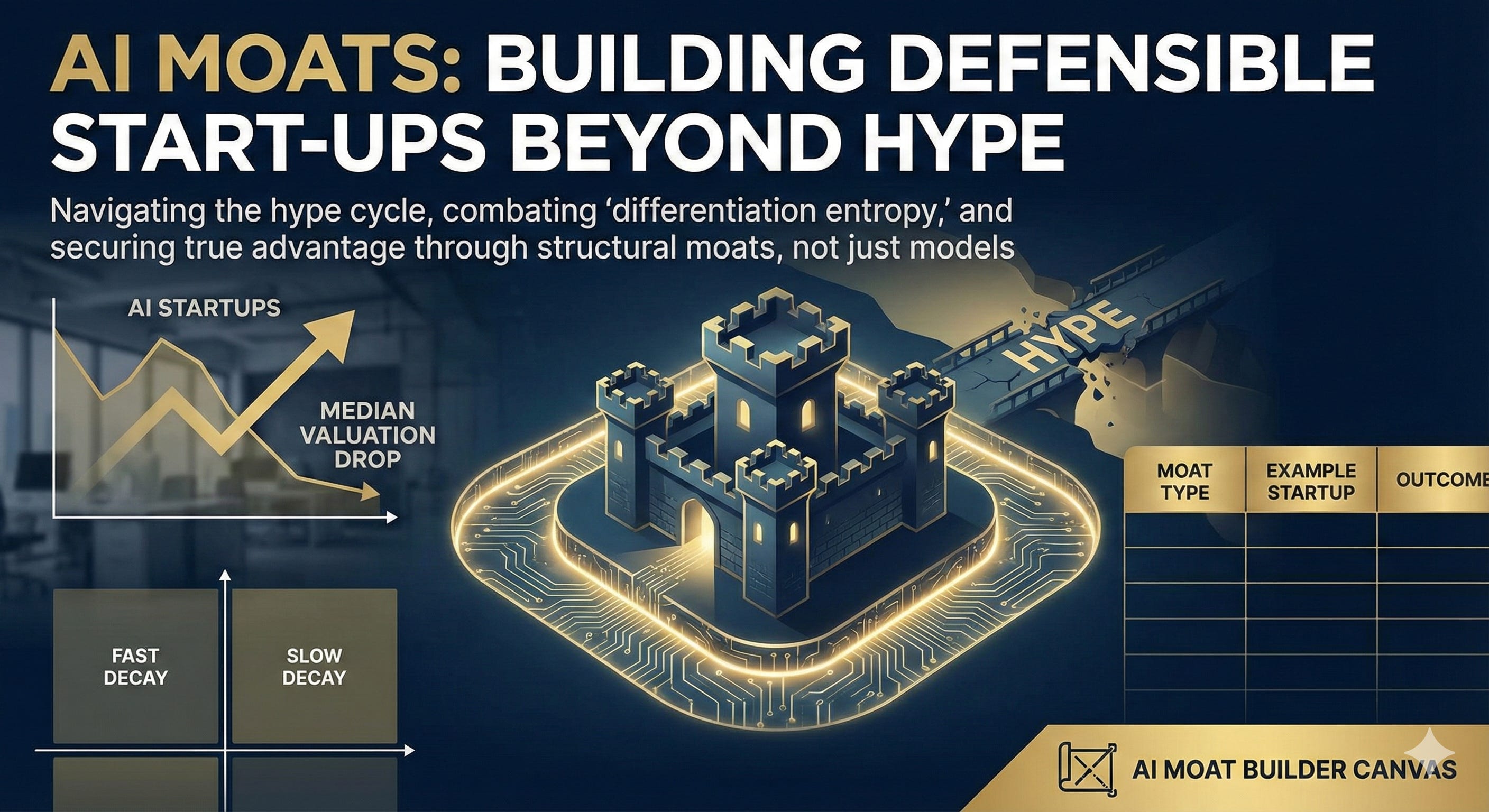
Your AI startup can be moving fast, winning users, and still wake up to a platform update that looks a lot like your product. That is why AI startup defensibility has become the boardroom question founders cannot dodge. According to TechCrunch, Disrupt 2026 will host a session built around a blunt prompt: what happens when OpenAI ships your roadmap? It is the right question. The AI market has shifted from model access to product survival, and the old answer, move faster, now feels thin. If a frontier lab can fold your best feature into ChatGPT, Microsoft Copilot, or an API release, what are you really building? The answer is rarely one thing. It is data, workflow control, distribution, trust, and boring operational depth. Boring, in this market, may be the highest compliment.
What founders should take from the Disrupt debate
- Feature wrappers are exposed. If your product is a thin UI over a frontier model, platform risk is high.
- Workflow ownership matters. Products tied to daily business tasks have more staying power than clever demos.
- Private data can help. But only if it improves outcomes and is hard for rivals to collect legally or cheaply.
- Distribution is defense. The best model does not always win. The product closest to the buyer often does.
- Speed still matters. But speed without a moat is just running on a treadmill.
Why AI startup defensibility got harder
The platform companies are no longer waiting. OpenAI, Anthropic, Google, Meta, Microsoft, and Amazon are adding product layers on top of their models because customers keep asking for complete tools, not raw intelligence. That puts startups in a tight spot.
A year ago, a polished chatbot for sales notes, legal summaries, or customer support triage could feel fresh. Now those functions are turning into settings, plugins, or default features inside bigger platforms. What looked like a company can become a menu item.
The uncomfortable truth is simple. If your roadmap can be guessed from a frontier model demo, you may be building the platform team’s backlog.
That does not mean AI startups are doomed. It means the cheap playbook is dead. I have covered enough platform shifts to know the pattern: the first wave sells access, the second wave sells convenience, and the durable companies sell a better way to work.
The OpenAI roadmap problem
OpenAI has a unique gravitational pull because it sits close to developers, consumers, and enterprise buyers at the same time. A startup may use OpenAI’s API, compete with ChatGPT, and pitch customers who already buy Microsoft tools tied to OpenAI models. That is an awkward triangle.
What happens if OpenAI adds long-term memory, native agents, spreadsheet skills, voice workflows, or domain-specific templates? Many startups in those lanes will need to explain why they still deserve budget. And no, a nicer interface is not enough for most buyers.
That is the hard part.
Look, the right analogy is not chess. It is restaurant supply. If a giant food distributor starts selling prepared sauces, a small restaurant cannot survive by bottling the same sauce with a prettier label. It needs a local reputation, a distinct menu, faster service, better sourcing, or a loyal crowd that returns every Friday.
How to improve AI startup defensibility now
Founders should stop asking whether OpenAI can copy a feature. Assume it can. The better question is whether OpenAI would want to copy the messy parts that make the product work in the real world.
- Own a painful workflow. Pick a job with many steps, approvals, exceptions, and handoffs. The messier the workflow, the harder it is to flatten into a generic assistant.
- Build around proprietary context. Customer data, usage history, domain feedback, and expert corrections can widen the gap over time.
- Win a narrow buyer first. A product for oncology trial coordinators, freight claims teams, or municipal permitting offices can beat a broad AI assistant because it speaks the buyer’s language.
- Integrate where work already happens. Email, CRM, ERP, ticketing, design tools, and databases are not glamorous. They are sticky.
- Prove ROI in plain numbers. Show time saved, tickets resolved, revenue recovered, risk reduced, or headcount avoided. Vague productivity claims will not carry you through procurement.
The best AI startup defensibility often looks unsexy from the outside. It is permissions, audit logs, latency fixes, exception handling, customer onboarding, compliance reviews, and support teams that know the domain. Platform labs can ship features quickly, but they do not always want to handle every industry’s plumbing.
Data is not a moat by default
Investors love hearing that a startup has proprietary data. The phrase sounds strong, but it can hide weak thinking. Data is only defensive if it is exclusive, useful, clean enough to improve the product, and tied to a feedback loop competitors cannot copy overnight.
A pile of transcripts is not a moat. A living system that learns which recommendations doctors accept, which contract clauses lawyers rewrite, or which alerts security analysts ignore is much stronger. The difference is active learning from real usage (with proper consent and governance), not passive storage.
Distribution may beat model quality
The old software lesson still applies. The product with the best distribution often beats the product with the neatest technology. Microsoft proved this for decades, and AI will not repeal that rule.
If your startup sells into enterprises, your enemy may not be a better model. It may be the bundled tool that is already approved by IT, already covered by procurement, and already sitting inside the customer’s workflow. That is why partnerships, channel sales, compliance posture, and buyer education matter so much.
Can a startup still break through? Yes, but it needs a wedge sharp enough to make switching worth the hassle. That wedge might be accuracy in a regulated niche, faster deployment, better human review, or a result the incumbent cannot match.
What I would ask on the Disrupt stage
TechCrunch’s session title points to the question every AI founder should rehearse before a partner meeting. I would make it more direct: if OpenAI ships your top three features next quarter, what gets stronger about your company?
Good answers sound specific. Bad answers lean on vibes. Here are the answers I would trust more:
- Our customers stay because we manage the whole workflow, not one task.
- Our data advantage improves with every reviewed output.
- Our product is approved for a regulated use case the platform does not serve well.
- Our buyer trusts our domain team, implementation process, and support model.
- Our integrations create switching costs that a generic assistant cannot erase.
This is where founders need to be honest. If the only reason customers use you is that ChatGPT does not yet have a button for your use case, you are renting time. And rent comes due.
The next move for founders
AI startup defensibility is no longer a pitch deck slide. It is a weekly operating discipline. Review your roadmap and mark every feature a frontier lab could ship as a native capability, then move resources toward workflow depth, data loops, compliance, distribution, and customer trust.
The platform wave will keep rising. The startups worth watching will be the ones that stop pretending they can outrun it and start building where the platforms do not want to get their hands dirty.