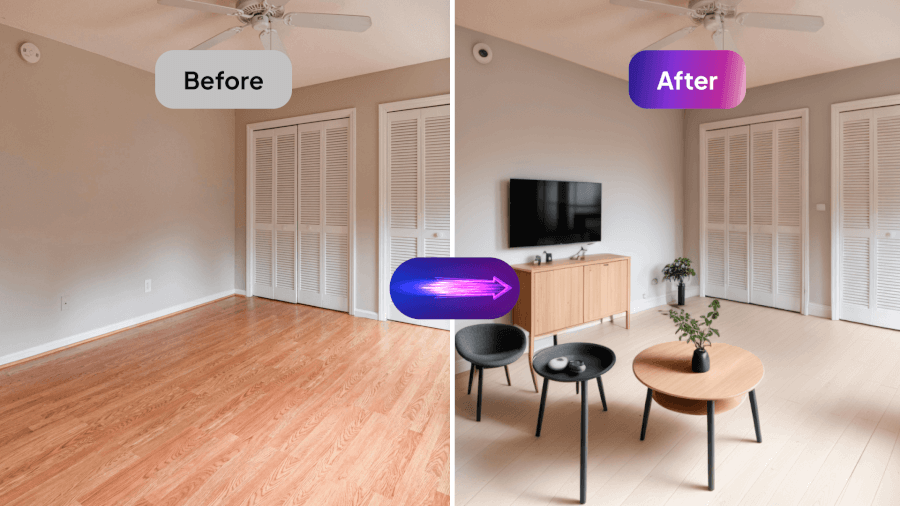
AI Virtual Staging Is Changing Apartment Listings
Empty rooms are hard to sell. They flatten out in photos, hide scale, and make listings feel colder than they are. That is why AI virtual staging has become such a fast fix for real estate agents, landlords, and apartment marketers. You can turn a bare unit into a furnished space in minutes, often for a fraction of the cost of physical staging. The problem is simple. Once the furniture is fake, the line between helpful presentation and misleading polish gets thin. And that matters now because renters and buyers are making decisions faster, often from a phone screen, before they ever step inside.
Look closely and you can see the tradeoff. Better photos can help a listing get attention, but they can also create a gap between expectation and reality. How much editing is too much when the goal is to help people imagine a space?
Why AI Virtual Staging Is Catching On
- It cuts cost. Traditional staging can run into the thousands. AI staging can be much cheaper.
- It saves time. Agents can produce staged images quickly, which helps listings go live faster.
- It improves weak photos. Empty rooms often look smaller and less useful than they really are.
- It supports marketing at scale. Property managers with many units can edit photos without moving physical furniture.
That business case is easy to understand. A vacant apartment is like a blank menu with no photos. People can read the description, but they still want a picture of the meal.
What AI Virtual Staging Actually Does
Most AI virtual staging tools take an empty room photo and add furniture, decor, lighting tweaks, and sometimes even wall art or rugs. The better tools try to respect the room’s layout, window placement, and perspective. But they are still making guesses, and guesses can fail.
That is where the trouble starts. A chair may look plausible, yet the scale may be off by a few inches. A couch can hide awkward flooring, and a wide-angle shot can make a room feel larger than it is. These are not small details when someone is deciding whether to sign a lease or book a showing.
Staging should help people understand a space. If it changes the space into something else, the tool stops being useful and starts becoming a problem.
AI Virtual Staging and Listing Trust
Trust is the real currency here. If a listing looks too polished, people start asking what else has been edited. That skepticism is healthy. Real estate has enough friction already without adding another layer of uncertainty.
Some markets and platforms already expect disclosure when images are digitally altered. The exact rules vary, and local laws can matter. Agents and brokers should check what their MLS, platform, or state requires before posting staged images. The safest approach is plain disclosure in the listing copy and image captions (for example, “virtually staged”).
What good disclosure looks like
- Label the image as virtually staged.
- Keep an original photo nearby for comparison.
- Do not hide structural flaws, views, or finishes.
- Use staging to show scale, not to disguise reality.
But disclosure alone is not enough if the image itself oversells the unit. A sofa can be fake. The floor plan cannot be.
Where AI Virtual Staging Helps Most
The strongest use case is the empty, awkward, hard-to-photograph space. Studio apartments, new builds, and recently renovated units often benefit most. The staging gives the brain something to anchor on. People can picture a table by the window or a bed in the corner, which makes the room feel usable.
It also helps with seasonal inventory. A property manager with dozens of vacant units does not have time for custom photo shoots every week. AI staging can keep marketing moving without waiting on a furniture truck.
Where It Goes Too Far
Here is the line I would draw. If the edit changes the practical reality of the unit, it is too much. Adding a lamp is fine. Removing a wall, enlarging windows, or making a dark basement look sunlit is not.
The best rule is to treat AI staging like a clean coat of paint, not a renovation. It should improve presentation, not rewrite the structure. That distinction sounds obvious, but plenty of listings ignore it.
There is also a human factor. People remember disappointment more than they remember a nice photo. That makes aggressive editing a bad long-term strategy, even if it bumps click-through rates in the short run.
How to Use AI Virtual Staging Without Misleading People
- Match the style to the unit. A luxury penthouse and a starter studio should not look like the same catalog shoot.
- Keep the architecture honest. Windows, doors, ceilings, and room proportions should stay true.
- Use the same angle for comparison. Show both the original and staged version if possible.
- Write like a person. Say what the image is. Do not bury the disclosure in legal noise.
The smartest teams use staging as one part of the listing, not the whole pitch. Floor plans, square footage, neighborhood context, and actual condition photos still matter. Without them, the pretty picture becomes a trap.
What Comes Next for AI Virtual Staging
Expect the tools to get faster and more realistic. They will probably get better at lighting, furniture placement, and room consistency. That will make them more useful, and more dangerous if sellers get sloppy.
The real test is not whether AI can stage a room. It is whether the person using it respects the difference between presentation and deception. If you are showing people a home, that difference is not optional. What happens when the edit is so good that nobody notices it was an edit at all?


