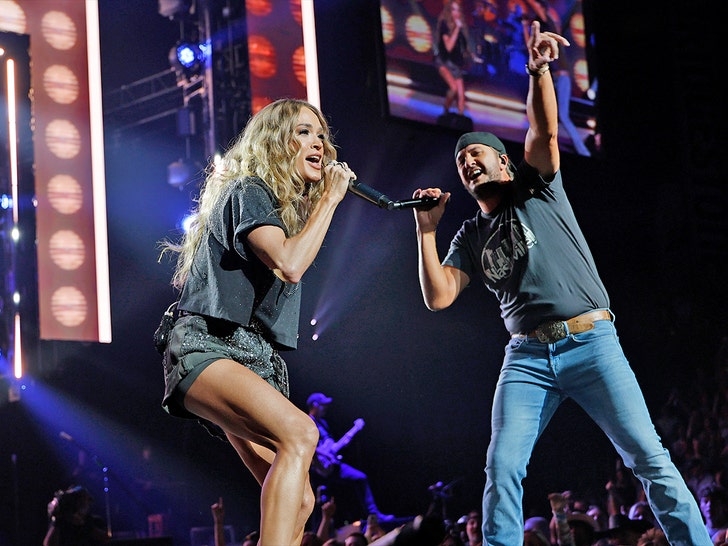
Carrie Underwood and Luke Bryan Give Livin’ on a Prayer a Country Makeover
You know a song has crossed into pop culture bedrock when a new version can still start an argument nearly 40 years later. The Carrie Underwood Luke Bryan Livin’ on a Prayer remake puts Bon Jovi’s 1986 rock anthem back in the spotlight, this time with a country twist from two of the genre’s biggest TV-era stars. Parade reported on the performance, noting the song’s long life and its place among widely recognized rock classics. That matters because “Livin’ on a Prayer” is not a forgotten catalog cut. It is one of those songs people know after three seconds, from the talk box intro to the shout-along chorus. So what happens when Nashville voices take on New Jersey arena rock? You get a useful test of how far a classic can bend before fans start guarding the gates.
Why This Version Stands Out
- The song choice is loaded. “Livin’ on a Prayer” is tied to Bon Jovi’s peak and still carries stadium-sized expectations.
- Underwood brings vocal force. Her range fits the song’s big chorus without needing to copy Jon Bon Jovi.
- Bryan adds a looser country feel. His delivery softens the edges and shifts the mood.
- The makeover works best as a tribute. It does not replace the original, and it should not try to.
The Carrie Underwood Luke Bryan Livin’ on a Prayer Makeover, Explained
Bon Jovi released “Livin’ on a Prayer” in 1986 on the album Slippery When Wet. Written by Jon Bon Jovi, Richie Sambora, and Desmond Child, the track became a defining arena-rock single and one of the band’s signature songs.
That is why any remake walks into a crowded room. Fans already have the original wired into memory. The bass line, the talk box, the key change, and the “whoa-oh” hook are not small details. They are the furniture.
Parade framed the new performance as a makeover of a 1986 hit that has been ranked among the greatest songs of all time, which is the right lens. This is less about reinvention and more about seeing how a familiar anthem holds up in different hands.
Underwood and Bryan are not strangers to big-stage pressure. Underwood has long mixed country polish with rock vocals, especially in live settings. Bryan, meanwhile, tends to favor charm and rhythm over vocal gymnastics. That contrast gives the remake its shape.
It is karaoke-proof, but not risk-proof.
Why Livin’ on a Prayer Still Works in 2025
“Livin’ on a Prayer” survives because its structure is almost unfairly effective. The verses sketch a blue-collar couple, Tommy and Gina, trying to hang on. The chorus then blows the doors open with a line that feels built for crowds: “Take my hand, we’ll make it, I swear.”
That formula travels well. Rock bands, country singers, wedding DJs, and TV talent shows all reach for it because the emotional math is simple. Struggle plus hope plus a chorus people can yell. Like a good diner burger, the ingredients are plain, but the timing has to be right.
What country voices change
A country-leaning version can make the story feel less glossy. The original has 1980s chrome all over it, from the production to the guitar tone. Underwood and Bryan can pull the lyric closer to a front-porch drama, especially if the arrangement gives the vocal more room.
But there is a catch. Strip away too much muscle and the song loses its engine. The best country-rock covers keep the lift while changing the texture (that is where many TV performances either land or wobble).
How Carrie Underwood Handles Livin’ on a Prayer
Underwood is the safer bet on this song, and I mean that as praise. She has the pipes for the upper register, but she also understands attack. “Livin’ on a Prayer” needs a singer who can push without sounding like they are doing vocal CrossFit.
Her history helps. She has covered rock material before, and her best performances often sit near the country-rock border. That makes the Bon Jovi catalog a natural fit, even if the song still belongs to another era and another accent.
The smart move is not to imitate Jon Bon Jovi’s rasp. It is to treat the chorus like a handoff. Keep the hook intact, then let her tone carry the update.
What Luke Bryan Adds to the Livin’ on a Prayer Makeover
Bryan’s role is different. He does not need to overpower the song. He needs to ground it. His presence turns the performance into a shared moment rather than a straight vocal showcase.
That can work because “Livin’ on a Prayer” is already theatrical. A duet format gives the song a new angle, especially with two celebrity voices that bring different fan bases. Is it the definitive version? No. But that is the wrong test.
The better question is whether it makes a familiar song feel live again for a few minutes. On that score, the pairing makes sense.
Why Classic Rock Makeovers Keep Happening
TV and streaming have changed how old songs re-enter the charts, feeds, and family group chats. A cover does not need to beat the original. It only needs to create a fresh reason to talk about it.
For artists, the upside is clear:
- Instant recognition. The audience knows the hook before the first chorus arrives.
- Cross-generational reach. Parents, longtime rock fans, and younger country viewers all have a way in.
- Low explanation cost. Nobody needs a lecture on why the song matters.
- Room for personality. A strong singer can change phrasing, pacing, or tone without rewriting the song.
The risk is just as clear. Pick a song this loved, and every choice gets judged against memory. Memory is not fair. It remasters everything.
The Real Test for the Carrie Underwood Luke Bryan Livin’ on a Prayer Cover
The Carrie Underwood Luke Bryan Livin’ on a Prayer cover should be judged as a live tribute, not as a replacement for Bon Jovi’s original. That distinction matters. Some covers aim to reframe a song. Others simply let a new crowd sing along.
This one sits closer to the second camp. It works best when you stop asking whether it improves the 1986 version and start asking whether it reminds people why the song lasted in the first place.
Honestly, that is the more useful measure. A classic does not need protection behind glass. It needs performers willing to take a swing, and fans willing to admit that a familiar chorus can still find a new room.
What to Watch Next
If this performance gains traction online, expect more country stars to reach for classic rock songs with huge hooks and built-in nostalgia. The playbook is too tempting. But the artists who win will be the ones who respect the original structure while bringing a clear point of view.
For listeners, the next step is simple: play the Bon Jovi original, then play the Underwood and Bryan version. If the new take sends you back to the 1986 recording, it has already done its job.