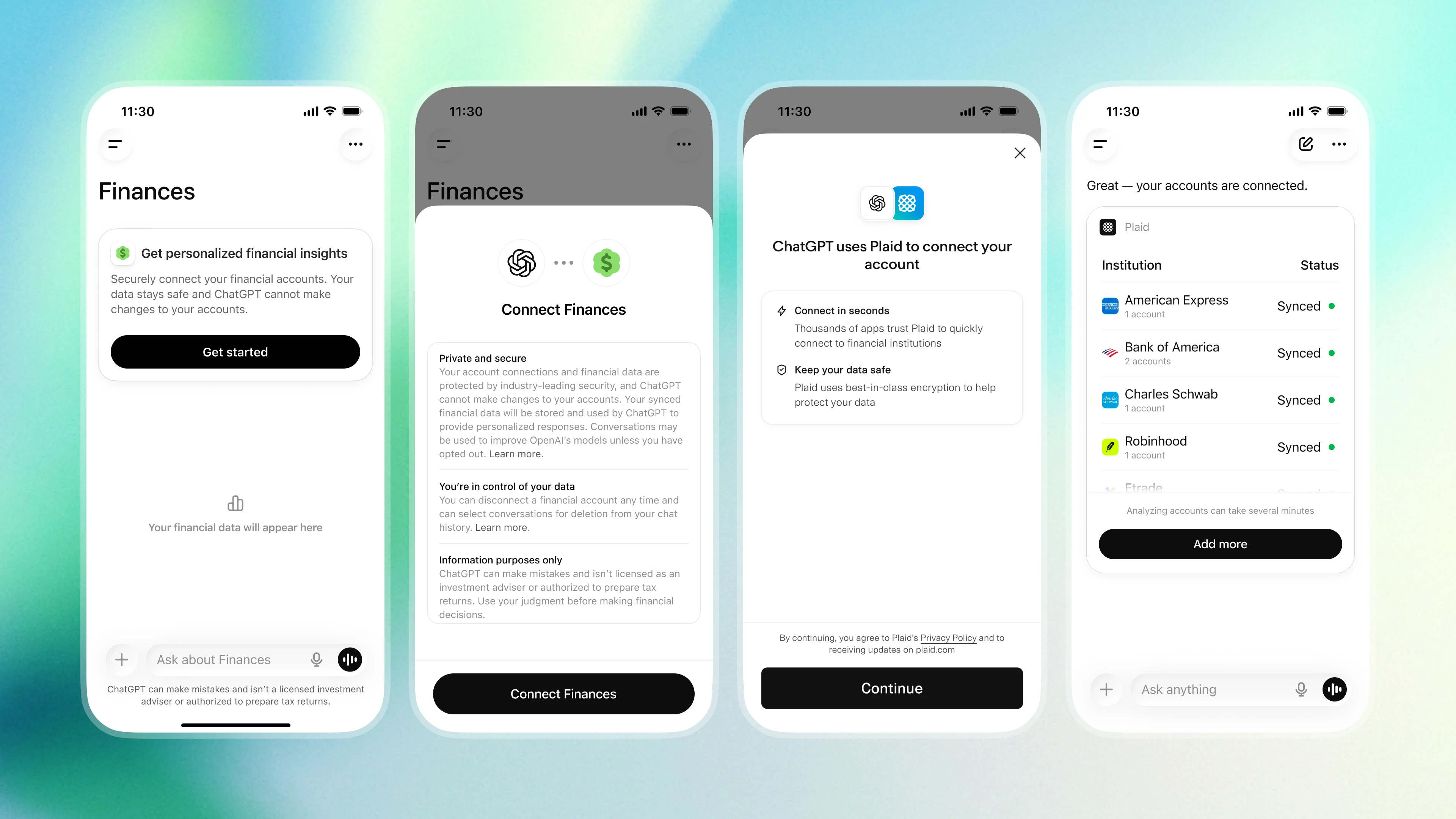
ChatGPT for Personal Finance: What Connecting Your Bank Account Really Means
Money apps already track your spending, flag subscriptions, and sort your transactions. So why does ChatGPT for personal finance matter right now? Because OpenAI appears to be pushing beyond generic chatbot answers into something far more useful, and far more sensitive. If ChatGPT can connect to your bank accounts, it stops being a writing tool and starts acting like a financial interface that can read your cash flow, explain patterns, and answer questions in plain English. That is a big shift for anyone who feels buried in financial dashboards and half-helpful budgeting apps. But convenience is only half the story. The real question is whether this becomes a trusted money assistant or just another layer between you and your bank data.
What stands out
- ChatGPT for personal finance points to a more conversational way to manage budgeting and spending.
- Bank account connections could make advice more relevant because the model can respond to actual transaction history.
- Privacy and security will likely decide whether mainstream users adopt it.
- OpenAI is entering a space crowded with banks, fintech apps, and established budgeting tools.
Why ChatGPT for personal finance is a bigger deal than it sounds
Plenty of apps already connect to checking accounts and credit cards. That part is old news. What is new is the interface.
Most personal finance tools still make you work like an analyst. You open charts, scan categories, fiddle with rules, then try to figure out what changed last month. A conversational system flips that around. You ask, “Why did my spending jump in April?” or “Can I afford a $400 car payment?” and get an answer built around your data.
That sounds obvious, but it matters. Software has been making people adapt to the tool for years. OpenAI wants the tool to adapt to the person instead.
Here’s the thing. The winning product may not be the one with the fanciest AI. It may be the one that turns messy financial data into answers normal people can use in 10 seconds.
How a bank-connected ChatGPT could actually help
If OpenAI executes well, this could land somewhere between a budgeting app, a financial coach, and a search engine for your own money habits. Think of it like having a good editor for your finances. The raw material is already there, but someone still needs to cut through the noise.
1. Faster budgeting
Most budgets fail because setup is annoying. Categories break. Transfers get misread. And people give up. A chatbot could make budgeting less rigid by letting you set goals in natural language, then adjusting recommendations as your spending shifts.
2. Better spending explanations
Charts tell you what happened. They rarely tell you why. A finance-focused assistant could spot patterns across recurring bills, seasonal expenses, travel, dining, or debt payments, then explain them without jargon.
3. Real-time decision support
This is where the idea gets interesting. You could ask whether a purchase fits your current cash position, how much room you have before the next paycheck, or which subscriptions have become dead weight.
4. Less friction around financial literacy
People do not always need a certified financial planner. Sometimes they just need a clean answer to a basic question, like whether paying off a card or building emergency savings should come first (it depends on interest rate, cash cushion, and timing).
The obvious sticking point: trust
OpenAI can build a polished interface. That is not the hard part. The hard part is convincing people to hand over bank-level visibility to an AI product, especially one tied to a company better known for chat and image tools than financial services.
And yes, that skepticism is healthy.
Financial data is different from shopping history or movie preferences. Bank connections expose income, debts, habits, and weak spots. If a product misreads that data, gives shaky advice, or leaves people confused about how their information is used, trust can disappear fast.
Look, fintech history is full of products that felt smart until users asked a simple question: who exactly is responsible when something goes wrong?
What users should check before trying ChatGPT for personal finance
If this feature rolls out broadly, do not stop at the demo. Read the boring parts. That is where the real story usually lives.
- Data access scope. Find out whether the product can view balances only, or full transaction history across accounts.
- Data retention. Check how long financial data is stored and whether it is used to improve models.
- Third-party integrations. Many finance tools rely on aggregators such as Plaid or similar connectors. That matters for both reliability and security.
- Advice boundaries. See whether the tool frames its answers as education, recommendations, or automated financial guidance.
- Error handling. Ask yourself what happens if it mislabels spending, misses a bill, or gives bad planning advice.
Where this fits in the fintech fight
OpenAI is not entering an empty market. It is stepping into a crowded, expensive fight that already includes banks, neobanks, budgeting apps, credit tools, and wealth platforms. The differentiator will not be basic account aggregation. Everybody has that.
The differentiator is whether ChatGPT for personal finance can become the front door for financial decisions. If users start asking ChatGPT where their money went, whether they can save more, or which bill is hitting hardest, then banks and fintech apps risk becoming back-end pipes.
That is the strategic angle people should watch. Once the interface layer shifts, power often shifts with it too. We saw that with web browsers, smartphones, and app stores. Personal finance could be next.
Will AI financial help be good enough?
That depends on what people expect. For basic budgeting, transaction review, cash-flow planning, and spending summaries, AI should be able to do solid work if the data feed is accurate. For taxes, investing, credit decisions, and debt strategy, the stakes rise fast.
A chatbot can explain, compare, and surface patterns. It should not be treated like a fiduciary. That line matters.
Honestly, this is where hype usually outruns reality. Financial guidance is full of edge cases. Income is irregular. Couples share accounts in strange ways. Small business expenses bleed into personal cards. One missed detail can change the answer.
What TechCrunch’s report signals
Based on TechCrunch’s report, the big signal is not just the feature itself. It is OpenAI’s willingness to move ChatGPT closer to highly personal, high-trust use cases. That tells you the company sees its future as more than a chatbot tab in a browser.
It wants ChatGPT embedded in your daily decisions.
And that is both the opportunity and the risk. A helpful money assistant could save users time and reduce confusion. A sloppy one could create false confidence, which is far more dangerous than obvious failure.
What to watch next
The smart move is to track three things as this develops.
- Permission design. Are controls clear, limited, and easy to revoke?
- Answer quality. Does the system explain its reasoning in a way users can verify?
- Financial partnerships. Does OpenAI work with banks, aggregators, or compliance-heavy finance firms to make the product credible?
If those pieces are strong, ChatGPT could become a useful money layer for millions of people. If they are weak, this ends up as a flashy demo that users try once, then abandon. Which way will it go? My bet is that demand will be real, but adoption will hinge on whether OpenAI treats financial trust as non-negotiable rather than optional.