ChatGPT Trusted Contacts and Self-Harm Alerts
If you use ChatGPT for emotional support, OpenAI’s new ChatGPT trusted contacts feature deserves a close look. The company is testing a system that could let ChatGPT suggest reaching out to a trusted person during a mental health crisis, including possible self-harm situations. That matters because more people now treat AI chatbots like a late-night confidant, therapist substitute, or crisis sounding board. And that shift carries real risk. A tool built for conversation can feel deeply personal, even when it is not qualified to handle an emergency. So the real question is simple. Can a chatbot help without crossing a line on privacy, safety, and human judgment? The answer depends on how this feature works in practice, not on OpenAI’s marketing copy.
What stands out
- OpenAI is testing ChatGPT trusted contacts for moments that may involve self-harm risk.
- The feature appears designed to nudge users toward human support, not replace crisis services.
- Privacy is the hard part. Any emergency alert system tied to personal chats raises obvious consent questions.
- Chatbots can offer triage-style support, but they still lack the judgment of trained clinicians and crisis counselors.
What is the ChatGPT trusted contacts feature?
Based on reporting from The Verge, OpenAI is working on a feature that would let users add a trusted contact to ChatGPT. In a serious mental health moment, the chatbot could encourage the user to notify that person or help connect them. The feature is tied to conversations that suggest self-harm risk or emotional crisis.
That is a notable step because it shifts ChatGPT from giving on-screen guidance to prompting real-world intervention. Think of it like a smoke alarm that also points you to the nearest exit. Useful, maybe. But only if it goes off at the right time.
AI safety features sound sensible on paper. The hard part is deciding when a private conversation becomes an emergency worth escalating.
Why ChatGPT trusted contacts matter now
People already use AI companions and general chatbots for support they do not get elsewhere. Some want anonymity. Others want instant replies at 2 a.m. But convenience can blur the limits of the tool.
Look, this is where the hype around empathetic AI starts to crack. A chatbot can mirror concern, ask follow-up questions, and suggest coping steps. It cannot truly assess danger the way a licensed professional or emergency responder can.
That gap is non-negotiable.
OpenAI’s move suggests the company knows users are bringing severe mental health issues into ChatGPT chats. That should surprise no one who has watched this space for the past two years. The bigger issue is whether adding trusted contacts reduces harm or creates fresh problems around false alarms, user trust, and data handling.
How ChatGPT self-harm alerts could work
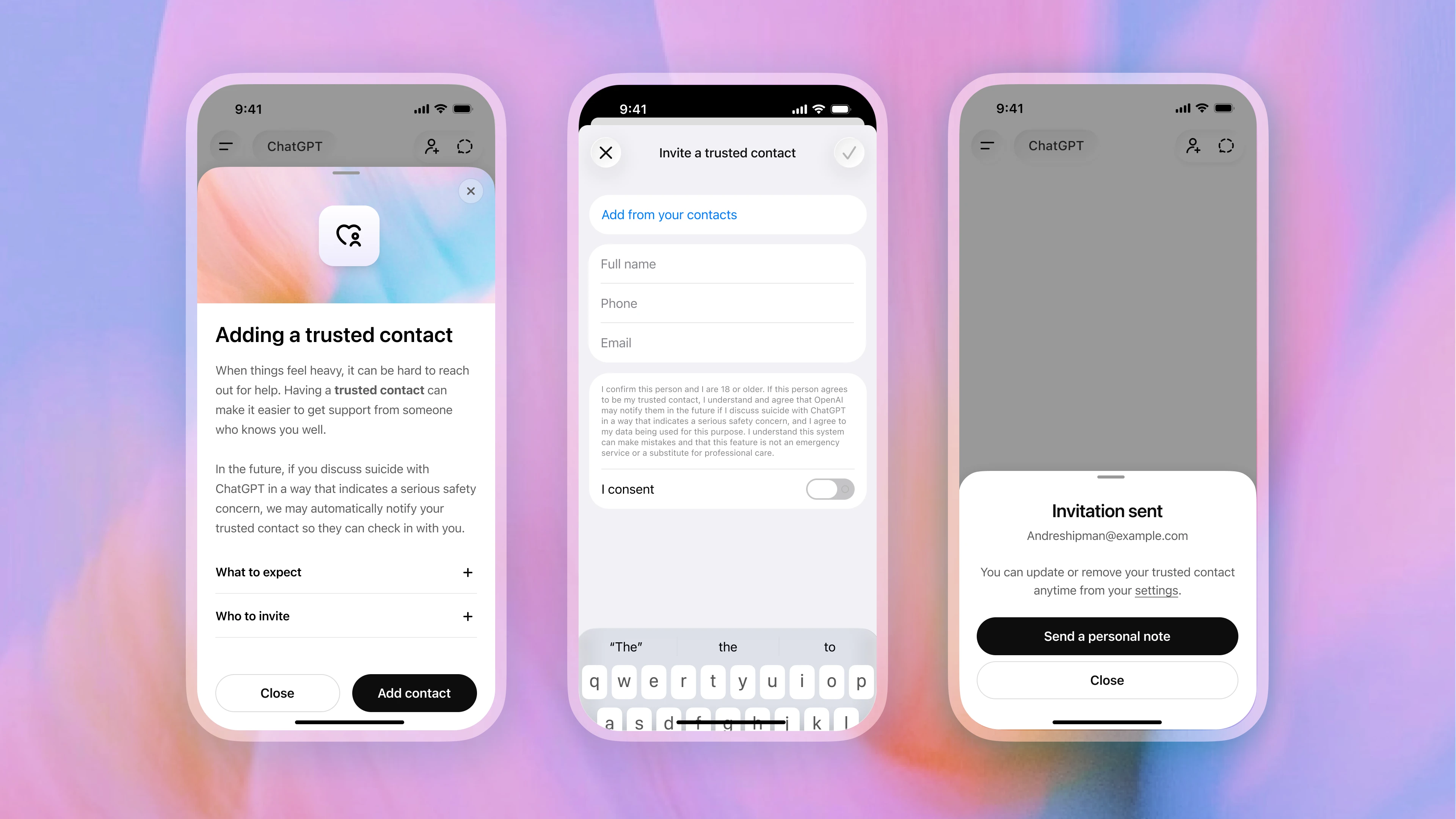
OpenAI has not published a full public product spec in the source report, so some details remain unclear. But the broad shape seems straightforward. Users would likely add a contact in advance, then ChatGPT would surface that option when a conversation triggers its safety systems.
Most likely flow
- You add a trusted contact inside ChatGPT settings.
- You have a conversation that signals self-harm risk.
- ChatGPT prompts you to contact that person, along with crisis resources.
- Depending on the final design, the system may ask for confirmation before sharing anything.
The consent step matters more than any polished interface. If the system contacts someone automatically, privacy concerns spike fast. If it only suggests outreach and leaves the final action to the user, the safety upside may be smaller. Either way, tradeoffs are baked in.
The privacy problem behind ChatGPT trusted contacts
This is where the feature gets thorny. To be blunt, private chats with AI already sit in a strange zone. They feel intimate, but they run through a company’s systems, policies, and moderation tools. Adding a trusted contact brings a third party into that equation.
What happens if ChatGPT misreads sarcasm, fiction, or venting as imminent danger? What if a user sets up a contact during a stable period, then later regrets giving that person a path into a crisis moment? And what if the contact itself is unsafe (an abusive partner, for example)? Those are not edge cases. They are obvious product design questions.
Any solid version of this feature would need clear guardrails:
- Explicit opt-in before a contact is added
- Easy removal and account-level controls
- Clear disclosure about what information could be shared
- Strong limits on automatic alerts
- Fallback guidance to crisis hotlines and local emergency services
Honestly, if those controls are weak, users should be skeptical.
Can AI do this well enough?
AI systems are decent at pattern matching. They are far less reliable at context. That matters because self-harm detection is all context. A user might quote song lyrics, discuss a news event, write fiction, or describe past trauma. Another user might mask severe distress behind flat language and never trigger a warning at all.
That is why these systems work best as a support layer, not as the final authority. In mental health terms, the safest role for ChatGPT is closer to triage or signposting. It can suggest the next step. It should not pretend to be the step.
And yes, there is still value in that. If ChatGPT can steer someone toward a friend, family member, 988 in the US, or local crisis services at the right moment, that could help. But a feature like this should be judged by precision, consent, and restraint. Not by how caring the bot sounds.
What users should do before turning on ChatGPT trusted contacts
If OpenAI rolls this out broadly, do not just click through the setup screens. Treat it like choosing an emergency contact on your phone or naming someone on a medical form. Pick carefully.
Smart setup questions
- Do you trust this person to respond calmly and quickly?
- Would you want them involved in a mental health emergency?
- Do they understand your history and warning signs?
- Could they make the situation worse?
- Do you know exactly what ChatGPT may share with them?
Here’s the thing. The best trusted contact is not always the closest person in your life. It is the person most likely to help in a grounded, practical way.
What this says about the direction of AI chatbots
For years, tech companies tried to present chatbots as useful assistants with neat boundaries. Users ignored those boundaries almost immediately. They ask for life advice, relationship guidance, grief support, and crisis help because the bot is there, always on, and oddly easy to talk to.
So OpenAI is dealing with the obvious next phase. Once users treat ChatGPT like a companion, the company has to decide how much duty of care it accepts. That is a product question, a policy question, and eventually a regulatory question too.
The analogy I keep coming back to is architecture. If you know people will gather on a balcony, you do not just hang a sign and hope for the best. You reinforce the structure, limit the load, and plan for emergencies. AI companies are only now admitting that people have been standing on the balcony for a while.
What to watch next
The Verge report points to a feature that could be helpful if OpenAI handles it with restraint. But the details will decide everything. Will alerts be user-controlled? Will there be region-specific crisis resources? Will users get full visibility into what was flagged and why?
Those answers matter more than the feature announcement itself. If OpenAI wants ChatGPT trusted contacts to be taken seriously, it needs to show the work, publish the rules, and accept scrutiny. Otherwise, this will look like another safety patch on a product that people already lean on far more heavily than its makers once imagined.
And if AI companies want to sit this close to human vulnerability, they should expect harder questions, not softer ones.