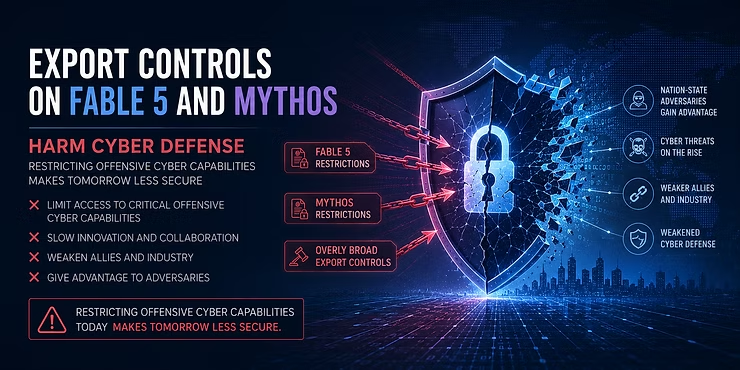
Cyber Export Controls Fail, and Mythos Proves Why
Governments keep reaching for cyber export control as a fix for spyware, intrusion tools, and other software that can be turned against people. The problem is that the policy keeps running into the same wall. Code crosses borders too easily, vendors rebrand products fast, and the buyers who want abuse-ready tooling usually find a way around the rules. If you care about cyber export control, you need to understand that this is not a narrow compliance issue. It shapes what gets sold, who gets watched, and how fast bad actors adapt. Why do policymakers keep betting on a tool that history keeps breaking?
- The target keeps moving. Software can be copied, changed, and resold faster than regulators can write new rules.
- Labels do not stop abuse. “Defense” and “offense” are often the same code base with a different pitch deck.
- Enforcement lags reality. By the time a case is public, the market has already shifted.
- Mythos is a warning sign. It shows how easy it is for a cyber tool to sit in the gray zone.
What cyber export control is trying to do
Cyber export control is meant to limit the spread of software that can be used for intrusion, surveillance, or digital sabotage. In practice, it tries to separate legitimate security research tools from products that can be repurposed for abuse. That sounds clean on paper. It rarely is.
The line between lawful security work and harmful capability is thin. A pen-test platform can test networks. The same platform can help break into them. A vendor may insist its product is for internal defense, while a buyer quietly wants reach into a dissident’s phone. That gap is where the policy breaks down.
Export rules can shape the paperwork. They do a far worse job of shaping the intent of the buyer.
Why cyber export control keeps missing the real threat
Look, the core problem is not technical complexity alone. It is the market structure. The same exploit chain can be wrapped in a commercial product, sold through a shell company, and moved through friendly jurisdictions. Once that happens, the regulator is chasing a moving truck with a bicycle.
History keeps repeating this pattern. Encryption controls failed because strong crypto spread anyway. Spyware rules struggle because the tools are often built to be deniable. And now Mythos sits in the same bucket: a reminder that naming a product does not tell you how it will be used.
Three reasons the rules break down
- Dual use is the default. Most serious cyber tools can be used for defense or intrusion.
- Jurisdiction is messy. A vendor, reseller, developer, and end user may all sit in different countries.
- Software evolves too quickly. New features, patched builds, and renamed offerings blur the trail.
And that is before you get to the paperwork theater. A company can claim compliance while moving capability through affiliates and contractors. The paper trail looks tidy. The real trail does not.
What Mythos tells us about the policy gap
Mythos matters because it fits a familiar pattern. It is another example of a cyber capability that may be described as controlled, legitimate, or defensive, while still raising obvious abuse risks. That is the old export control trap. Authorities try to regulate the box instead of the outcome.
Think of it like airport security focused only on suitcase labels. You can stamp every bag you want. If the contents are still hidden, the label means very little. Cyber export control has the same flaw. It focuses on product classification, while the real harm depends on deployment, secrecy, and buyer behavior.
Mythos also shows how quickly the market adapts. Vendors learn the language that unlocks approvals. Buyers learn which intermediaries to trust. Regulators get left with a narrow set of visible cases and a much larger hidden market.
What would actually help
There is no magic fix, but some steps are better than pretending export control alone can solve the problem.
- Track end use, not just product type. Regulators should ask who deploys the tool and against whom.
- Increase transparency. Public reporting on licensing, denials, and enforcement would make abuse harder to hide.
- Target intermediaries. Shell resellers and front companies are often the real pipeline.
- Fund independent research. Outside scrutiny helps expose products that official filings clean up too neatly.
But even these steps have limits. If the tool is software, the state is always reacting after the fact. That is the uncomfortable truth. The best policy may be less about pretending to stop every transfer and more about making abuse expensive, visible, and politically toxic.
Where cyber export control should go next
The old model was built for hardware, crates, and shipping manifests. Cyber tools do not respect that world. They move too quickly, mutate too easily, and often hide behind legitimate security work. Mythos is just the latest proof.
So what should you watch next? Watch for rules that follow money, buyers, and deployment. Watch for enforcement that names resellers, not only vendors. And watch for lawmakers who stop treating a license as a solution. If export control cannot keep pace with the code, what exactly is it controlling?