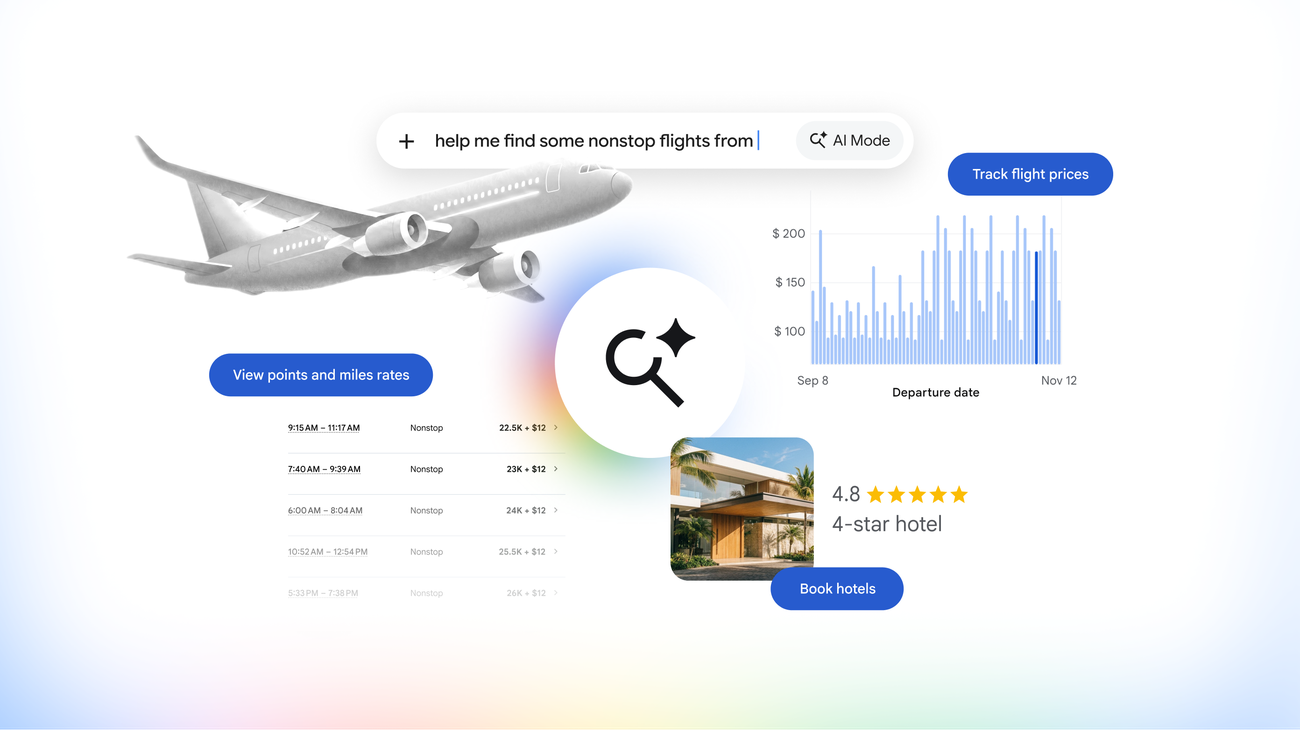
Google AI Mode Flight Price Tracking and Hotel Booking
If you plan trips online, you already know the drill. You bounce between search, airline sites, hotel tabs, and price alerts, then hope you did not miss a fare drop. Google AI Mode flight price tracking and hotel booking is trying to cut that mess down. That matters now because travel search is getting more conversational, more automated, and more sticky inside Google’s own products. The upside is obvious. The risk is too. If Google becomes the front door for planning, booking, and price monitoring, you may save time, but you also give one company a lot more control over how you compare options. That is the real story here.
What changed in Google AI Mode
- Flight price tracking now lets you watch fares and get updates instead of checking manually.
- Hotel help aims to move you from search results to booking decisions faster.
- The travel flow sits inside AI Mode, so you can ask in plain language instead of building every query by hand.
- Google is pushing deeper into the planning stage, not just the final click.
That shift sounds small. It is not. Search used to hand you links and get out of the way. Now Google wants to act more like an itinerary assistant, one that remembers your trip intent and keeps nudging you toward action. Think of it like a concierge desk in a hotel lobby. Helpful when it works. Annoying when it starts steering too hard.
The big change is not just better search. Google is trying to own more of the travel decision chain, from inspiration to booking to follow-up alerts.
Why Google AI Mode flight price tracking matters
Price tracking is already common in travel apps, but putting it into AI Mode removes friction. You do not need to build a perfect search query every time. You can ask for a route, a date range, or a hotel area, and the system can keep watching for changes.
That is useful for travelers who are flexible on timing. It is even more useful for people booking family trips, business travel, or multi-city routes, where price swings can be brutal. Have you ever refreshed the same fare ten times in a day? Exactly.
Google also has a data advantage here. It sees huge search volume, booking behavior, and intent signals across its products. That can make alerts smarter than a generic fare tracker, though Google will still need to prove that its recommendations are timely and not just convenient for Google.
How hotel booking fits into AI Mode
Hotel search is messy because the filters are endless. Location, star rating, breakfast, cancellation terms, parking, late check-in. AI Mode tries to reduce that search fatigue by letting you describe what you want in plain language, then refining the results around those needs.
That may sound like a small UX tweak, but it changes behavior. Instead of teaching you how to search, Google wants you to talk naturally and let the system translate. For many travelers, that will feel easier than wrestling with dozens of sliders and checkboxes. For hotel operators and travel partners, it means the battle for visibility gets even tighter.
- Start with a simple trip request.
- Let AI Mode surface a smaller set of options.
- Track the fare or room price if you are not ready to book.
- Move from monitoring to purchase when the number looks right.
That flow is efficient. It is also a stronger lock-in mechanism than old-school search pages.
Where Google AI Mode flight price tracking still has limits
AI helpers are only as good as the data behind them. Flight prices change fast, and airlines do not always make their full inventory easy to compare. Hotel rates can shift with loyalty status, package deals, and opaque fees. So yes, Google can reduce work, but it cannot remove the basic chaos of travel pricing.
There is another wrinkle. If AI Mode becomes the main path, you may see fewer obvious side-by-side comparisons from independent travel sites. That does not mean those sites disappear. But it does mean your first stop may shape your final choice more than it used to. And that is why travel search is starting to look less like a directory and more like a gatekeeper.
Look, that is the trade. Convenience on one side. Control on the other.
What you should do differently
- Use AI Mode to track routes you are already considering, not to replace your own checks entirely.
- Compare the final price on the airline or hotel site before you book.
- Watch cancellation terms and fees, not just the headline rate.
- Keep a second price tracker if your trip is expensive or time-sensitive.
That last point matters. A second source is boring. It is also smart.
Why this move fits Google’s bigger strategy
Google has spent years turning search into a more transactional product. Flights, hotels, maps, reservations, local results. AI Mode just pushes that pattern further. The company is betting that users want fewer steps and more guided decisions, especially when the task is repetitive.
There is a business reason too. Travel is high value. If Google can keep you inside its interface longer, it can shape more of the journey and create more chances to capture booking intent. That is the kind of move Wall Street likes because it ties AI features to revenue potential, not just novelty.
But the pressure will rise fast. Travelers expect trust, speed, and accuracy. Miss the price alert by a day, recommend the wrong hotel, or bury fees, and the polish falls apart. AI Mode has to be more than a demo.
What to watch next
The real test is whether Google makes travel planning feel simpler without turning it into a closed loop. If flight price tracking stays accurate and hotel booking stays transparent, many users will stick with it. If the experience feels biased, cluttered, or too eager to funnel you toward partners, people will look elsewhere.
My bet? Google will make the first step of travel planning easier, then keep extending the funnel until booking feels almost automatic. The question is whether travelers accept that bargain once they see how much control they have given up.
Would you rather have one assistant that does most of the work, or a messier set of tools that leaves you more control?