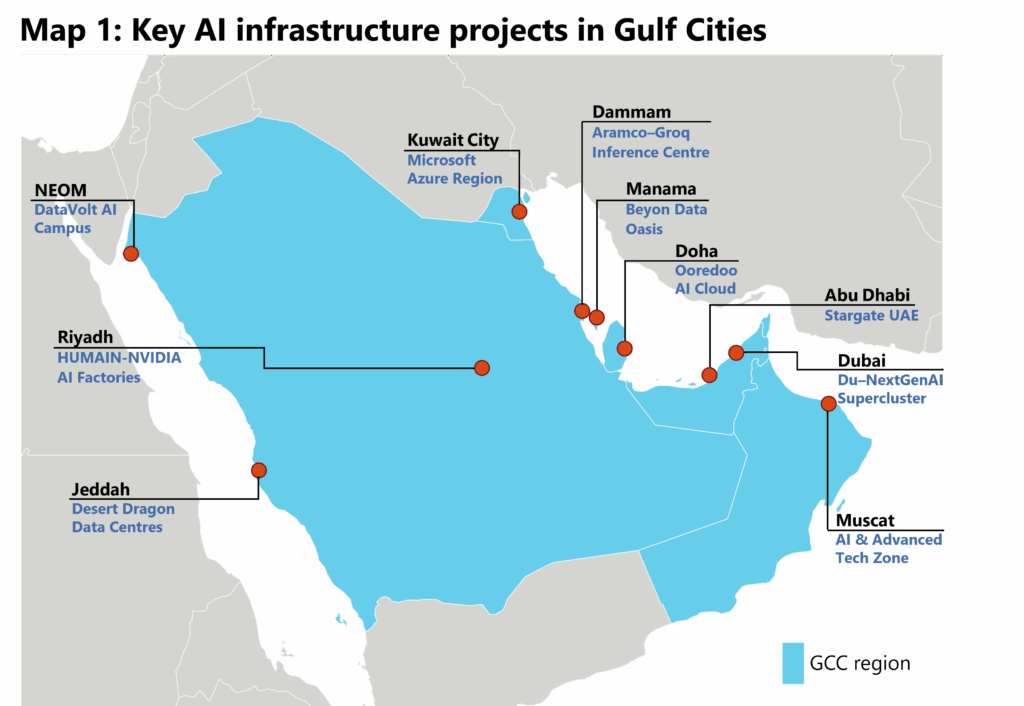
Gulf AI Boom Meets an Undersea Cable Bottleneck
The Gulf wants to become a serious AI hub, fast. Saudi Arabia, the UAE, and nearby states are pouring money into data centers, cloud regions, and state-backed AI plans. But there is a less glamorous problem sitting under the water. Gulf AI infrastructure depends on undersea internet cables, and that network is under strain from outages, chokepoints, and uneven routing. If you care about cloud performance, model training, or regional digital sovereignty, this matters now. AI data centers need power and chips, sure, but they also need reliable international connectivity. Without that, the whole pitch starts to wobble. Think of it like building a world-class airport with too few runways. The terminals may look polished, but traffic still backs up.
What matters most
- The Gulf’s AI push depends on undersea cables that connect the region to Europe, Asia, and Africa.
- Cable cuts and geographic chokepoints can slow traffic, raise costs, and weaken resilience.
- More data centers alone will not fix the problem if international bandwidth remains fragile.
- Governments and telecom firms need route diversity, faster repairs, and more landing points.
Why Gulf AI infrastructure depends on undersea cables
Most people hear “AI boom” and think of Nvidia GPUs, cheap energy, and giant server halls. Fair enough. But Gulf AI infrastructure also rests on the physical internet, and much of that internet runs through submarine cables on the seabed.
These cables carry the vast majority of intercontinental data traffic. Industry estimates often put that figure above 95 percent, and firms such as TeleGeography track how essential these systems are to global connectivity. So if the Gulf wants to host AI workloads for businesses across regions, cable resilience is non-negotiable.
That is the part many glossy investment announcements leave out.
For AI, bandwidth and latency shape real outcomes. Training large models can involve moving data across borders. Serving AI products to users in Europe, Africa, and Asia also depends on fast, stable connections. And if your traffic has to take a longer route after an outage, performance drops and costs can rise.
Building AI capacity without fixing network fragility is like adding more lanes to a highway that still funnels into one tunnel.
What is the Gulf’s undersea cable problem?
The issue is not that the Gulf has no cables. It has plenty of important links. The problem is concentration. Too much traffic passes through a small number of sensitive routes and landing areas, especially around the Red Sea, the Suez corridor, and the Arabian Gulf.
When a cable is cut, traffic can be rerouted, but only to a point. Redundancy helps, yet redundancy is weaker when many systems follow similar paths. One disruption can ripple across several networks at once.
Why does this keep happening? Because undersea cables are vulnerable in dull, physical ways. Ship anchors, fishing activity, construction work, and natural wear can all damage them. Repairs are specialized, expensive, and sometimes slow due to permits or geopolitics.
And that creates a bad fit with the sales pitch around regional AI growth. AI infrastructure needs the boring basics to work every day, not just during launch week.
Why chokepoints matter so much
The Gulf sits in a strategically valuable spot between Europe, Asia, and Africa. That sounds like an advantage, and it is. But geography cuts both ways.
Some of the region’s cable routes pass through narrow maritime corridors. That makes them efficient in normal times. It also makes them exposed. If several cables are affected near the same zone, operators can face congestion, slower failover, and a bigger scramble to restore service.
Look, this is not a fringe risk. Global cable incidents happen every year, and the internet usually keeps going because networks reroute traffic. But “usually keeps going” is not the same as “ideal for latency-sensitive AI workloads.”
How cable limits affect data centers and cloud growth
The Gulf has strong reasons to invest in AI. Energy access is a plus. Capital is available. Governments want to diversify beyond oil. Cloud providers and local champions see a market for regional hosting, sovereign AI, and enterprise services.
Still, data centers do not become strategic assets by magic. They need three things working together:
- Reliable power
- Modern compute hardware
- High-capacity, resilient network links
Miss one, and the whole model weakens.
If an enterprise in Riyadh or Dubai wants to train models on global data, weak international connectivity becomes a drag. If a startup wants to serve users across continents, route instability hurts product quality. If a government wants local AI systems without overdependence on foreign infrastructure, cable concentration undercuts that goal.
Honestly, this is where hype runs ahead of reality. Announcing a new AI campus is easy. Building a regional network fabric that can absorb shocks is slower work.
Latency, resilience, and cost
Latency is not the only metric, but it matters. So does resilience. A route that looks fine on a slide deck may perform poorly during a cable fault if backup paths are longer or more congested.
There is also the cost angle. Carriers and cloud firms may need to buy more diverse transit, reserve extra capacity, or pay for more complex routing arrangements. Those costs do not vanish. They show up in enterprise contracts, cloud pricing, and long-term infrastructure bets.
That matters if the Gulf wants to compete with established hubs in Europe and Asia.
What needs to change in Gulf AI infrastructure
The answer is not “build fewer data centers.” It is to match AI ambition with network realism. That means more route diversity, more landing stations, and stronger regional interconnection.
Here are the practical moves that would help most:
- Add cable diversity. New systems should avoid duplicating the same vulnerable paths where possible.
- Expand landing points. More entry and exit points reduce dependence on a handful of sites.
- Improve terrestrial backhaul. Cross-border fiber links can help when subsea routes fail.
- Speed up repair logistics. Faster permits and better coordination can cut downtime.
- Design for failure. Cloud and AI operators should plan traffic engineering around outages, not treat them as rare exceptions.
There is also a policy question here. Should Gulf states treat undersea cable resilience as core national AI infrastructure? They probably should. Power grids get strategic attention. Ports do too. International connectivity deserves the same seriousness.
Why this matters beyond the Gulf
This is not just a regional telecom story. It says something bigger about AI development worldwide. Countries want local compute, local cloud regions, and more control over digital systems. But physical infrastructure still sets hard limits.
That is the quiet truth under a lot of AI policy talk.
The same pattern shows up elsewhere. Data sovereignty plans in Europe, cloud expansion in Africa, and chip projects in Asia all run into the same basic fact. The internet is physical, capital heavy, and unevenly distributed. Fancy software cannot wish that away.
For companies eyeing the Gulf, this means due diligence needs to go deeper than GPU counts and electricity prices. Ask where traffic lands. Ask how many diverse paths exist. Ask what happens during a cable break. A veteran infrastructure buyer knows this stuff decides whether a region is merely promising or actually dependable.
Where this goes next
The Gulf can still become a major AI and cloud corridor. The ingredients are there, and the political will looks real. But the undersea cable issue is not a footnote. It is a structural constraint.
My view? The winners in the region will be the players who treat connectivity as product infrastructure, not background plumbing. More server racks will grab headlines. Better network resilience will decide who earns trust.
So the next time you hear a big claim about Gulf AI infrastructure, ask a plain question. Where does the traffic go when the cable fails?