Lightspeed India AI Fund Targets Early-Stage Startups
Finding serious early-stage AI capital in India is still harder than the headlines suggest. Plenty of investors talk about AI, but fewer have the patience to fund messy company building before revenue, hiring, and infrastructure costs settle down. The Lightspeed India AI fund, reportedly targeting $250 million according to TechCrunch, matters because it points to where global venture firms think the next wave of Indian startups may form. Not consumer apps with AI pasted on top. The sharper bet is on founders building models, agents, developer tools, vertical software, and AI services for markets that already spend money. If you are a founder, this is a signal. If you are an investor, it is a stress test for your own India thesis.
Why this move stands out
- Lightspeed is aiming at early-stage AI, where company risk is high but ownership can be meaningful.
- The reported $250 million target suggests a focused India vehicle, not a small side pocket.
- AI infrastructure costs make seed-stage discipline more important than it was during the last SaaS cycle.
- India has talent density, but exits and deep-tech monetization still need proof.
Why the Lightspeed India AI fund matters now
India has produced strong software exporters, consumer internet companies, and fintech players. AI adds a different test because startups need technical depth, access to compute, proprietary data, and buyers willing to trust young vendors with real workflows. That is a tougher recipe than launching another app with a polished onboarding screen.
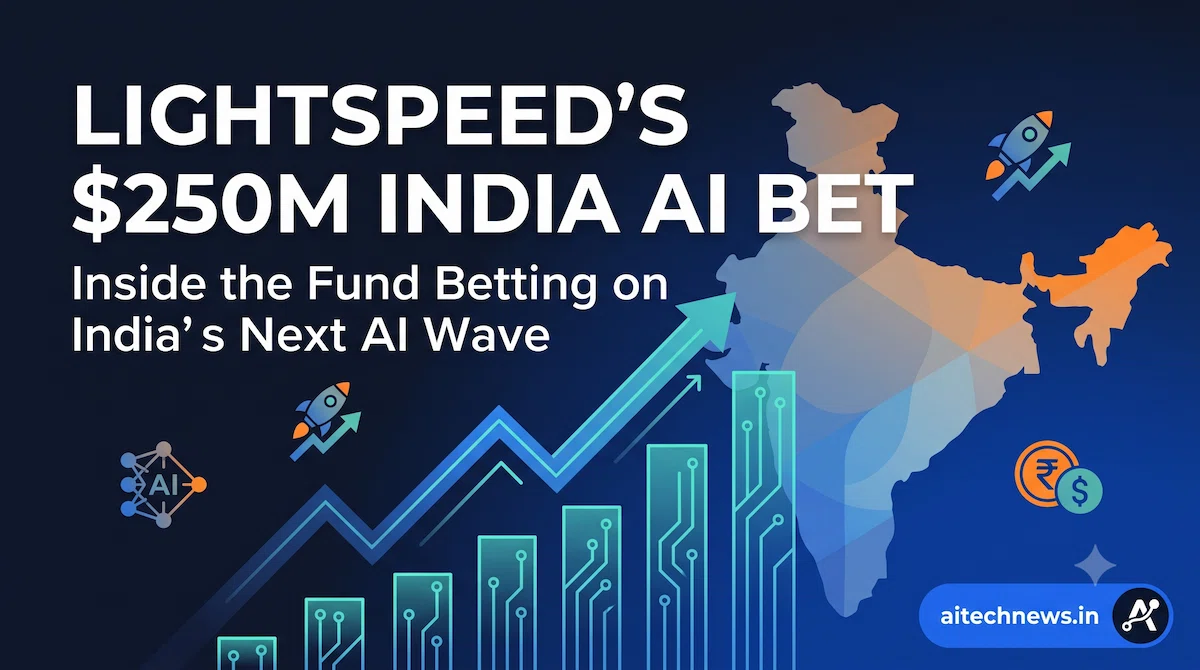
TechCrunch reported that Lightspeed is targeting $250 million for a new India fund focused on early-stage AI. The number is not the whole story. What matters is the timing, because capital is moving from broad AI enthusiasm toward narrower bets with harder questions.
Can this company defend its data advantage after the first demo?
That question will decide which startups deserve venture money and which ones are features waiting to be copied. I have watched enough AI funding cycles to know that the first wave rewards the best storytellers, while the second wave rewards the teams with distribution, gross margin, and a product buyers cannot rip out easily.
For founders, the signal is clear. A big-name fundraise target helps the category, but it will not save a weak product from the math of compute costs, sales cycles, and customer churn.
What the Lightspeed India AI fund may back
Lightspeed has not publicly mapped every subcategory it plans to target, based on the TechCrunch report. Still, early-stage AI in India is likely to cluster around a few practical areas. These are not sci-fi bets, they are where customers already feel pain.
- AI agents for business operations: Tools that handle support, finance, HR, compliance, sales ops, or internal knowledge work.
- Developer infrastructure: Testing, code generation, observability, model evaluation, data pipelines, and deployment tools.
- Vertical AI software: Products for healthcare, manufacturing, logistics, legal work, insurance, and banking.
- India-first language AI: Speech, translation, local language assistants, and voice interfaces for non-English users.
- AI services with product DNA: Consulting-heavy businesses that can turn repeated work into software over time.
The last category is easy to dismiss, but that would be a mistake. India has a massive services base, and AI-native services firms may become the bridge between old outsourcing demand and new automation products. The risk is that many never escape custom work.
What founders should take from the Lightspeed India AI fund signal
If you are raising in India, do not walk into investor meetings with a generic AI pitch. Everyone has seen the same demo pattern by now, a chat interface, a few workflow automations, and a slide claiming a huge market. You need sharper proof.
Start with the buyer. Name the person who signs the contract, show why the budget exists, and explain why your tool is better than hiring another analyst or plugging in an existing model from OpenAI, Google, Anthropic, Meta, or an open-source stack. The bar is higher because foundation models keep getting cheaper and stronger.
- Show customer data with permission, even if it is early pilot usage.
- Break out model cost, inference cost, human review cost, and gross margin.
- Explain what improves as you get more customers.
- Prove your product works in Indian conditions, including language, bandwidth, compliance, and price sensitivity.
- Know whether you are selling to India, selling from India, or doing both.
Think of it like building a restaurant, not winning a cooking contest. A brilliant dish gets attention, but the business survives on sourcing, repeat customers, kitchen timing, pricing, and staff training. AI startups face the same grind (only with GPUs instead of ovens).
The hard part: India has talent, but AI needs more than talent
India’s engineering base is a real advantage. The country has founders who understand global software markets, and many have worked at major tech companies or scaled SaaS firms. That gives venture firms a solid reason to look earlier and write larger checks.
But AI company building has a different cost curve. Model training, inference, data cleaning, security reviews, and enterprise integrations can burn cash before the product reaches repeatable revenue. Early-stage investors will have to decide whether they are funding research, software, services, or some awkward mix of all three.
Honestly, that is where hype usually breaks. A startup can look brilliant in a demo and still fail because procurement takes nine months, the model hallucinates in edge cases, or the customer wants human review on every output. Founders who talk plainly about these limits will stand out.
How this affects India’s venture market
A new Lightspeed India fund aimed at AI would add pressure on local and global firms to define their own positions. Accel, Peak XV Partners, Nexus Venture Partners, Blume Ventures, and other India-focused investors are already watching AI closely. More dedicated capital can raise valuations for the best teams, especially at seed and Series A.
That does not mean every AI startup gets funded. Venture firms are still carrying scars from overheated funding rounds in 2021 and 2022. The stronger funds now want cleaner milestones, tighter burn, and a clearer path from pilot to paid deployment.
There is also a policy angle. India is working through questions around AI governance, data protection, copyright, digital public infrastructure, and semiconductor capacity. A founder who ignores regulation is asking for trouble, particularly in finance, health, education, and public-sector use cases.
What to watch next
The reported $250 million target is only the opening move. The more useful evidence will come from the first 10 to 20 investments, the check sizes, and the kinds of founders Lightspeed chooses to back. Are they funding model builders, application startups, AI services firms, or infrastructure companies?
Watch hiring too. Funds that want to win in AI need partners and operators who can evaluate technical claims, not just market slides. A good AI investor should be able to ask about evals, latency, data rights, and unit economics in the same meeting.
The smartest founders should treat this as an opening, not a guarantee. Get your customer proof in order, know your cost structure, and be ready to explain why your product gets stronger with time. If Lightspeed is placing a bigger India AI bet, the next question is simple: which startups are strong enough to make that bet look obvious five years from now?