Open-Weight AI Safety Gets a Public Test
AI teams face a blunt problem: they want stronger models, but they do not always know how those models fail until users find the cracks. That is why open-weight AI safety matters right now. According to TechCrunch, Base Labs has launched an open-weight AI safety partnership with Hugging Face and Goodfire, putting model access, safety work, and public scrutiny in the same frame. This is not a small shift for developers who build on open models.
The timing matters because open-weight releases keep gaining traction against closed AI systems from companies such as OpenAI, Anthropic, and Google DeepMind. If open models are going to power agents, coding tools, customer support, and internal business workflows, safety testing cannot sit behind a locked door. The hard question is simple: who gets to inspect the machine before it reaches millions of users?
What Stands Out
- Base Labs is tying its safety effort to the open-weight model ecosystem, where builders can inspect and modify model weights.
- Hugging Face brings distribution, community review, and model hosting muscle to the project.
- Goodfire adds an interpretability angle, a field focused on understanding model behavior rather than treating models as black boxes.
- The partnership points to a wider industry split between closed-model control and public safety testing.
Why Open-Weight AI Safety Is Different
Open-weight models give developers access to the trained parameters of an AI system. That does not always mean the full training data, training code, or license terms are open, so you should not confuse open-weight with open source.
Still, the difference is real. Researchers can run independent evaluations, red teams can test weak spots, and companies can adapt models for specific needs without sending every prompt to a third-party API.
Open weights make safety a public test, not a private promise.
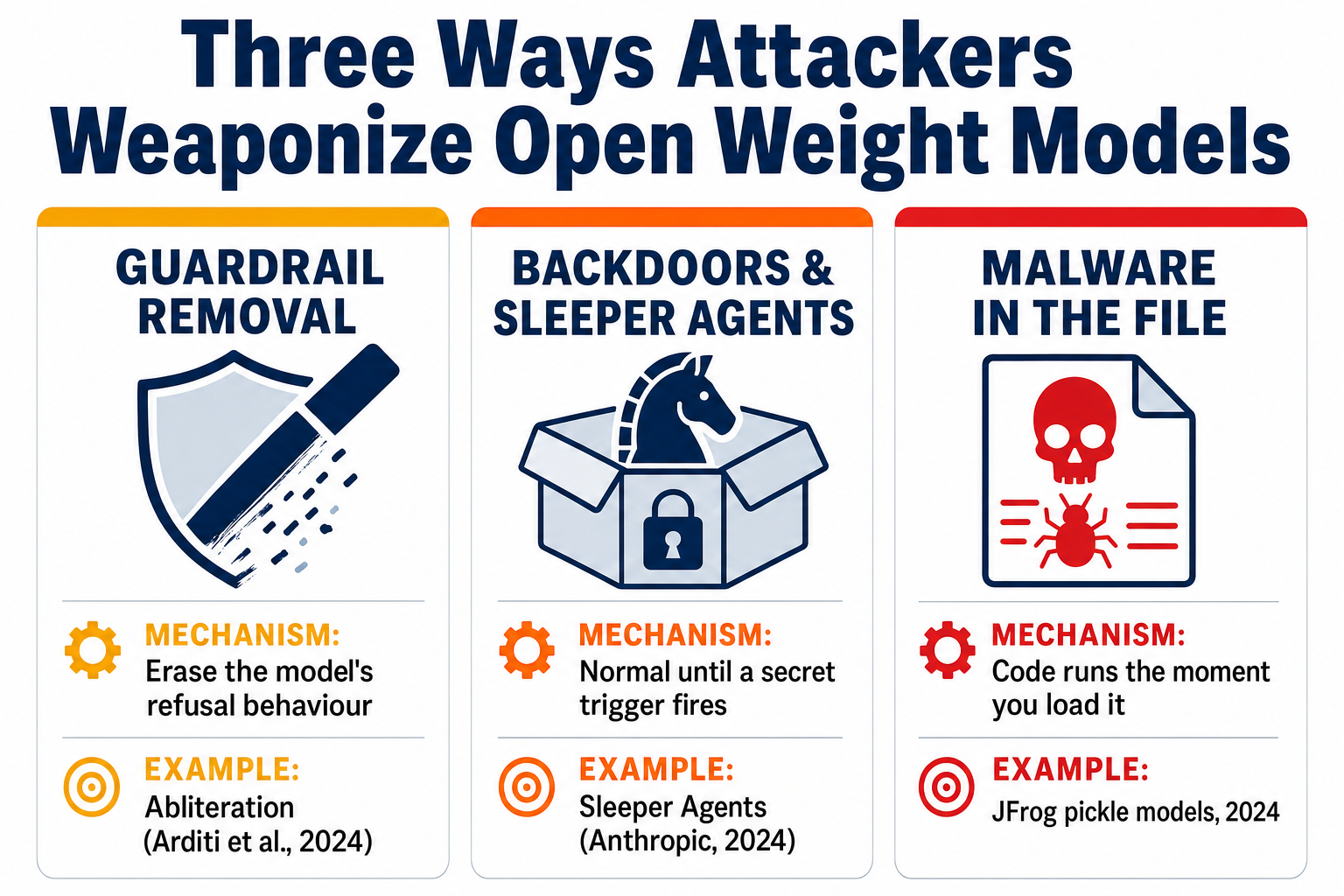
That does not make them safe by default. A released model can be copied, fine-tuned, stripped of guardrails, or repurposed in ways the original lab did not intend. The same access that helps defenders can help attackers, which is why serious safety work has to happen before and after release.
What Base Labs, Hugging Face, and Goodfire Bring
Base Labs appears to be betting that open-weight AI safety needs a shared operating model, not scattered blog posts and one-off benchmarks. TechCrunch frames the launch as a partnership with Hugging Face and Goodfire, two names that make sense for different reasons.
Goodfire has been associated with AI interpretability, including work that tries to identify how features inside neural networks affect outputs. That matters because standard safety tests often show what a model did, while interpretability work tries to explain why it did it.
Hugging Face is the obvious public square for open AI models. Its model hub, datasets, Spaces, and community tooling make it a natural place for testing, comparison, and distribution.
The useful version of open-weight AI safety is not a press release. It is repeatable testing, clear release terms, documented risks, and tooling that normal developers can use.
Base Labs sits in the middle of that triangle if it can turn safety ideas into practical workflows. That means model cards, evaluations, risk reports, and mitigation steps that do not require a PhD to run.
Open-Weight AI Safety Needs Better Benchmarks
AI safety benchmarks have a reputation problem. Too many are easy to overfit, narrow, or disconnected from how people actually use models in production.
For open-weight models, the test suite has to cover more than jailbreak prompts. It should examine dangerous capability, data leakage, bias, tool use, agent behavior, and fine-tuning risks.
Useful checks for builders
- Run task-specific evals. A model that behaves well in a chatbot demo may fail badly inside a coding agent or document review system.
- Test before and after fine-tuning. Alignment can shift when you train on company data, synthetic data, or narrow instruction sets.
- Track refusal quality. A safe model should not refuse harmless work, and it should not comply with dangerous requests.
- Log model changes. Version drift can break safety assumptions, especially when teams swap checkpoints without review.
- Use outside red teams. Internal tests miss patterns because employees know the system too well.
Think of it like pressure-testing a bridge before traffic opens. You do not inspect one beam, declare victory, and hope rush hour goes fine.
The Open Model Debate Is Getting Sharper
The split between closed and open AI systems has become one of the most tense fights in the field. Closed-model companies argue that controlling access reduces misuse, while open-model advocates say public review exposes flaws faster and prevents power from concentrating in a few labs.
A public safety partnership gives the open side a stronger answer. If the ecosystem can show credible testing, visible mitigations, and fast updates, it can push back against the claim that openness is reckless by design.
For developers, the practical trade-off is control versus convenience. Closed APIs often give you managed infrastructure and vendor guardrails, while open-weight models give you more freedom, more responsibility, and more work.
What Developers Should Watch Next
Security teams should not treat this partnership as a magic stamp. Watch for concrete releases, public methods, reproducible evaluations, and clear licenses before you build policy around it.
Public safety work also needs adoption. If developers ignore the tools, skip evaluations, or fine-tune models without controls, the partnership will become another good idea that never reaches production.
- Look for model cards that explain training limits and known failure modes.
- Check whether safety tools work with the models your team actually uses.
- Ask whether eval results can be reproduced outside the partner companies.
- Review license terms before using open-weight models in commercial systems.
- Set a rollback plan if a model update creates new safety issues.
Why This Matters Beyond One Launch
Regulators in the United States, European Union, and United Kingdom are already pressing AI companies for more transparency around risk. Open-weight AI safety projects could give policymakers a clearer view into how independent testing can work without forcing every model into the same closed compliance box.
Look, I have covered enough AI launches to distrust tidy claims. The partnership is promising because it points in the right direction, but the proof will come from boring details: docs, tests, bug reports, update cadence, and whether independent researchers can verify the work.
The Next Test Is Execution
The next phase of open-weight AI safety will not be won by slogans about openness or control. It will be won by teams that publish useful tools, admit model failures quickly, and make safer deployment the easier path for builders.
If Base Labs, Hugging Face, and Goodfire can make that happen, open models will have a stronger case in the market. If not, the loudest voices in AI safety will keep arguing while developers ship systems with guesswork as their main defense.