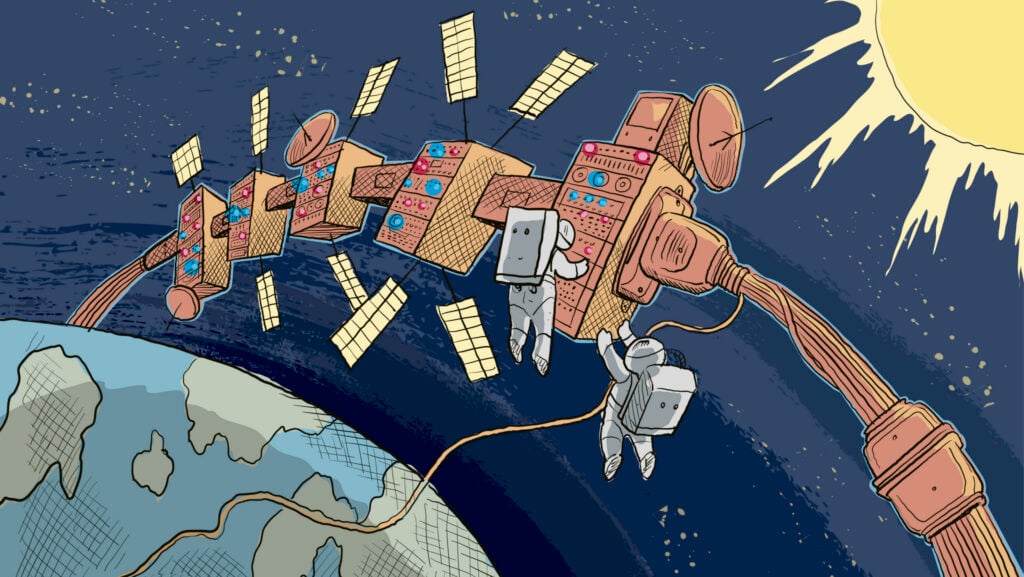
Orbital Data Centers: Why Elon Musk’s Hype Faces Real Questions
Orbital data center plans sound clean on paper. Put the servers in space, avoid land costs, skip some cooling headaches, and power them with constant sunlight. That is the pitch around orbital data center hype, and it is getting louder just as AI demand keeps hammering every part of the cloud stack. But the idea runs straight into physics, launch economics, maintenance, and reliability. Those are not small details. They are the whole business. If you care about where compute capacity really comes from, you need to separate the story from the math. Otherwise you end up funding a very expensive press release.
- Launch cost still dominates the economics of putting heavy compute in orbit.
- Heat rejection in space is harder, not easier, than many pitch decks imply.
- Repair and replacement are slow and costly compared with terrestrial data centers.
- Power is not free, even with solar panels in orbit.
- The real test is whether orbital compute can beat cheaper options on uptime, latency, and total cost.
Why orbital data center hype is getting attention now
AI infrastructure has become a land grab. Companies need more GPUs, more power, and more cooling, and they need them fast. That pressure makes almost any alternative sound attractive, especially one that promises abundant solar energy and no local zoning fights.
But hype grows fastest where constraints are real. That is exactly what is happening here. The question is not whether orbital data center hype can attract headlines. It can. The question is whether it can survive contact with operating budgets.
“A good idea is not the same thing as a viable platform. In infrastructure, the unit economics usually win.”
What the orbital data center pitch gets right
There is a kernel of logic behind the concept. Space gives you uninterrupted sunlight in some orbits, which can help with power generation. You also avoid many terrestrial limits like land use, local water constraints, and some cooling bottlenecks.
That matters because ground-based data centers are under pressure. The U.S. Department of Energy has said data centers already use a material share of electricity, and that demand is rising with AI. Utilities, regulators, and operators are all feeling that squeeze. So yes, people are looking up.
Here’s the thing. Sunlight is only one part of the system. A data center is a machine for moving heat, feeding power, and replacing failed hardware at speed. Space changes every one of those jobs.
Where the orbital data center hype starts to break
Launch costs are still brutal
Every kilogram sent to orbit costs money, and a data center is not a lightweight payload. Servers, shielding, power systems, thermal hardware, and redundancy all add mass. Even if launch prices keep falling, they have to fall a lot before space becomes competitive with a warehouse in Texas or Virginia.
Think of it like shipping bricks to build a kitchen on a mountain peak when there is already a supply store at the base. You can do it. But why would you unless the mountain gives you something the store never can?
Heat does not disappear in space
Many people hear “vacuum” and assume cooling gets easier. It does not. In orbit, you cannot dump heat into air or water the way you do on Earth. You need radiators to push waste heat away, and those radiators add weight, surface area, and failure points.
That is a hard engineering tradeoff. The more compute you pack in, the more heat you must reject. And the more heat you reject, the more structure you need just to keep the system alive.
Maintenance is ugly
Terrestrial data centers win because technicians can swap parts quickly. A failed drive is annoying. A failed power supply is a routine ticket. In orbit, a bad component can turn into a permanent loss.
That changes the design from “repairable” to “replaceable,” which is a very different cost model. If you cannot roll a truck to the site, every failure becomes a bigger bet.
What investors and operators should ask
- What is the cost per usable compute hour? Not the launch cost alone, and not the hardware cost alone. The full stack matters.
- How is heat rejected at scale? Show the radiator design, the redundancy plan, and the thermal limits.
- What happens when a module fails? If the answer is “launch another one,” the economics probably do not work.
- What workload fits this platform? Latency-sensitive AI inference, training, storage, and general cloud services are not the same thing.
- What is the exit plan? If orbital compute underperforms, can the assets be repurposed?
These are the questions that separate engineering from theater. And they matter more than the name attached to the pitch.
Who might actually need orbital compute
Not every wild idea is useless. There may be narrow cases where orbital systems make sense. Scientific sensing, defense workloads, or specialized edge processing could justify the complexity if the mission needs space anyway. But that is a far cry from replacing ordinary cloud data centers.
That distinction matters. A niche tool can be valuable without becoming a universal platform. The AI industry keeps confusing those two things, and that has burned a lot of capital already.
What the SoftBank-style skepticism signals
When major backers ask hard questions, they are usually reacting to one thing. The numbers have not caught up with the story. That is not a personal critique of any founder. It is how disciplined capital behaves when a pitch starts leaning on spectacle.
Look, the space economy has real promise. Reusable rockets, in-orbit servicing, and satellite manufacturing are all moving. But orbital data center hype asks for a leap that is far bigger than most people admit. The leap is not from Earth to orbit. It is from a rough concept to a unit-economics win.
That is the gap.
The bottom line for orbital data center hype
For now, orbital data center hype feels ahead of the engineering and miles ahead of the economics. Could that change? Sure. New launch systems, better thermal materials, and cheaper autonomous servicing could shift the equation over time.
But until someone shows a credible cost model, a real thermal design, and a failure plan that does not collapse under scrutiny, the smart move is caution. The next round of funding should buy proof, not just ambition. What matters now is simple. Can orbital compute beat a conventional data center on cost, uptime, and practical value, or is it just another expensive way to say “maybe”?