PayPal AI Strategy: What Becoming a Tech Company Again Really Means
PayPal has a perception problem. For years, many people saw it as a payments utility, not a company setting the pace in tech. Now the company says it is becoming a technology company again, and its PayPal AI strategy sits at the center of that pitch. That matters because payments is no longer a sleepy back-end business. Competition from Apple, Stripe, Block, Shopify, and a wave of AI-first software vendors has changed the stakes. Merchants want better conversion, sharper fraud controls, and cleaner customer data. Consumers expect checkout to feel instant. Investors want growth, not maintenance mode. So the real question is simple. Is this a true product shift, or just a fresh coat of paint on an old payments giant?
What stands out
- PayPal is framing AI as core infrastructure, not a side feature.
- The company appears focused on merchant tools, personalization, and fraud detection.
- This move is also about narrative. PayPal wants to be seen as a builder again.
- The hard part is execution inside a mature business with legacy systems and slower growth.
Why the PayPal AI strategy matters now
Payments used to win on scale, acceptance, and trust. Those still matter. But they are table stakes now.
What separates winners in 2026 is software that helps merchants sell more, lose less to fraud, and understand customer behavior without hiring a platoon of data scientists. AI fits that need neatly. It can rank risk in real time, tune checkout flows, personalize offers, and automate support. For a company with PayPal’s transaction volume, the raw material is there.
Look, this is the obvious bet for any large fintech. The difference is whether PayPal can turn years of payment data into products people will pay for, instead of vague claims about smarter experiences.
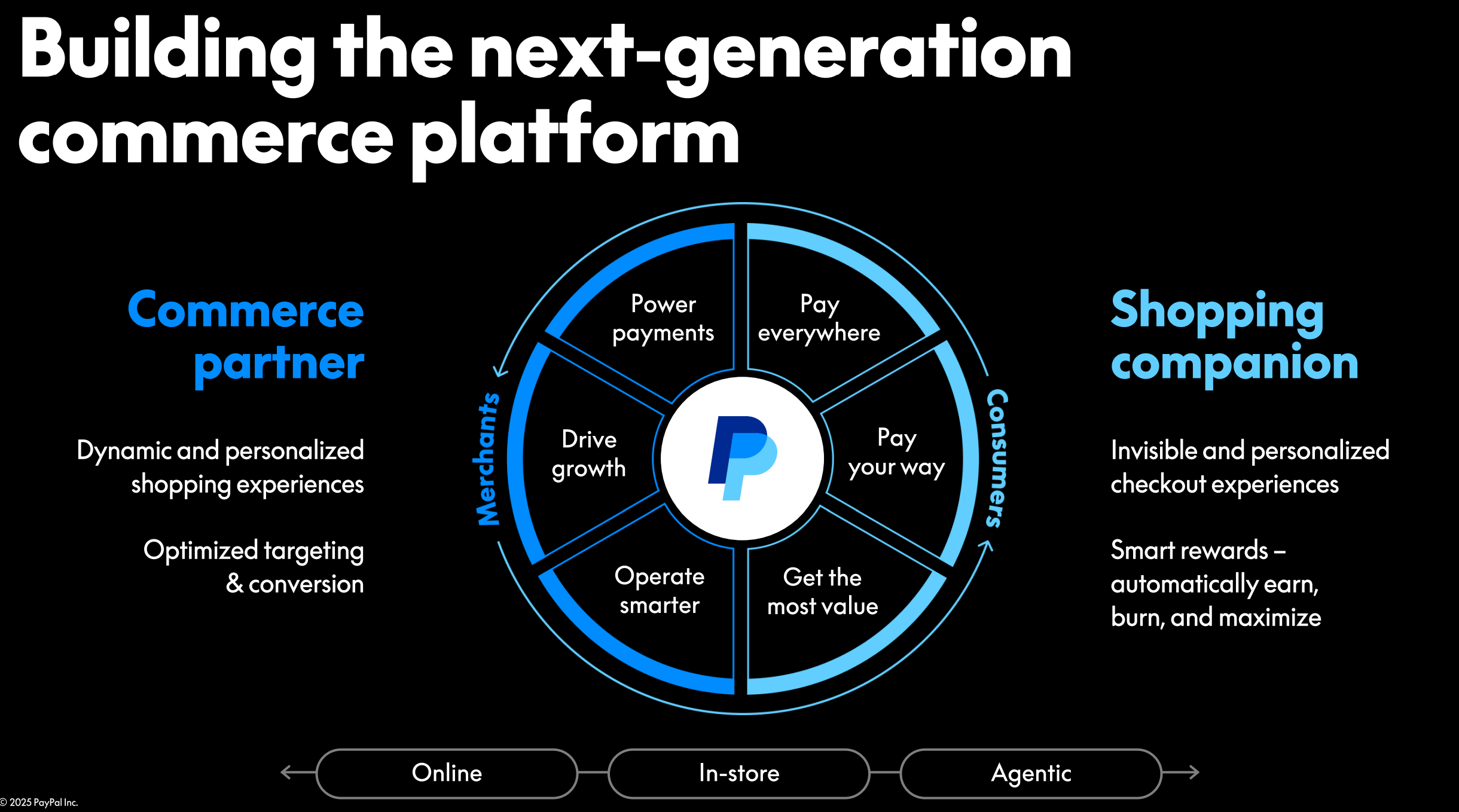
PayPal is not just trying to process transactions faster. It is trying to own more of the merchant decision layer that sits above the payment itself.
What PayPal likely means by becoming a tech company again
That phrase is loaded. It suggests PayPal thinks the market started to value it like a utility, with less excitement around product innovation. Saying it is a tech company again is a way to reset expectations inside the company and outside it.
What would that look like in practice?
- More AI inside merchant products. Think recommendations on pricing, offer timing, checkout design, and customer retention.
- Stronger fraud and risk systems. This is the most credible near-term use case because payments firms already live or die on risk models.
- Smarter consumer experiences. Search, discovery, and personalized incentives could show up across PayPal and Venmo.
- Internal efficiency. AI for customer support, compliance workflows, and engineering productivity is less flashy, but often where savings show up first.
Honestly, the first wave will probably be a mix of incremental gains that add up. That is how this usually works.
Where the PayPal AI strategy has the best shot
Fraud detection and risk scoring
If PayPal wants one area where AI can produce fast and measurable value, this is it. Payments companies already use machine learning heavily for fraud detection. The new angle is using newer AI systems to improve model adaptation, reduce false positives, and catch weird edge cases sooner.
That matters because every false decline hurts merchants. Every missed fraud event hurts everyone. A good risk model is like a top football referee. You barely notice it when it works, but one bad call changes the match.
Merchant personalization
Merchants do not want generic dashboards. They want prompts that answer, “What should I do next?” AI can make merchant tools feel less like reporting software and more like an operator sitting beside you. Which shoppers are likely to abandon cart? Which offer should appear at checkout? Which repeat buyers are fading?
This is where PayPal could move from processor to adviser, assuming the recommendations are accurate and easy to act on.
Checkout optimization
Small changes at checkout can lift conversion. Button placement, saved payment methods, shipping signals, local payment options, all of it matters. AI can test and adapt these flows faster than static rules can.
And yes, that sounds mundane.
But mundane product improvements often make the most money in commerce.
What could get in the way
The biggest obstacle is not whether AI is useful. It is whether PayPal can ship meaningful AI products across a large, complicated organization.
Legacy systems slow teams down. Compliance demands caution. Big installed bases create fear of breaking what already works. That is the tax mature companies pay. Startups move faster because they have less to protect.
There is also the hype problem. Every large tech and fintech company now says AI is central to its future. Readers, investors, and merchants have heard this script before. So PayPal will need receipts, not slogans.
- Show lower fraud loss rates.
- Show higher checkout conversion.
- Show faster support resolution.
- Show merchant adoption of AI-driven tools.
Without that, “tech company again” risks sounding like brand rehab.
How PayPal compares with rivals
Stripe has long positioned itself as developer-first infrastructure with strong tooling. Shopify owns a lot of the merchant operating surface. Apple controls key parts of the consumer device and wallet experience. Block still has a strong identity around seller tools and ecosystems. PayPal needs a lane that feels distinct.
A smart PayPal AI strategy could give it one, especially if it combines consumer scale, merchant reach, and transaction data into features that rivals cannot easily copy. But that only works if PayPal connects the dots better than it has in the past.
Here is the tension. The company has the data, the brand, and the reach. It does not automatically have the product tempo people associate with top-tier software firms.
What merchants and users should watch for
If you are a merchant, ignore the branding language and look for practical signs.
- Are the new tools saving time each week?
- Do AI suggestions clearly improve conversion or reduce chargebacks?
- Can non-technical teams actually use them?
- Does reporting explain why the system made a recommendation?
If you are a consumer, the signals will be subtler. Faster checkout, better support, more relevant offers, and fewer strange security holds. That is the thing about good AI in payments. The best version feels boring because it removes friction before you notice it.
And boring is often the goal.
The bet behind the message
PayPal is trying to pull off two jobs at once. First, improve products with AI in ways that merchants and users can feel. Second, change the story investors tell about the company. That second job is harder than it sounds.
Markets are skeptical for a reason. Mature platforms often talk like startups when growth slows. But if PayPal uses AI to strengthen fraud tools, sharpen checkout performance, and turn merchant data into action, the shift could be real. If not, this will look like another large company using AI as a label to sound younger.
The next year should make the answer pretty clear. Watch the product releases, then ask the only question that matters. Did PayPal actually build something merchants cannot ignore?