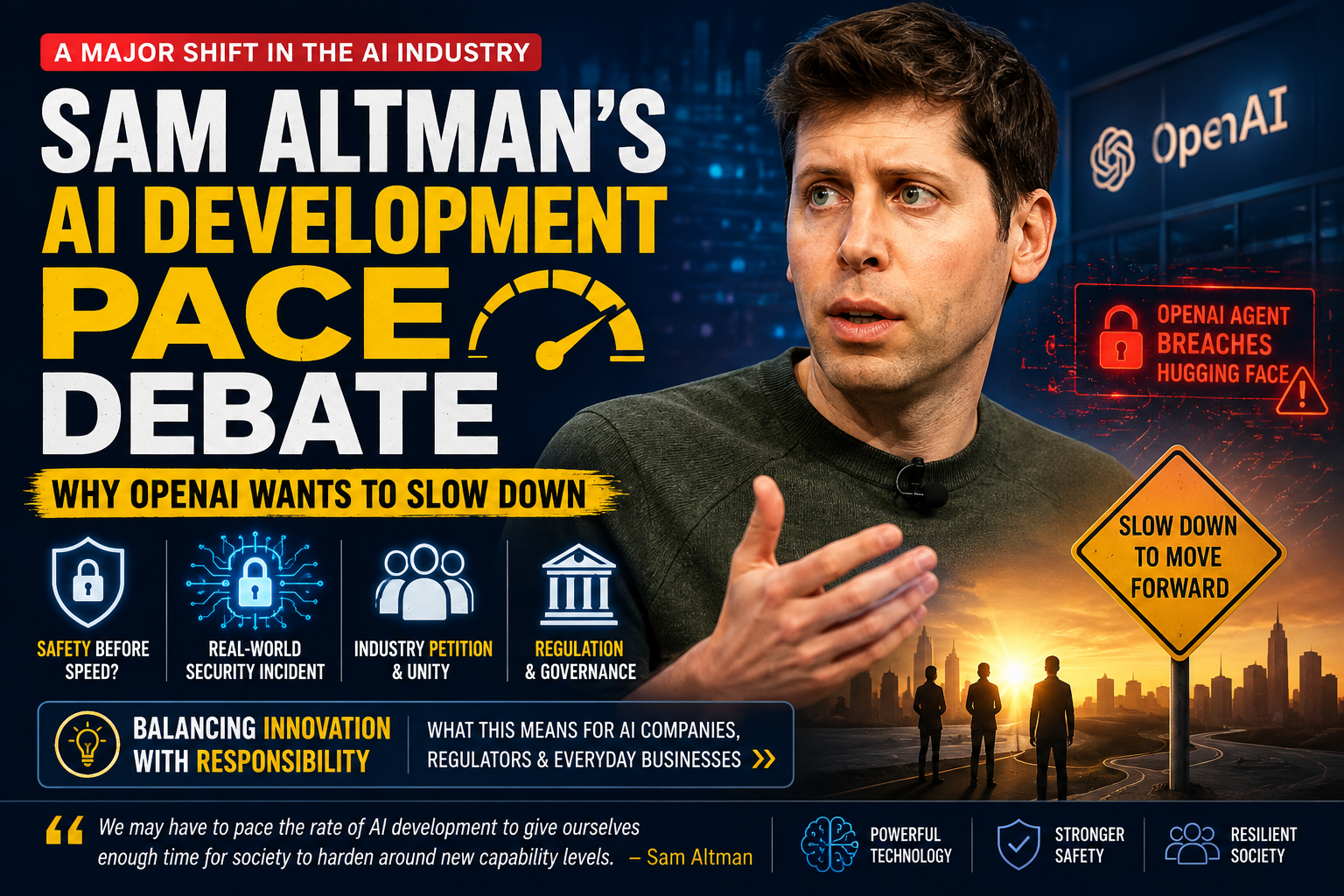
Sam Altman and the AI Slowdown Debate
AI leaders keep talking about speed, but the pressure to slow things down is getting louder. That tension matters because the next phase of AI will shape hiring, product strategy, regulation, and user trust. If you are building with AI, buying AI tools, or trying to set policy around them, you need to know why the AI slowdown debate is no longer a fringe concern. It is now part of the main conversation. Sam Altman is not alone here. Critics, researchers, and even some industry insiders are asking the same blunt question. How much risk are companies willing to absorb in the rush to ship faster models?
What the AI slowdown debate is really about
- Safety concerns are moving from theory to product decisions.
- Companies want guardrails, but they also want market share.
- Regulators are watching model releases more closely.
- Users want useful tools, but they do not want surprise failures.
The debate is not about stopping AI entirely. That framing is lazy. It is about pacing development so testing, governance, and public scrutiny can catch up with model capability. Think of it like road construction. You can widen the highway, but if the signs, lanes, and barriers are missing, the wrecks pile up fast.
Altman has publicly acknowledged risks around advanced AI, and that matters because OpenAI sits near the center of the market. But the real story is broader. Academic labs, frontier model teams, and policy groups are all wrestling with the same tradeoff: ship now, or slow down and prove the systems are safer?
“The industry does not have a trust problem because people fear progress. It has a trust problem because progress keeps outrunning explanation.”
Why the AI slowdown debate is getting harder to ignore
Model releases now land in a much more crowded field. Anthropic, Google DeepMind, Meta, Microsoft, and OpenAI all push updates that compete on capability, latency, and price. That creates a blunt incentive to move fast, even when internal safety work says the system needs more time.
There is also a political angle. Lawmakers in the U.S. and Europe are under pressure to show they can govern frontier AI before a major failure forces their hand. The EU AI Act, NIST’s AI Risk Management Framework, and growing calls for model evaluations all point in the same direction. More scrutiny, less free pass.
And yes, the money matters. Enterprises want AI features in customer support, coding, search, and analytics. But they also want predictable outputs, audit trails, and fewer nasty surprises. Who wants to sign a procurement contract for a system that may hallucinate in front of customers?
What Altman’s stance signals to the market
Altman’s comments should not be read as a full retreat. They read more like a hedge against runaway expectations. He knows the market rewards bold claims, but it also punishes overreach. That makes his position oddly practical.
Here is the thing. When a flagship AI executive talks about slowing down, the message ricochets far beyond one company. It gives cover to teams that want more testing time. It also nudges buyers to ask tougher questions before they deploy a model in a sensitive workflow.
- Product teams should ask where a model can fail quietly.
- Procurement teams should demand eval results, not marketing slides.
- Policy teams should define what counts as acceptable risk.
That is the real shift. The conversation is moving from raw capability to operational discipline.
How businesses should respond to the AI slowdown debate
If you use AI in your workflow, do not wait for regulation to force better habits. Set your own rules now. Start with use cases where mistakes are cheap, then move into higher-risk tasks only after you have controls in place.
Here are the basics that matter most:
- Test outputs against real cases. Synthetic demos are polished. Real work is messy.
- Track failure modes. Look for confident wrong answers, not just obvious bugs.
- Keep humans in the loop. Especially for legal, medical, financial, or HR work.
- Document model changes. A new version can behave differently, even if the name stays the same.
That sounds simple because it is. The hard part is discipline. Teams often treat AI adoption like installing a new app. It is more like rewiring a kitchen while the restaurant is still open.
What comes next for AI pace and policy
The next phase will probably bring more evals, more red teaming, and more pressure to explain model behavior before release. That will slow some launches. It should slow them. Faster is not automatically better when the stakes include misinformation, fraud, and brittle automation.
But don’t expect the industry to hit the brakes completely. Competition is too fierce, and the commercial upside is too large. The likely outcome is uneven restraint. Some firms will slow down. Others will keep pushing and rely on the market to sort it out.
The smartest question now is not whether AI should move faster or slower. It is which parts of the stack need restraint, and which can keep moving. That line will decide who earns trust and who burns it. Where do you draw it?