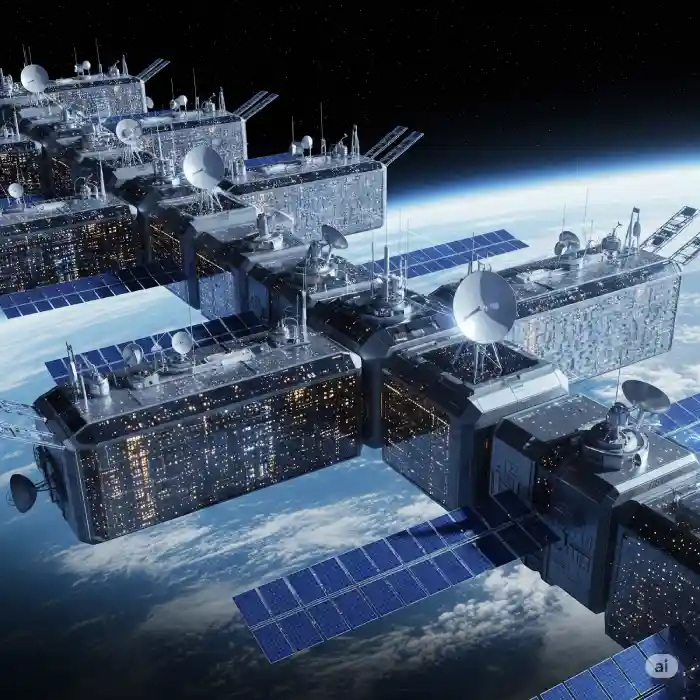
Space Data Centers: Why Starcloud’s $170M Bet Matters Now
Enterprises drowning in AI workloads are running into power caps, land constraints, and heat limits. Starcloud just banked $170 million in Series A funding to build space data centers, pitching orbital compute as the relief valve for Earth-bound bottlenecks. The appeal is obvious: near-limitless solar power, frigid vacuum cooling, and isolation from terrestrial grid outages. The risk is equally clear: launch costs, latency, and service reliability. If you are planning heavy AI inference or training expansion, you need to know whether space data centers belong in your roadmap this year, not in a distant sci-fi timeline. Can orbital racks actually lower your cost per inference while keeping data governance intact?
What to Watch Right Now
- Launch economics are falling, but payload pricing still drives total cost.
- Latency will vary by orbit; edge caching becomes non-negotiable.
- Radiation-hardened hardware and redundancy set your reliability baseline.
- Data sovereignty rules follow your jurisdiction, even 500 miles up.
Space Data Centers: Core Feasibility
Starcloud is betting on a simple equation: cheap solar plus free vacuum cooling beats urban power bills. It is like moving a hot restaurant kitchen to a windy cliffside; the environment does half the work. But hardware must survive radiation, micrometeoroids, and launch vibration. Look at mission profiles that blend hardened CPUs with modular racks that can be swapped on service flights. A single-sentence paragraph fits here.
Latency is the tax you cannot dodge; plan for it rather than hope physics bends.
Expect round-trip latency to swing between 30 ms for low Earth orbit and 500 ms for higher orbits. That means inference near users needs edge nodes on the ground with orbital clusters handling periodic retraining or batch analytics. Cache models at regional PoPs and treat space as an extension of your cloud, not a replacement.
Space Data Centers Pricing Playbook
Investors wrote a $170 million check because launch costs keep sliding. Track per-kilogram pricing across SpaceX, Rocket Lab, and emerging small launchers. If payload rates slip under $1,000 per kilogram, the math for orbital GPUs starts to look competitive against urban colocation with 40-cent-per-kWh power. But include insurance, on-orbit servicing, and deorbit costs in your model. Hidden fees kill ROI faster than any headline number.
Security and Compliance in Space Data Centers
Data sovereignty is not suspended in orbit. Your legal obligations follow your corporate domicile. Align encryption, key management, and access logging with the same standards you apply on the ground. And build for loss: assume a failed module is gone for good and design zero-trust enclaves with tenant isolation baked into the firmware. Treat every uplink as hostile until proven otherwise.
Audit Steps You Can Run This Quarter
- Classify workloads by latency sensitivity and move only batch-friendly jobs to a simulated high-latency environment.
- Model TCO using current launch rates plus 20% contingency for insurance and deorbiting.
- Demand radiation tolerance specs and mean time between service windows from vendors.
- Run a compliance tabletop: can you revoke keys if a module bricks on orbit?
Building a Space-Aware Architecture
Think in tiers. Ground edge for fast responses. Regional cloud for coordination. Orbital layer for power-hungry training cycles that tolerate delay. Similar to sports teams rotating players to stay fresh, you rotate workloads to where energy is cheapest and cooling is effortless. Use content delivery patterns in reverse: instead of pushing content to users, you push models to orbit, train, then pull updated weights down during scheduled windows.
Market Signals Beyond Starcloud
Look for co-location deals with satellite operators, partnerships with hyperscalers, and regulatory filings that hint at spectrum use. If rivals announce optical downlinks with higher bandwidth, that changes your data egress math overnight. And if a national regulator tightens debris rules, your servicing cadence might slip.
Where This Goes Next
Space data centers shift from headline fodder to procurement checklists once one vendor proves sub-100 ms effective latency with stable uptime. That is the bar. Until then, pilot with small models, measure everything, and keep your contracts short. Ready to put a GPU in orbit, or will you wait for someone else to take the first hit?