AI Agents Could Spread Like Worms
AI agents are moving from demos to real work, and that changes the risk profile fast. The mainKeyword here is AI agents security risks, because the danger is no longer a chatbot saying the wrong thing. It is software that can take actions, call tools, copy instructions, and move from one system to another with very little human oversight. That sounds efficient until you picture a bad prompt, a poisoned document, or a compromised account triggering a chain reaction. Why does this matter now? Because more teams are wiring agents into email, files, code, and internal apps before they have set hard limits on what those systems can touch.
- AI agents can amplify mistakes across multiple tools, not just one chat window.
- Data poisoning and prompt injection are practical attack paths, not science fiction.
- Least-privilege access matters more when an agent can act on your behalf.
- Logging and review need to cover actions, not just prompts.
- Kill switches and scope limits should be built in before deployment.
Why AI agents security risks feel different
Classic malware spreads because it can run code and copy itself. Agents do not need to be full-on worms to cause similar damage. They can be instructed to fetch data, forward messages, edit tickets, or trigger workflows, and each step opens a new surface.
That is the part many leaders miss. They see a productivity layer. Security teams see an orchestration engine with a lot of trust attached to it. If an agent has access to Slack, Drive, Jira, GitHub, and a payment tool, the blast radius grows with every permission you add.
The real risk is not that an agent thinks. It is that it can act faster than your review process can keep up.
How an AI agent turns into an attack path
Attackers do not need to break the model itself. They can target the inputs around it. A poisoned file, a malicious email, or a hidden instruction in a web page can steer an agent into doing something it should not.
Think of it like a restaurant kitchen where every station trusts every note on the counter. One bad ticket can send the wrong order to half the room. And if the cook has permission to change the menu, the damage gets worse.
Common failure points
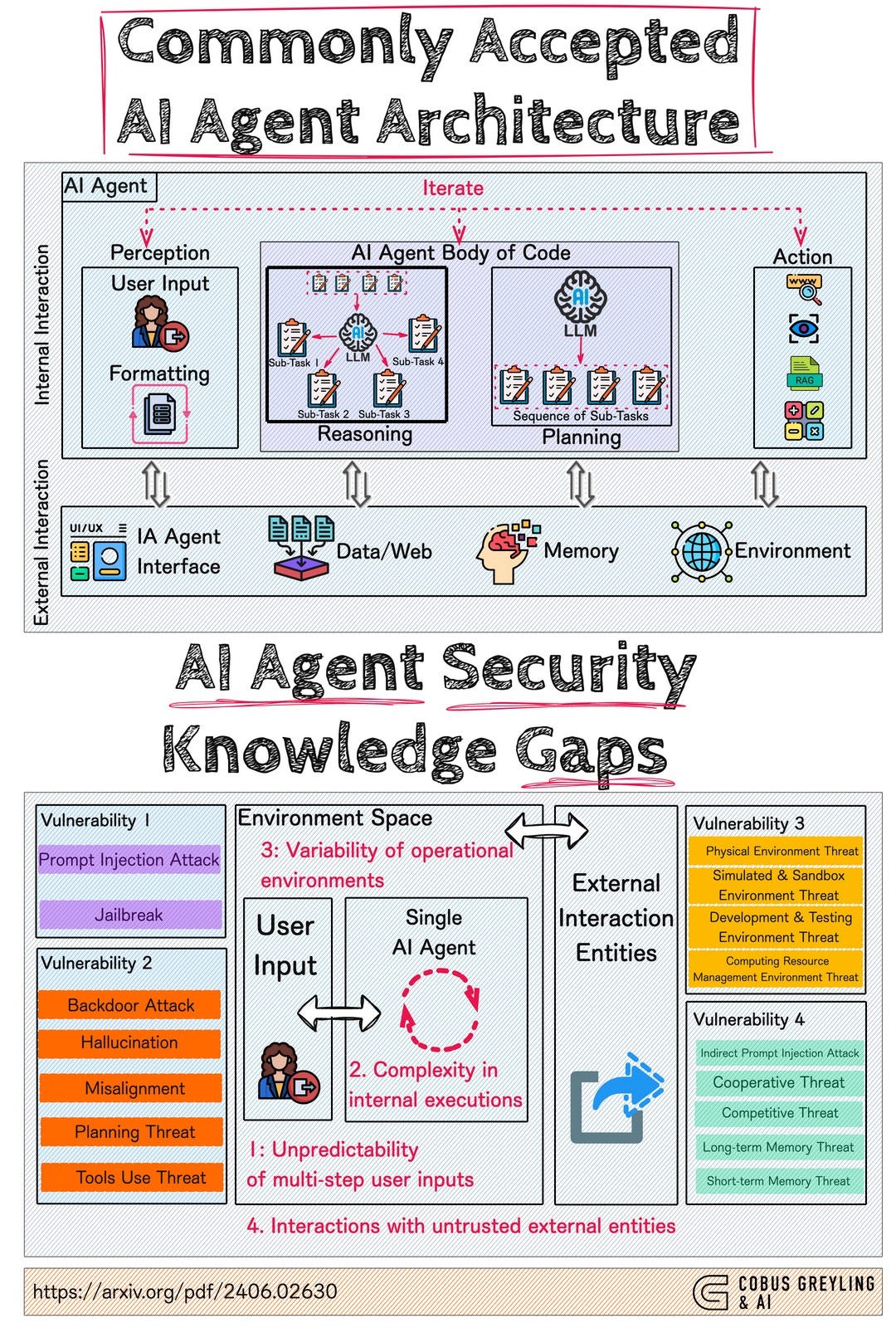
- Prompt injection. A hidden instruction overrides the task the agent was given.
- Data poisoning. Bad content enters a knowledge base or document store and shapes future actions.
- Tool abuse. The agent uses connected apps in ways the operator did not expect.
- Permission creep. A pilot project starts with broad access and never gets tightened.
- Automation loops. One bad action feeds the next, and the system keeps going.
What security teams should do with AI agents security risks
Start with scope. What can the agent read, change, send, or approve? If you cannot answer that in one sentence, the setup is already too loose. Limit access by task, not by convenience.
Then separate suggestion from execution. An agent can draft a response, but a human should approve money movement, external sends, admin changes, and code merges. That is boring. It is also non-negotiable.
Practical controls that help
- Use short-lived credentials and rotate them often.
- Restrict tool access to the smallest set needed for the task.
- Log every action the agent takes, including the tool call and output.
- Scan inputs for prompt injection and suspicious content.
- Separate environments for testing, staging, and production.
- Require human approval for high-impact actions.
Security vendors love to talk about guardrails, but guardrails are only useful if they are placed before the cliff. A policy document alone will not stop an agent from sending an email, filing a ticket, or opening a door in your SaaS stack.
What leaders should ask before shipping an agent
Ask three blunt questions. What happens if the agent is tricked? What happens if it is over-permissioned? What happens if it repeats a bad action 100 times? If the answers make you uneasy, good. That means you are still paying attention.
Teams should also test failure modes the way red teams test other systems. Feed the agent hostile content. Give it conflicting instructions. Watch where it reaches for tools it should not use. If you only test happy paths, you are doing theater, not security.
One more thing. Do not treat every agent the same. A summarizer with read-only access is one thing. An agent that can send invoices or deploy code is another. The policy should reflect that gap.
Where this goes next
AI agents will keep spreading because they save time and reduce busywork. That part is real. But the companies that move fastest without hard controls will also create the best case studies for failure.
Look at the pattern and you can see it clearly. The industry is building a new automation layer, and the security model is still catching up. Which side of that gap will your team be on when the first serious incident lands?