China-US AI Race Pushes Open-Source Models Forward
The China-US AI race is not just about who builds the biggest model. It is also about who sets the pace for open-source AI, model access, and developer adoption. That matters now because companies are making real bets on which stacks they can trust, fine-tune, and ship without getting trapped by one vendor. If you are choosing AI tools for product work, research, or internal automation, the stakes are practical, not abstract. The model you pick shapes cost, control, data handling, and how fast your team can move. And the gap between flashy demos and useful deployment is still wide.
Look past the headlines and you see a tougher truth. Open models are becoming a pressure point in the competition between the United States and China. Who benefits when model weights are shared widely, and who loses control when developers can remix them? That question is now central to the market.
What this shift means in the China-US AI race
- Open-source models lower the barrier to entry. Smaller teams can test advanced AI without paying for every API call.
- Model ecosystems matter as much as raw performance. Distribution, tooling, and community support shape adoption.
- China and the US are competing on access and influence. That includes who gets downloaded, fine-tuned, and deployed.
- Enterprises want control. Many prefer models they can inspect, host, and adapt.
Why Hugging Face sits at the center of this fight
Hugging Face has become the market’s public square for model sharing. Developers use it the way chefs use a shared prep kitchen. The ingredients are there, the recipes are visible, and anyone serious enough can test what works.
That role gives it unusual influence in the China-US AI race. If a model lands on Hugging Face and gains traction, it can spread faster than a closed product ever could. That matters for Chinese labs trying to reach global developers, and it matters for US firms trying to defend their lead without locking everything behind a paywall.
Open-source AI is not a side story anymore. It is one of the main battlegrounds.
But open access cuts both ways. It helps adoption, and it reduces friction. It also makes it easier for rivals to inspect, copy, and improve on each other’s work. That is the tradeoff. Clean and simple.
How companies should read the China-US AI race
If you buy AI products for your team, do not get distracted by nationalistic hype. Ask a sharper set of questions instead. Which model can you run where you need it? Which one can you audit? Which one fits your compliance posture?
- Check deployment flexibility. Can the model run on your own infrastructure, or does it force you into one cloud?
- Review licensing terms. Some open models are open in name but narrow in practice.
- Test fine-tuning support. If your use case is specific, you need a model that adapts well.
- Measure community momentum. Active contributors often matter more than marketing claims.
- Track export and policy risk. Rules can change quickly, especially in strategic tech sectors.
Here’s the thing. The best model on paper is not always the best model for your workflow. A model is like a building frame. If the frame is strong but the doors do not fit, you still have a problem.
What Chinese model makers gain from open distribution
For Chinese AI labs, open-source release can solve a few hard problems at once. It creates global visibility. It builds trust with developers. It also gives their models a chance to compete outside the limits of local brand recognition.
That is why Hugging Face matters so much. It is a distribution channel, a credibility layer, and a testing ground. A model that draws downloads and forks can influence the market even if its creator never wins the enterprise sales war. And in a crowded field, that kind of reach is valuable.
Still, reach is not the same as dominance. Many open models get attention and then fade. Sustained use depends on reliability, documentation, and support. Fancy benchmarks do not pay the bills.
What US companies need to watch next
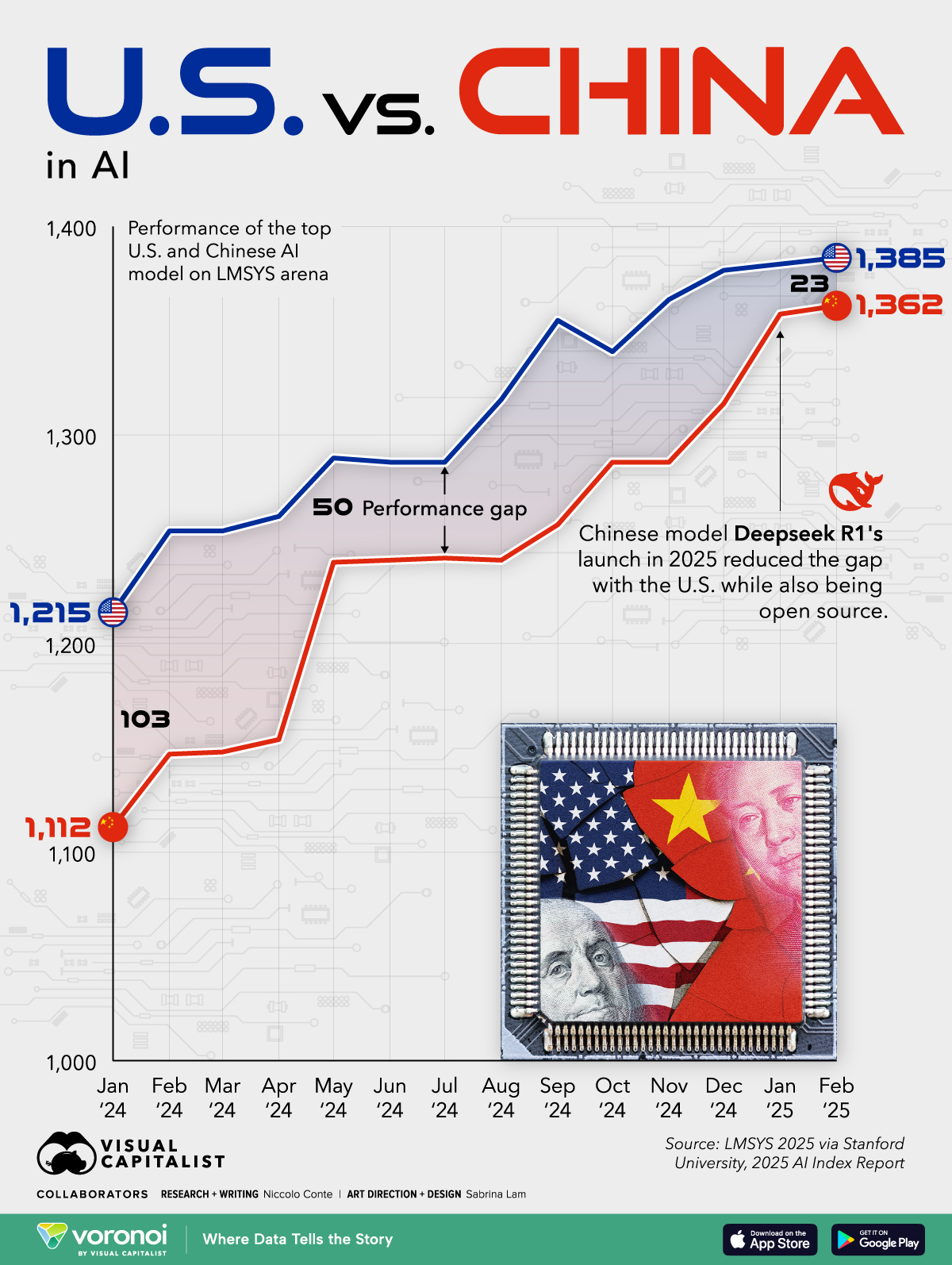
US firms cannot assume they will keep the edge just because they started early. The pace of open model releases has changed the math. The competition now looks less like a sprint and more like a season-long race, with lineup changes every few weeks.
That means product teams should watch three things closely. First, model quality relative to compute cost. Second, how quickly open releases get adapted into commercial tools. Third, whether policy shifts create new barriers around data, distribution, or chip access.
Honestly, the old playbook of hiding everything behind a closed API looks weaker than it did two years ago. Why pay a premium forever if a capable open model can do 80 percent of the job? That question is forcing vendors to sharpen their value proposition fast.
A real-world test for buyers
If you are evaluating AI models this quarter, run a small pilot. Use the same prompt set, the same data, and the same success criteria across one closed model and one open model. Compare accuracy, latency, total cost, and how much work it takes to maintain the setup.
That test will tell you more than any keynote. It will also tell you whether the model ecosystem around the product is healthy or thin.
The China-US AI race will keep pushing open-source models into sharper focus. The next real question is not who announces the largest model. It is who builds the most useful one that developers actually keep using.
What to watch over the next 12 months
Watch for more Chinese models on Hugging Face, more enterprise pilots built on open weights, and more pressure on US vendors to explain why their closed systems deserve the premium. The winners will not just be the fastest lab. They will be the teams that make AI easier to adopt without making it harder to trust.