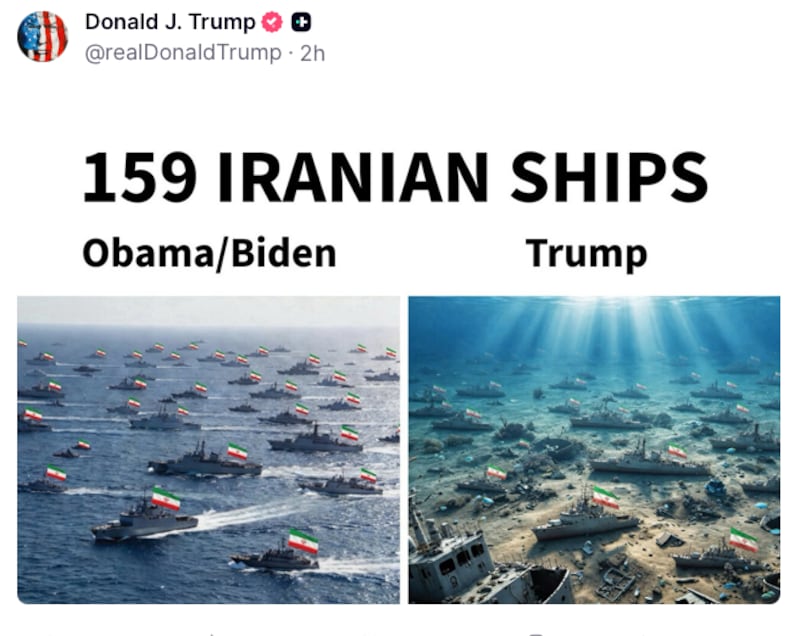
Trump AI Claim on Iran Warships
Political claims about artificial intelligence move fast, and they often land before the facts do. That is exactly why the Trump AI claim on Iran warships matters. When a public figure ties AI to military intelligence, the statement can shape how people think about national security, surveillance, and the reliability of machine-driven analysis. You are not just hearing a soundbite. You are hearing a claim that can influence trust in both government and AI tools. So what should you make of it? Look, the smart move is to separate the headline from the evidence, then ask what was actually said, what can be verified, and what this says about the way AI gets used in political messaging.
What stands out here
- The Trump AI claim on Iran warships sits at the intersection of politics, military intelligence, and public trust.
- Claims about AI often sound more precise than the evidence behind them.
- You should judge these statements by sourcing, context, and technical plausibility.
- Loose AI rhetoric can muddy real debates about defense technology and surveillance.
What was the Trump AI claim on Iran warships?
According to reporting from The Hill, former President Donald Trump referenced AI while discussing Iran and warships. The core issue is less about flashy wording and more about implication. If AI was presented as a source for identifying, tracking, or validating military activity, that raises an obvious question. Was this a documented intelligence assessment, a broad reference to modern surveillance tools, or political improvisation?
That distinction matters because AI in defense is real, but it is also easy to overstate. Image recognition, satellite analysis, signal processing, and pattern detection already play roles in military and intelligence work. But none of that means every political claim about AI-backed military insight is grounded in verified reporting.
AI can assist intelligence work. It does not erase the need for human judgment, sourcing, and verification.
Why the Trump AI claim on Iran warships got attention
The phrase hit a nerve because AI carries authority in public debate. Say “AI” and many people assume the output is objective, data-rich, and hard to dispute. Honestly, that is where a lot of bad analysis starts.
Politicians know this. AI can be used as a credibility shortcut, even when the underlying details are thin. In a national security setting, that shortcut gets riskier. Claims about hostile states, naval movements, or military posture can affect public opinion fast, especially when tensions in the Middle East are already high.
One sentence can do a lot of damage.
Think of it like replay review in sports. A slow-motion clip looks final, but the camera angle can still mislead you. AI in intelligence works the same way. The system may surface a pattern, flag an object, or rank a target, yet the output still depends on data quality, model limits, and human interpretation.
How AI is actually used in military and intelligence analysis
If you want to assess the Trump AI claim on Iran warships fairly, you need a grounded sense of what AI can and cannot do. Defense agencies and contractors use machine learning for tasks such as reviewing satellite imagery, detecting anomalies, sorting large data sets, and speeding up classification workflows.
That sounds solid. But it is not magic.
Common real-world uses
- Satellite image analysis. AI can help identify ships, vehicles, runways, and infrastructure changes.
- Pattern detection. Systems can flag unusual movement or repeated behaviors across large data sets.
- Signal and sensor processing. Models can sort through noisy inputs faster than manual review alone.
- Decision support. Analysts may use AI outputs as one layer in a wider intelligence process.
Notice the pattern. These tools support people. They do not replace verification. And they certainly do not make every public statement about military events self-proving.
What questions should you ask about claims like this?
Here’s the thing. You do not need to be a defense analyst to pressure-test political AI claims. You just need a short checklist and a little skepticism.
A practical filter
- What is the source? Is the claim tied to an agency assessment, named officials, or reporting from established outlets?
- What does “AI” mean here? Is it satellite imagery analysis, a chatbot-style shorthand, or vague branding?
- Was the claim independently verified? One quote is not evidence.
- Is there technical plausibility? Could current military AI systems reasonably do what is being implied?
- Who benefits from the framing? Fear, certainty, and urgency are powerful political tools.
And yes, intent matters. A loose reference to AI may be casual, but casual language around military intelligence can still distort public understanding.
The bigger issue: AI as a political prop
This story is about more than one remark. It shows how AI has become a catch-all term in political speech. That is a problem because the term covers everything from predictive analytics to computer vision to simple automated sorting. If leaders blur those categories, the public gets a warped picture of what the technology is actually doing.
That confusion has real stakes. It shapes debates about Pentagon spending, intelligence oversight, surveillance law, and foreign policy credibility. It also feeds a broader habit in public life, where “AI” gets used as a stamp of certainty rather than a tool with limits, trade-offs, and failure modes.
As a reporter who has watched tech hype spill into policy for years, I think this is the part people should take most seriously. The danger is not only false claims. It is lazy framing.
How to read future AI national security stories
You will see more stories like this. AI is now fused with defense, diplomacy, and campaign rhetoric. So your best move is to read with discipline (even when the headline tries to push you toward outrage).
- Separate the quote from the evidence behind it.
- Look for named institutions, documents, or corroborating reports.
- Check whether the claim describes a known AI capability or a vague idea.
- Watch for certainty that arrives too early.
- Remember that public officials can overstate technical systems, just like executives do.
That last point matters more than many readers admit. Political language about AI often borrows the same habits you see in product marketing. Big promise. Thin detail. Heavy implication.
What to watch next
The Trump AI claim on Iran warships will fade as a headline, but the pattern will stick around. Expect more public figures to invoke AI when discussing military threats, border enforcement, cyber risk, and intelligence gathering. The term sounds authoritative, and that makes it useful in a fight.
Your job is simpler. Ask whether the claim has facts under it, or just heat. If AI is going to shape public policy, then vague political references to it should face the same scrutiny as any intelligence claim. And if they do not, what exactly are we rewarding?


